Will an AI leasing assistant actually improve your leasing operation?
23 August 2026
9 min read
Discover how an AI leasing assistant can transform your operations by improving response times and conversion rates with real-time data integration.
Yes, if you have one thing in place first: a real-time connection to your property management system. An AI leasing assistant that reads and writes to your PMS as tours book and units lease will cut response times and lift conversion. One that runs on a nightly data sync will quietly hand prospects a leased unit and erode trust in the tool within weeks. That single technical requirement decides most outcomes.
The rest is a matter of fit and follow-through. AI leasing tools suit teams with enough lead volume to justify configuration, at least one PMS with an open integration path, and a willingness to run a proper pilot rather than switch everything on at once. Property managers running email-only outreach or a single small portfolio may see less return, at least at first.
Best fit: Multi-unit portfolios with steady enquiry flow and a PMS that supports live data exchange.
Non-negotiable requirement: Real-time PMS/CRM integration, not batch updates.
Caveat: Identity verification and document handling need a secure, consented workflow, not chat-based sharing.
Response times of under five minutes are achievable with automated triage, and portfolios with strong integration report meaningful gains in tour bookings. Hauzed is one platform built around this approach for landlords and agencies managing verified tenant demand.
#automated leasing solutions#smart leasing software#digital leasing tools#virtual leasing agent#AI tenant communication#how does AI leasing work#AI rental assistant#ai leasing assistant#property management AI#best real estate chatbots#leasing chatbot
Related Articles
Strip away the marketing language and an AI leasing assistant does four things: it triages inbound enquiries, qualifies prospects against your criteria, books tours (including self-guided ones), and chases up the people who go quiet. It can also nudge applicants towards finishing paperwork and answer the same fifteen questions about pet policy and parking that eat a leasing agent's morning.
Channel choice matters more than most teams expect. Web chat and SMS handle high-volume, low-complexity questions well because the natural language processing behind them is now reliable enough to interpret casual phrasing without much friction, as Harvard Business Review's overview of NLP sets out. Voice still needs a tighter script and usually escalates faster. Email works best for follow-up sequences rather than live back-and-forth.
Web chat: fast, high-volume, best for FAQs and initial qualification.
SMS: strong for reminders, tour confirmations, and re-engaging cold leads.
Voice: useful for accessibility and older prospects, but needs earlier human handoff.
Email: reliable for scheduled nurture sequences, weak for real-time queries.
Not every conversation belongs to the bot. AI should contain routine, factual, repetitive exchanges. It should hand off anything involving price negotiation, disability accommodation requests, disputes, or a prospect who is clearly frustrated.
What ROI do property teams actually see?
Speed is the variable that moves the needle hardest. Multifamily conversion research shows leads contacted within five minutes convert to tours at dramatically higher rates than leads left for an hour, with drop-off in that window running as high as 65 to 80%. An assistant that answers instantly, every time, removes that entire failure mode.
The benchmark that matters most: teams tracking speed-to-lead as a KPI tend to see the clearest before-and-after picture, because it's the metric AI improves most reliably and fastest.
Operator case studies back this up in practice. Portfolios running always-on leasing assistants report fewer missed leads and stronger persistence on follow-up, because the system doesn't forget to chase a prospect on day four the way a busy human might, according to Rently's analysis of 24/7 leasing AI. Results vary by how deep the integration runs and whether the portfolio is centralised or fragmented across systems, a pattern GTC's work on multifamily leasing AI documents repeatedly.
For a pilot, track:
Average response time to first contact
Lead-to-tour conversion rate
Tour-to-lease conversion rate
Containment rate (resolved without human handoff)
Why integration depth decides whether AI leasing works
A leasing assistant is only as trustworthy as the data behind it. If your PMS updates overnight, a prospect can book a tour for a unit that leased that afternoon, and that single bad experience undoes weeks of goodwill. Real-time read/write access is what prevents it, and it is consistently the technical detail that separates deployments that scale from ones that get quietly switched off, per GTC's integration analysis.
Handoffs need the same rigour as the automation itself. Define explicit triggers (price questions, legal queries, complaints) and make sure the human agent inherits full context and a suggested next message, not a cold transfer.
Map your current lead sources and confirm your PMS has a live integration path, similar to the calendar and email syncing patterns Microsoft Outlook uses for scheduling.
Set handoff triggers and required context fields before launch, not after complaints arrive.
Build identity verification and consented document upload into the flow using secure sign-on standards, such as those in Microsoft's identity documentation.
Run a 30 to 60 day pilot on one property or region before rolling out further.
Pro Tip:Ask any vendor to show you what happens when a unit status changes mid-conversation. Watching that edge case handled live tells you more than any sales deck.
How do you choose the right AI leasing assistant?
Start with a checklist, not a demo. The demo will always look smooth; the checklist tells you whether it survives your actual portfolio.
Does it offer real-time, bidirectional PMS integration, or a batch sync?
Does it support chat, SMS, email, and voice, or just one channel?
Can qualification flows be configured without a developer?
Does it export clean reporting data for response time, containment, and conversion?
How does it handle handoff, and what does the receiving agent actually see?
Weigh the trade-offs honestly. An end-to-end leasing platform that also handles matching and follow-up will need broader integration but reduces tool sprawl, guidance echoed in our piece on AI tenant discovery. A narrow point tool for scheduling alone is easier to bolt on but leaves other lead-loss points untouched.
Ask what data trained the qualification model and whether it's been tuned for rental leasing specifically.
Ask what governance exists over automated decisions affecting applicants.
Ask for a pilot with defined KPIs and an exit clause if response time or containment targets aren't met.
Postpone adoption if your lead volume is too low to generate meaningful data, or if your PMS has no integration roadmap at all. A lighter, semi-automated workflow may serve you better until then.
How Hauzed applies AI to rental workflows
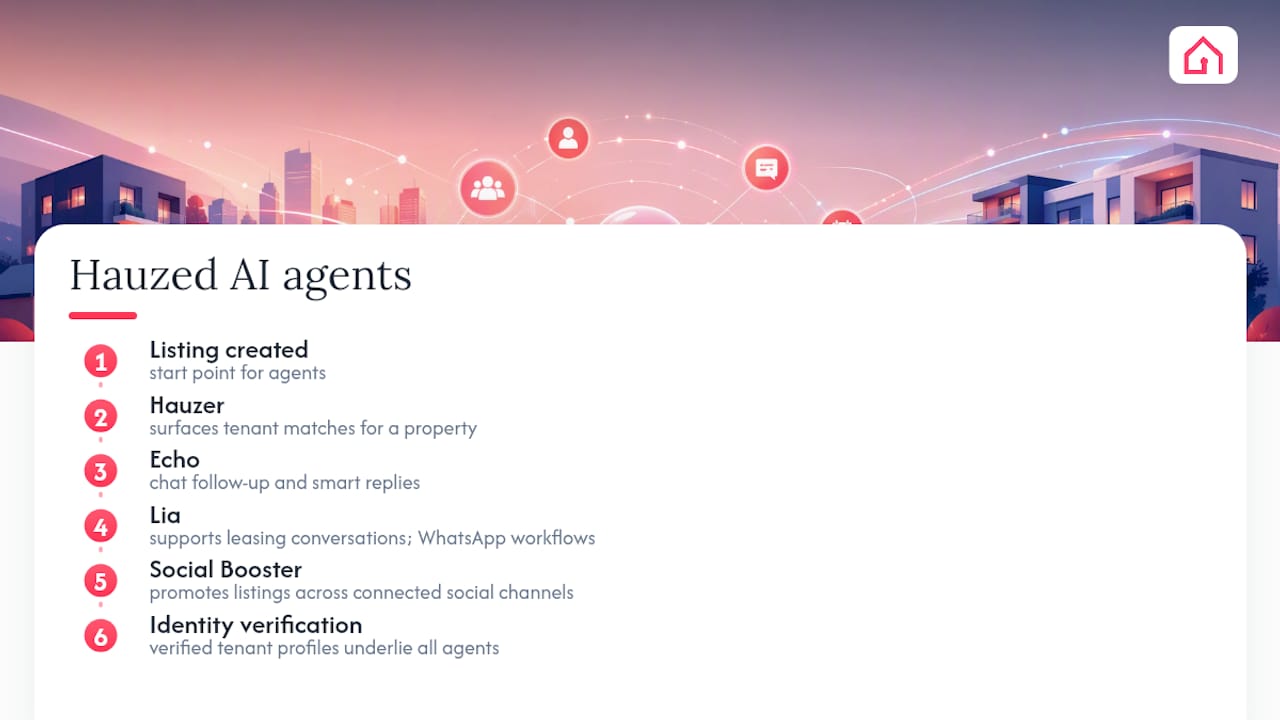
Hauzed builds AI agents around specific rental tasks rather than one generic chatbot. Hauzer surfaces tenant matches for a listed property so landlords review candidates instead of scanning every enquiry manually. Echo handles chat follow-up and smart replies, reducing the volume of repetitive messages a landlord answers directly. Lia supports leasing conversations and WhatsApp-style workflows where available. Social Booster promotes listings across connected social channels when enabled.
Identity verification sits underneath all of it. Verified tenant profiles give landlords a clearer picture of who they're talking to before a serious conversation starts, which improves lead quality without claiming to guarantee approval or financial standing.
Agencies get bulk publishing and team accounts, similar to the workflows described in our guide to managing multiple rental properties, cutting the time spent re-entering listings property by property.
Some actions still require landlord review, depend on plan access, and rely on consented document flows. Hauzed's agents assist the process; they don't replace the landlord's final decision.
How Hauzed helps you start an AI-assisted leasing workflow
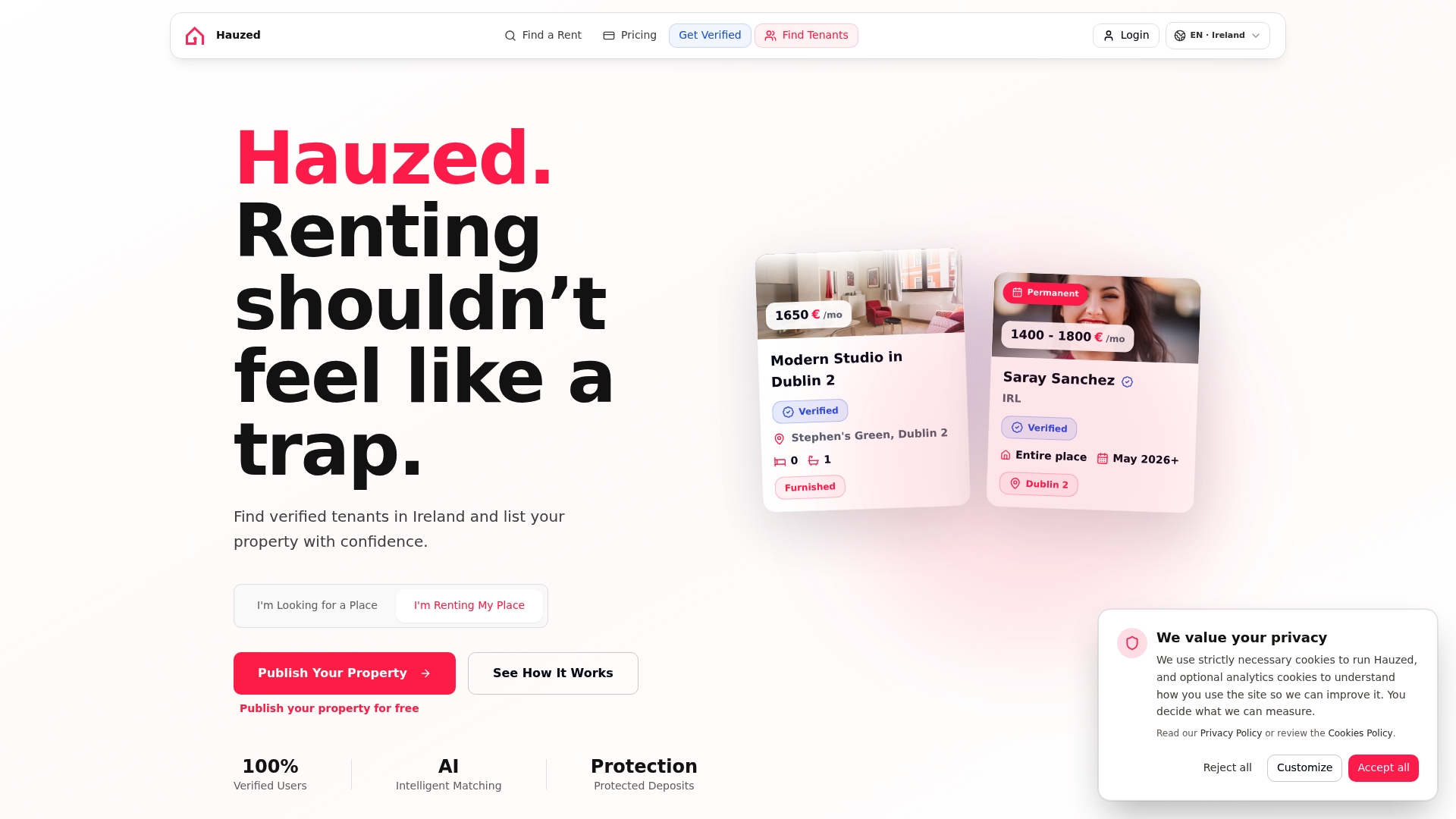
If you want a working example rather than a theoretical checklist, Hauzed gives landlords and agencies a marketplace built around verified tenants, AI matching through Hauzer, chat follow-up through Echo, and visit scheduling in one place.
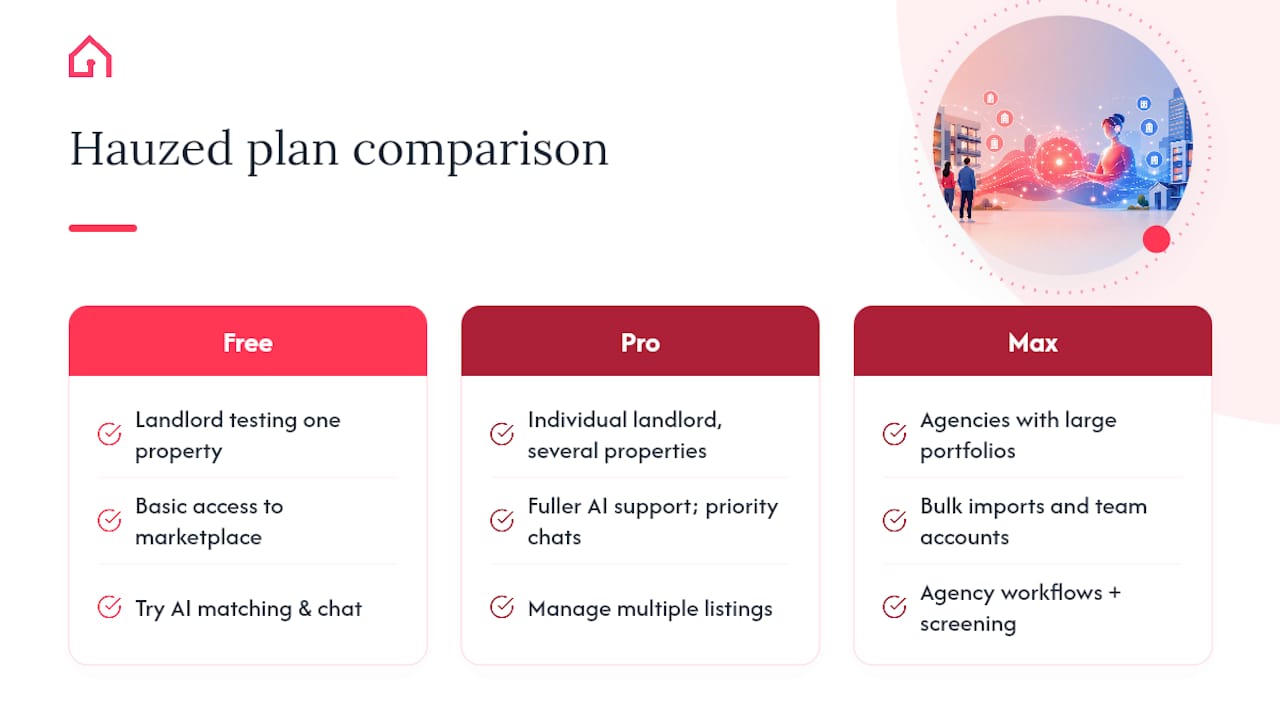
The Free plan suits a landlord testing the waters with one active property. Pro fits individual landlords managing several properties who want fuller AI support and priority handling of verified tenant chats. Max is built for agencies running bulk imports and team accounts across a larger portfolio, a workflow also covered in our tenant screening checklist for readers tightening up verification steps before onboarding tenants.
A sensible first 30 days looks like onboarding your property details, letting Hauzer generate initial matches, and tracking response time and enquiry-to-viewing conversion as your baseline. For landlords weighing broader promotion alongside AI matching, a service like AdPropix's tenant finder ads can complement lead generation while Hauzed handles the qualification and follow-up load. Visit the Hauzed platform to check current plan details and start with the property you most need to fill.
A short note on piloting AI responsibly
We built Hauzed around verified participation because AI without trust just automates noise faster. Our advice to any landlord or agency starting out: run a small pilot on one or two properties first, watch response time and conversion rather than trusting a vendor's headline number, and keep a human reviewing handoffs weekly, not just at launch.
Fairness matters as much as speed. Watch how qualification flows treat different applicants, and correct anything that looks skewed before scaling.
— Hauzed
An AI leasing assistant improves response speed and lead follow-through most reliably when paired with real-time PMS integration and a monitored human handoff.
Point
Details
Speed-to-lead is the biggest lever
Leads contacted within five minutes convert to tours far more often than those left for an hour.
Integration depth decides trust
Real-time PMS read/write access prevents the assistant offering already-leased units.
Contain routine work, hand off judgement calls
Let AI handle FAQs and scheduling; route pricing, disputes, and legal questions to a human.
Pilot before scaling
Test on one property with defined KPIs (response time, containment, lead-to-tour) before wider rollout.
Hauzed offers a working example
Hauzer, Echo, and Lia automate matching, replies, and leasing chats within a verified tenant marketplace.
It's software that handles inbound rental enquiries, qualifies prospects, books tours, and follows up automatically across chat, SMS, email, or voice.
How does AI leasing work with my existing PMS?
It needs a real-time, bidirectional connection to your property management system so unit availability and lead status stay accurate as they change.
Can AI leasing assistants replace human leasing agents?
No. They handle repetitive, high-volume tasks like FAQs and scheduling, while price negotiation, disputes, and complex cases still need a person.
How fast should an AI leasing assistant respond to a new lead?
Within minutes. Conversion drops sharply once an hour passes, so speed-to-lead is the metric most worth tracking in a pilot.
Does Hauzed offer an AI leasing assistant?
Yes. Hauzed's Hauzer agent matches tenants to properties, Echo handles chat follow-up, and Lia supports leasing conversations, all within a verified tenant marketplace.