Average Dublin rent in 2026: what renters need to know
28 June 2026
9 min read
Discover what is average Dublin rent 2026. Get insights on prices, policies, and tips for budgeting your move to Dublin this year.
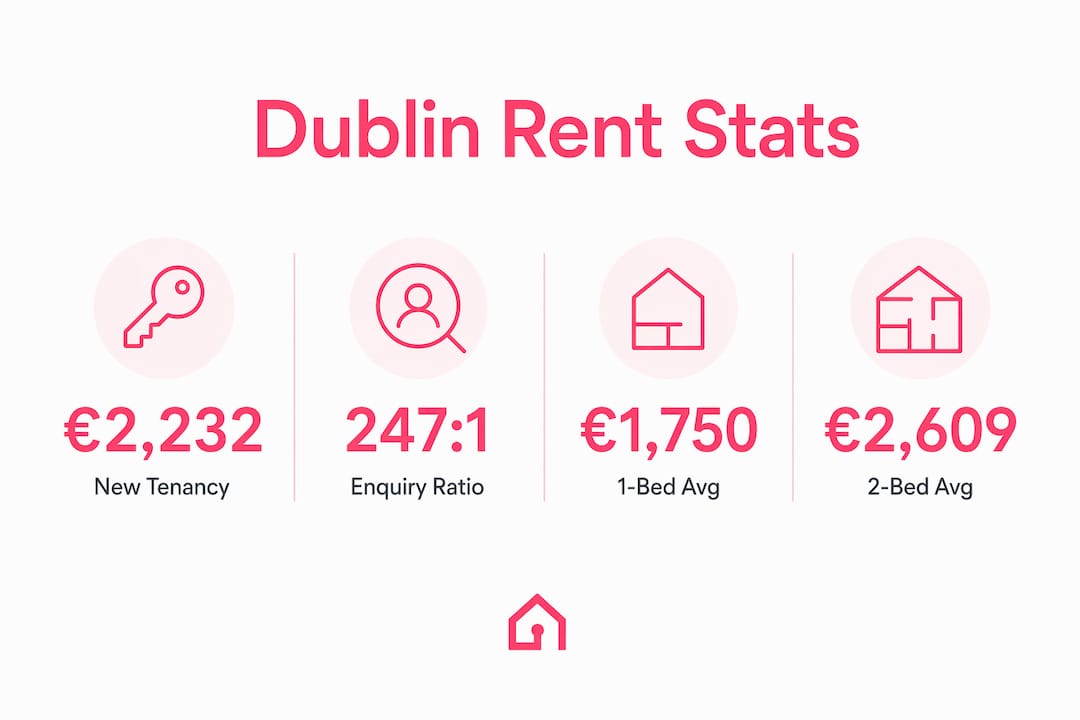
The average rent in Dublin for new tenancies is €2,232 per month as of Q1 2026, according to the RTB Rent Index. Existing tenancies average €1,939 per month, meaning new renters pay roughly €294 more each month than those already in situ. If you are planning a move to Dublin this year, understanding what is average Dublin rent 2026 is the first step to building a realistic budget. Prices vary sharply by apartment size, neighbourhood, and whether you are signing a fresh lease or inheriting an existing one. This guide breaks down the numbers, explains the policy shifts driving them, and gives you practical tools to plan your housing costs with confidence.
What is average Dublin rent in 2026 by size and location?
Rental prices in Dublin are not uniform. A one-bedroom apartment averages approximately €1,750 per month, while a two-bedroom averages €2,609 per month. That gap of nearly €860 per month reflects how sharply family-sized homes are priced above starter flats.
Location adds another layer of variation. Outer neighbourhoods such as Cabra and Crumlin sit at the lower end of the scale, with some one-bedroom flats available from around €1,300 per month. Premium locations like Grand Canal Dock push well above €2,400 per month for comparable properties. The difference between renting in an outer suburb and a city-centre postcode can amount to several hundred euros every single month.
The table below gives you a practical snapshot of what to expect across different property sizes and representative areas.
Property type
Representative area
Approximate monthly rent
One-bedroom apartment
Cabra / Crumlin
€1,300–€1,500
One-bedroom apartment
Dublin city centre
€1,750–€2,000
Two-bedroom apartment
Dublin city centre
€2,400–€2,609
Two-bedroom apartment
Related Topics
#why dublin rental market is competitive#dublin rental market explained 2026#average rent Dublin by area 2026#what will Dublin rent be#Dublin rent predictions 2026#how much is rent in Dublin 2026#what is average dublin rent 2026#2026 rent guide Dublin#Dublin apartment prices 2026#average rent prices Dublin 2026#rent trends in Dublin#cost of living Dublin 2026#Dublin housing market 2026
Related Articles
Grand Canal Dock
€2,400+
Pro Tip:If your budget sits closer to €1,500 per month, focus your search on outer Dublin postcodes such as D7, D12, or D24. You will find more availability and face slightly less competition than in D2 or D4. Hauzed lists verified Dublin rentals across a range of price points to help you filter by area and budget.
How have government policy changes shaped rent trends in 2026?
The most significant event in the Dublin rental market explained 2026 is the legislation that took effect in march 2026. The new rules allow landlords to reset rents to full market levels at the start of each new tenancy. Previously, rent increase caps meant that landlords letting to new tenants were often constrained by the previous tenant's rent. That constraint is now lifted at tenancy commencement.
The result was a record 4.4% quarterly rent increase between december 2025 and march 2026. That is the largest single-quarter rise since 2002. It means renters who signed leases in early 2026 faced significantly higher rents than those who renewed existing agreements.
Key market behaviours triggered by the march 2026 legislation include:
Rent resets at new tenancy start. Landlords moved quickly to bring rents in line with current market rates when reletting properties.
A temporary surge in listings. Many landlords who had delayed reletting properties chose to list in early 2026 to take advantage of the new rules.
A widening gap between new and existing tenancy rents. The €294 monthly premium for new tenancies is a direct consequence of this reset mechanism.
Increased urgency for renters. Properties listed at reset rents attracted immediate interest, shortening the window between listing and letting.
"The early 2026 listing spike is not a true easing of supply but a timing effect related to landlord behaviour amid new government rules." — Professor Ronan Lyons, Daft Report 2026 Analysis
Despite the temporary increase in listings, supply improvement remains short-lived. Listings nearly doubled in some areas briefly, but that reflected delayed reletting rather than new homes entering the market. The underlying supply shortage has not changed.
Understanding your rental rights as a tenant in Ireland is particularly relevant in this environment, especially when it comes to rent review clauses and tenancy agreements.
Why is the Dublin rental market so competitive in 2026?
Dublin's rental market is defined by a severe imbalance between demand and supply. The enquiry-to-listing ratio reached 247:1 in Q1 2026. That means 247 enquiries arrive for every single available property. No individual application stands out in that volume without deliberate preparation.
This level of competition has changed how landlords and letting agents operate. Block viewings and aggressive pre-screening are now standard practice. Landlords no longer schedule individual appointments for every enquiry. Instead, they filter candidates before the viewing even takes place.
Here is what that means practically for you as a renter:
Prepare your profile before you search. Landlords and agents assess candidates quickly. A complete, verified profile with references, employment details, and identification ready to share gives you a real advantage.
Respond within hours, not days. At a 247:1 ratio, properties are let fast. A slow response is effectively a withdrawal.
Attend block viewings prepared. Bring printed or digital copies of your key documents. Agents at block viewings often collect expressions of interest on the spot.
Use verified channels. Anonymous enquiries through informal channels are easy to ignore. A verified profile signals seriousness and reduces the landlord's risk.
Apply as a household, not as individuals. If you are renting as a couple or family, presenting a coordinated, joint application is more persuasive than separate messages arriving at different times.
Pro Tip:Hauzed allows renters to build a verified tenant profile before they even start applying. That means when a property you want becomes available, you are ready to act immediately rather than scrambling to gather documents under pressure.
What should renters budget for in Dublin in 2026?
Average rent prices Dublin 2026 are only part of the picture. Your total monthly housing cost includes rent plus utilities, and the gap between new and existing tenancy rents means your starting point matters enormously.
Budget planning should account for the following:
Base rent. For a new tenancy, budget a minimum of €1,750 per month for a one-bedroom and €2,609 for a two-bedroom. These are averages; premium locations cost more.
The new tenancy premium. You will pay approximately €294 per month more than someone already in an equivalent property. Over a 12-month lease, that is €3,528 more than an existing tenant pays for the same flat.
Utilities. Electricity, gas, and broadband typically add €150–€250 per month on top of rent in Dublin, depending on the property and usage.
Geographic flexibility. Choosing a property in an outer Dublin postcode rather than the city centre can reduce your monthly rent by €300–€500. That saving compounds significantly over a year.
Timing your move. The temporary listing surge in early 2026 offered slightly more choice. That window has narrowed. Moving mid-year or in autumn typically means less supply and more competition.
If you are comparing Dublin against other Irish cities, the cost of renting across Ireland varies considerably. Cork, Galway, and Limerick all sit below Dublin's average, which may be relevant if remote working gives you flexibility on location.
For families or couples with tighter budgets, affordable rental options in Dublin do exist, but they require early action and a strong application.
Key takeaways
Dublin's average new tenancy rent of €2,232 per month in 2026 reflects a market shaped by constrained supply, policy-driven rent resets, and intense competition that rewards prepared renters.
Point
Details
New tenancy average rent
New tenants pay €2,232 per month on average, versus €1,939 for existing tenancies.
Size and location drive variation
One-bedroom flats average €1,750; two-bedroom properties average €2,609 per month.
Policy reset caused record rises
March 2026 legislation triggered a 4.4% quarterly increase, the largest since 2002.
Competition is extreme
An enquiry-to-listing ratio of 247:1 means preparation and speed are non-negotiable.
Budget beyond base rent
Factor in utilities, the new tenancy premium, and geographic flexibility when planning costs.
Hauzed's view on Dublin rents in 2026
The numbers tell one story. The experience on the ground tells another. What strikes us most about the Dublin rental market in 2026 is not the headline average of €2,232. It is the gap between renters who are prepared and those who are not.
The 247:1 enquiry ratio sounds abstract until you are the person who sent a message at 9am and received a "property let" reply by noon. That is the reality for many renters right now. The listing spike in early 2026 gave a brief illusion of breathing room, but Professor Ronan Lyons was right: it was a timing effect, not a structural shift. Supply has not materially improved.
What concerns us about Dublin rent predictions 2026 is the compounding effect of the new tenancy premium. A renter signing a fresh lease today pays €294 more per month than their neighbour in the same building who renewed last year. That is not a small difference. Over two years, it amounts to over €7,000. Renters who can secure and hold a tenancy now are in a meaningfully better financial position than those who delay.
Our honest view is that the remainder of 2026 will not bring relief on prices. Build-to-Rent operators are focused on retaining long-term stable tenants precisely because re-letting is expensive and disruptive. That means fewer properties cycling back to the market. Renters who treat their application as a professional process, with verified identity, complete documentation, and fast responses, will consistently outperform those who rely on volume alone.
— Hauzed
Renting in Dublin in 2026? Hauzed can help
Finding a rental in Dublin right now takes more than browsing listings. It takes a verified profile, fast responses, and a process that protects you from scams and wasted time.
Hauzed is a trust-first rental marketplace built for Ireland. Renters can search verified listings, build a complete tenant profile, and connect with landlords through a secure, organised workflow. There are no anonymous messages, no Facebook group chaos, and no pressure to send sensitive documents through informal channels. Hauzed is free for renters. Whether you are looking for a studio or a family flat, search verified rentals on Hauzed and apply with confidence from day one.
FAQ
What is the average rent in Dublin in 2026?
The average rent for a new tenancy in Dublin is €2,232 per month as of Q1 2026, according to the RTB Rent Index. Existing tenancies average €1,939 per month.
Why did Dublin rents rise so sharply in early 2026?
New legislation effective march 2026 allowed landlords to reset rents to full market rates at the start of new tenancies. This triggered a record 4.4% quarterly increase between december 2025 and march 2026.
How much does a two-bedroom apartment cost to rent in Dublin?
A two-bedroom apartment in Dublin city centre averages approximately €2,609 per month. Prices vary by location, with outer areas offering lower rents.
Why is it so hard to find a rental in Dublin right now?
Dublin's enquiry-to-listing ratio reached 247:1 in Q1 2026, meaning demand vastly outstrips supply. Landlords now use block viewings and pre-screening to manage the volume of applications.
Is the increase in Dublin rental listings in 2026 a sign of improving supply?
No. The temporary surge in listings in early 2026 was caused by landlords delaying properties until after the march 2026 policy changes, not by new homes entering the market. Underlying supply remains constrained.