Six Step Verified Group Rental Application to Speed Landlord Approval
4 September 2026
9 min read
Use a six step safety first workflow to submit a verified group rental application. Share documents securely, show combined affordability, and speed...
A group rental application is one coordinated submission from several prospective tenants who intend to live together as a single household, rather than separate messages from separate people hoping to be matched up. The fastest way to get it right is simple: agree your budget, gather everyone's documents, and choose one lead applicant to manage the process. Do that before you contact a single landlord, and your application arrives complete, credible, and ready for a decision, not a follow-up email asking what's missing.
TL;DR:
Presenting a coordinated group application with verified profiles and secure document sharing accelerates landlord approval compared to multiple scattered enquiries.
All applicants must supply photo ID, proof of income, references, and guarantor info upfront to avoid delays and ensure a complete, credible submission.
A clear internal agreement on deposit handling, exit procedures, and rent splits helps prevent disputes caused by joint and several liability.
Landlords verify affordability through combined gross income and conduct parallel reference and credit checks for all named tenants.
Using platforms like Hauzed consolidates application documents and verification, making the process faster and reducing risks of scams.
When several tenants sign the same tenancy agreement, they become joint tenants, legally distinct from a house-share where each person holds an individual room licence with the landlord. Under a joint or group tenancy, everyone shares the whole property under one contract, and everyone shares responsibility for it too.
That has real financial weight. Every named tenant is usually jointly and severally liable for the entire rent and any damage, not just their own slice of it. If one flatmate stops paying, the landlord can pursue any or all of the others for the full amount.
This is exactly why landlords tend to prefer one clean application over four scattered enquiries:
One point of contact instead of a group text landlords never asked to join
Combined income and references reviewed together, giving a fuller affordability picture
Fewer duplicated questions and less confusion over who is actually applying
A clearer sense of who will be legally responsible if something goes wrong
What documents does each applicant need?
Every member of the group needs their own paperwork ready before the lead applicant submits anything. Landlords assessing a household application are effectively running several background checks at once, so gaps in one person's file slow down everyone else's.
Each applicant should have:
Photo ID (passport or driving licence) and proof of current address, usually a recent utility bill or bank statement
Proof of income: payslips, an employer letter, or self-employment accounts, since combined income is typically what landlords weigh against total rent
References from a previous landlord and, often, an employer, confirming rent was paid on time and conduct was reasonable
Guarantor details, where one applicant's income or credit history is weaker than the rest of the group
When you ask a referee for a reference, be specific about what you need confirmed: dates of tenancy, rent paid on time, no unresolved deposit disputes, and whether they'd rent to that person again. A vague reference request gets a vague answer that helps nobody.
Handle documents carefully. Share sensitive files such as passports or bank statements only through a secure upload with consent, never as attachments in a group chat that anyone could forward.
Pro Tip:Ask everyone in the group to save their documents in one shared, permission-controlled folder, or better still, through a platform's secure upload flow, so the lead applicant isn't chasing five separate email threads the night before a viewing.
How do you prepare and submit a group application step by step?
A coordinated submission beats a scramble of individual messages every time, and it starts with a short conversation the group has before anyone contacts a landlord.
Agree budget and occupancy first. Settle what the group can afford together, how many bedrooms you need, and who is actually moving in. Disagreements here are far easier to sort out now than after you've viewed a property.
Choose a lead applicant. One person coordinates communication, submits the application, and keeps track of what's outstanding. This does not make them solely liable for the tenancy, but it does make the process manageable.
Collect documents securely. Confirm everyone consents to their documents being shared with the landlord or agent, and store them in one place.
Complete the application form together. Fill in details for every applicant, not just the lead, and state combined affordability clearly rather than leaving the landlord to add it up.
Agree deposit handling and get signatures. Decide who pays what share and when, then have everyone sign off before submission.
Follow up. Confirm the application and references have actually been received, ask about likely timelines, and be ready for a group viewing or a follow-up call.
Two things trip groups up more than anything else: submitting before everyone's paperwork is ready, and failing to state combined income explicitly, leaving a landlord to guess whether the household can actually afford the rent.
What do landlords and agents check for group applicants?
Landlords assessing a household application run the same checks they'd run on a single tenant, just multiplied across everyone named on the tenancy. Getting ahead of these checks is the single best way to speed up a decision.
Expect scrutiny of:
Affordability, usually measured against combined gross income rather than each person's income in isolation
Referencing and credit checks, run in parallel across the group with everyone's consent, alongside identity verification at the enquiry stage
Guarantors, where a landlord asks for one applicant with weaker income or credit history to be backed by someone who can cover the rent if needed
Occupancy and licensing rules, particularly for properties that fall under HMO regulations, where the number of unrelated occupants matters
Groups that present combined affordability evidence, summed payslips or employer letters alongside a clear internal payment plan, tend to move through this stage faster than applicants who leave the landlord to piece the picture together.
What common pitfalls should groups avoid?
Joint and several liability means every named tenant answers for the whole rent, not their own share, if someone falls behind. Put a written internal agreement in place covering who pays what and what happens if someone wants to leave early. It won't override the tenancy contract, but it gives the group something to fall back on when a dispute arises.
Agree and document how the deposit is collected, held, and split at the end of the tenancy
Verify the landlord or agent is who they claim to be before sending any payment or personal document
Use a verified platform rather than unsecured email or messaging apps for sharing identity documents
Set an internal exit process for mid-tenancy departures, including how a replacement flatmate gets approved
Pro Tip:Never send a deposit before you've seen a signed tenancy agreement and confirmed the landlord's identity through a verified channel; a rushed transfer is one of the most common ways group renters get scammed.
How does Hauzed support a group rental application?
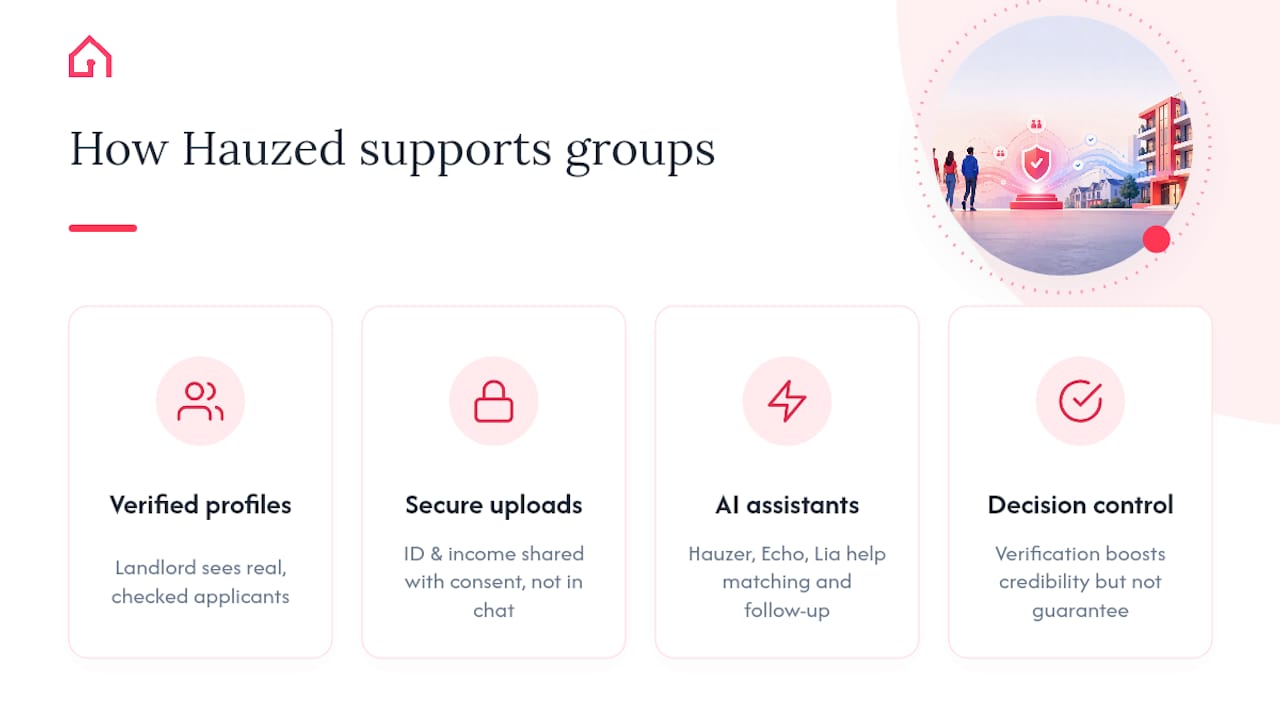
Hauzed builds group applications into the platform rather than leaving flatmates to coordinate over text. Each applicant gets a verified profile, so a landlord reviewing a household sees real, checked people instead of one anonymous enquiry among dozens. Document upload happens through a secure flow with consent, keeping ID and income evidence out of chat threads.
AI helpers such as Hauzer, Echo, and Lia assist with matching and follow-up, helping a landlord respond faster and keep track of a group's application without replacing their judgement. Verification strengthens a household's credibility, but it doesn't guarantee acceptance. The final decision always sits with the landlord or agent.
A renter-centred checklist worth keeping in your back pocket
Before any viewing or submission, get one sheet together: everyone's name and contact details, the agreed rent split, deposit arrangements, and each person's reference and verification status. Groups that turn up organised tend to get faster answers, simply because there's nothing left for the landlord to chase.
— Hauzed
Try Hauzed for a safer group rental application
Hauzed's core value for group applications is straightforward: verified tenant profiles, a built-in group-application workflow, and secure document sharing that keeps sensitive files off group chats and unsecured email. Instead of five separate messages landing in a landlord's inbox, one coordinated, verified submission does the job.
Create a profile, verify your identity where the platform asks for it, and invite your flatmates to join the same application for a listing you've all agreed on. A verified, complete household application stands out precisely because most of what a landlord receives doesn't look anywhere near this organised. Start your group rental application on Hauzed and see how much faster a coordinated submission moves.
Sources
For more on joint liability, read Shelter's guide to joint tenancies. Loc8me covers practical group-tenancy advice for flatmates, and Hauzed's blog walks through the full application process in more depth.
It's a single, combined submission from multiple prospective tenants who intend to live together as one household, rather than separate individual applications for the same property.
Is a group tenancy the same as joint and several liability?
Yes. When a group signs one tenancy agreement, every named tenant is usually liable for the full rent and any damage, not just their own share.
How do landlords assess combined income for a group application?
Landlords typically add up the group's gross income and compare it against the total rent, so presenting summed payslips or employer letters up front speeds up their decision.
What happens if one person in a group tenancy wants to leave early?
The tenancy agreement itself won't usually cover this, which is why groups should agree their own internal exit process, including how a replacement flatmate gets approved by the landlord.
Can Hauzed help coordinate a group rental application?
Yes. Hauzed lets each applicant build a verified profile and submit documents through one secure group-application workflow, giving landlords a single, complete submission to review.