How to get your rental deposit returned in Ireland
18 June 2026
9 min read
Learn how to get your rental deposit returned in Ireland. Understand your rights and gather the right evidence for a smooth process.
Getting your rental deposit returned is your legal right as a tenant in Ireland, provided you have met the terms of your tenancy agreement. Your landlord can only withhold money for unpaid rent, outstanding utilities, or damage that goes beyond normal wear and tear. The Residential Tenancies Board (RTB) offers a fully online dispute resolution service if your landlord refuses to cooperate. Understanding the process from the start puts you firmly in control.
What evidence do you need to get your rental deposit returned?
Strong documentation is the single most powerful tool you have when claiming your rental deposit back. Without it, any dispute becomes your word against your landlord's. The RTB favours tenants when landlords fail to present itemised evidence for deductions, so your own records matter just as much.
Gather the following before and after your tenancy:
Move-in photos and video: Date-stamped images of every room, appliance, and fixture taken on the day you collect the keys.
Move-out photos and video: Matching images taken on your final day, ideally with the landlord present.
Signed inventory list: A written record of the property's contents and condition at the start of the tenancy. Keep a copy signed by both parties.
Tenancy agreement: Your rental agreement sets out the deposit amount, conditions for return, and any specific obligations.
Receipts for cleaning or repairs: If you paid for professional cleaning or fixed something before leaving, keep every receipt.
All written communications: Save every email, text message, and letter exchanged with your landlord or letting agent throughout the tenancy.
The RTB's dispute process is fully online, and you will need to upload evidence such as photos, your lease, and correspondence to initiate mediation or adjudication. Organising these files into clearly labelled folders before you move out saves significant time later.
Pro Tip:Take a short walkthrough video on move-in day and send it to your landlord by email immediately. That email timestamp creates independent proof of the property's condition from day one.
Related Topics
#safe rental payment methods#rental applicant screening solutions comparison#rental scam prevention tools comparison#deposit not returned Ireland what to do#rent deposit refund process#claiming rental deposit back#get rental deposit returned#rental deposit return tips#when will I get my deposit back#steps to get security deposit#how to retrieve security deposit
Related Articles
How to formally request the return of your deposit
A formal written demand is often sufficient to resolve a deposit dispute without ever needing RTB action. Sending a clear, polite, and firm letter or email puts your request on record and gives your landlord a reasonable deadline to respond.
Follow these steps to compose and send your request:
Write a formal letter or email. Address it to your landlord or letting agent by name. State the property address, your tenancy start and end dates, and the exact deposit amount you are owed.
Attach your evidence. Include your move-out photos, a copy of the signed inventory, and any receipts for cleaning or repairs you carried out.
Set a clear deadline. Specify a return deadline of 7 to 14 days. This is reasonable and mirrors best practice, even though no statutory deadline exists in Irish law.
Send by email and recorded post. Email creates an instant timestamp. Recorded post provides physical proof of delivery. Use both.
Keep a copy of everything. Save the sent email, the postal receipt, and any replies. These become your evidence trail if the matter escalates.
Your letter should be factual and professional in tone. Avoid emotional language. State what you are owed, why you are owed it, and what you expect to happen next.
Pro Tip:Use a subject line like "Formal Request for Deposit Return — [Property Address] — [Your Name]" so the email is easy to find and impossible to dismiss as informal.
What can a landlord legally deduct from your deposit?
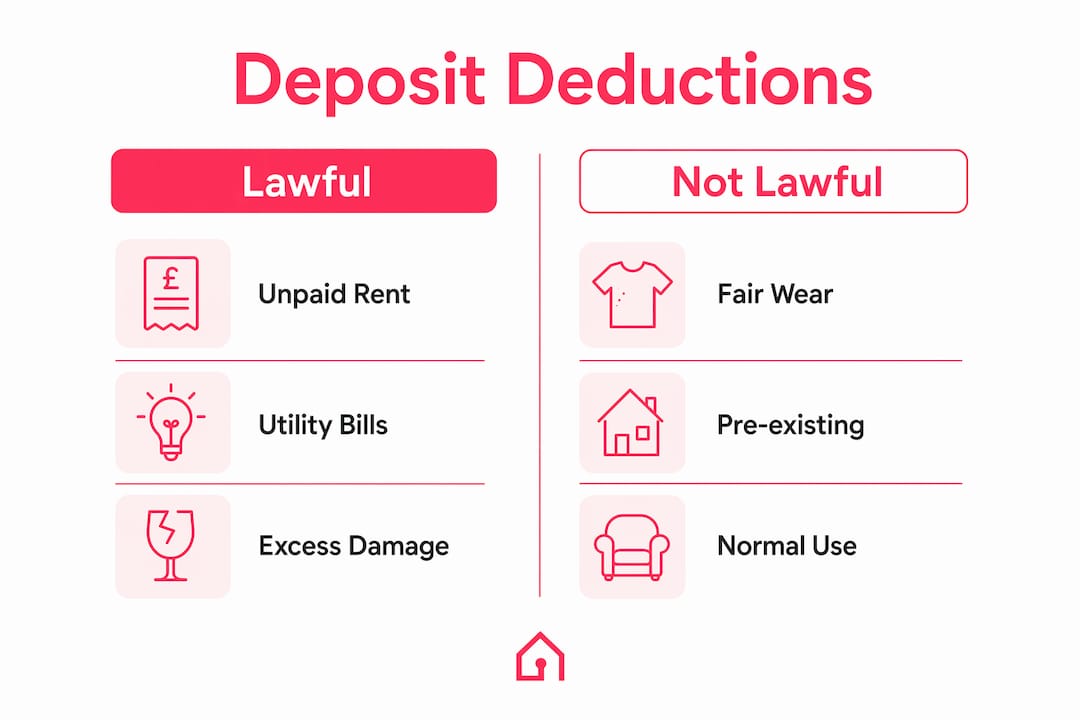
Permitted deductions are limited to three categories: unpaid rent, outstanding utility bills, and damage that goes beyond normal wear and tear. Anything outside these categories is not a lawful deduction.
Fair wear and tear means the gradual, minor deterioration that comes from ordinary daily use. A scuff on a skirting board, a small nail hole in a wall, or faded curtains after two years of sunlight all fall within fair wear and tear. Your landlord cannot charge you for these.
Lawful deduction
Example
Unpaid rent
Two weeks of missed rent at tenancy end
Outstanding utilities
Unpaid electricity bill in tenant's name
Damage beyond wear and tear
Broken window, large stain on carpet, missing furniture
Not a lawful deduction
Example
Fair wear and tear
Faded paint after a three-year tenancy
Pre-existing damage
Crack in wall present at move-in
General cleaning (if property was clean)
Landlord preference for professional clean
If your landlord does make deductions, they must provide an itemised breakdown with receipts or quotes. Excessive deductions without supporting evidence consistently favour tenants in RTB adjudications. A 2025/26 RTB tribunal awarded tenants €5,000 in damages in a case where strong evidence was presented, even where rent arrears existed. That outcome shows how much documented evidence shifts the balance.
What to do if your landlord refuses to return your deposit
If your landlord ignores your written request or disputes your claim without valid grounds, the RTB dispute resolution process is your next step. The process is fully online and accessible to all registered tenants.
Follow this structured approach:
Check your tenancy is registered. The RTB can only accept disputes for registered tenancies. Confirm your tenancy appears on the RTB register before applying.
File the Notice of Termination return form.Filing this form promptly after moving out is a critical but often overlooked step. It formalises your tenancy end date and supports your deposit claim timeline. Keep proof of submission.
Submit your RTB dispute application online. Go to rtb.ie and complete the online application. You will need to upload your evidence, including photos, your tenancy agreement, your written request, and any landlord responses.
Prepare a structured event timeline. A clear chronological timeline of events, including repair requests, communications, and attempts to contact your landlord, helps adjudicators understand your case quickly.
Attend mediation first. The RTB typically attempts mediation before a formal hearing. Mediation is less formal and often resolves disputes faster. Approach it with your evidence organised and your position clearly stated.
Proceed to adjudication if needed. If mediation fails, the case moves to a binding hearing. Decisions at this stage are legally enforceable.
Landlords must notify the RTB of tenancy termination within 28 days. If your landlord's submission conflicts with your own records, this discrepancy can itself become evidence in your favour.
Pro Tip:Label every document you upload to the RTB with a clear filename, such as "Move-Out-Photo-Kitchen-15March2026.jpg". Adjudicators review many cases. Clear labelling makes your evidence easier to assess and harder to overlook.
Key takeaways
Tenants in Ireland can successfully retrieve their security deposit by combining thorough documentation, a formal written request, and the RTB's online dispute process when needed.
Point
Details
Document everything
Take dated photos at move-in and move-out and keep all written communications.
Send a formal written request
A polite but firm letter with a 7–14 day deadline often resolves disputes without RTB involvement.
Know lawful deductions
Landlords can only deduct for unpaid rent, utilities, or damage beyond fair wear and tear.
File the Notice of Termination form
Submitting this form promptly formalises your tenancy end and supports your deposit claim.
Use RTB dispute resolution
The RTB's fully online process covers mediation and binding adjudication for unresolved disputes.
What tenants get wrong about deposit disputes
From working closely with renters across Ireland, the pattern is consistent. Tenants who lose deposit disputes almost always made the same mistakes at the start of their tenancy, not at the end. They moved in without taking photos, signed nothing, and assumed a good relationship with the landlord was enough protection. It is not.
The most damaging habit is relying on verbal agreements. A landlord who verbally promises to repaint the walls or overlook a small stain has made a promise that does not exist in any dispute process. If it is not written down, it did not happen. This applies to move-out conversations too. Always follow up any in-person discussion with a confirming email sent the same day.
Timing also matters more than most tenants realise. Waiting weeks after moving out to request your deposit weakens your position. Send your formal request within 48 hours of returning the keys. The sooner you act, the clearer the timeline becomes for everyone involved.
Patience and persistence are both necessary with the RTB process. Mediation and adjudication take time, but the process is fair and well-structured. Tenants who arrive with organised, dated evidence and a clear timeline consistently achieve better outcomes than those who arrive with a grievance and no paperwork.
— Hauzed
Rent with confidence from the start
Deposit disputes are far easier to avoid when your tenancy starts on solid ground. Hauzed is built for exactly that. Every listing on Hauzed goes through active moderation and AI-driven scam detection, so you know the property and landlord are genuine before you ever pay a penny. Verified tenant and landlord profiles mean both sides of the agreement are accountable from day one.
When you find a property through Hauzed's rental platform, you also get access to clear, transparent rental agreements and a communication trail that supports you throughout your tenancy. That paper trail is exactly what protects your deposit when it matters most. If you are still searching for the right place, explore rental costs across Ireland to plan your budget before you sign anything.
FAQ
How long does a landlord have to return a deposit in Ireland?
No statutory deadline exists in Irish law for deposit return. The widely accepted best practice is 21 days to return the deposit or provide an itemised list of deductions.
What can a landlord legally deduct from a deposit in Ireland?
Landlords can only deduct for unpaid rent, outstanding utility bills, or damage that goes beyond normal wear and tear. Deductions must be itemised and supported by receipts or quotes.
How do I dispute a deposit deduction with the RTB?
Apply online at rtb.ie and upload your evidence, including photos, your tenancy agreement, and all written communications. The RTB will first attempt mediation, then move to a binding adjudication hearing if needed.
What is fair wear and tear in an Irish tenancy?
Fair wear and tear refers to minor, gradual deterioration from ordinary daily use, such as faded paint or small scuffs. Landlords cannot charge tenants for this type of damage.
Does filing the Notice of Termination form affect my deposit claim?
Yes. Filing this form promptly after moving out formalises your tenancy end date and creates an official record that supports your deposit refund timeline in any RTB dispute.