Negotiate rent with landlord: a tenant's guide (England & Wales)
4 August 2026
14 min read
Learn how to negotiate rent with your landlord in England and Wales. Use expert tips to secure a better deal before signing or renewing!
Yes, you can negotiate rent with your landlord, both before you sign and at renewal. If your landlord serves a Section 13 notice proposing an increase you think is too high, you also have a statutory right to challenge it at the First-tier Tribunal (Property Chamber) — provided you apply before the new rent date arrives. Shelter England recommends researching local rents, documenting your payment reliability, and always insisting on a formal written notice rather than accepting an informal message as a valid proposal.
Your three immediate priorities:
Check your tenancy type. Most private renters in England and Wales hold an assured shorthold tenancy (AST), which gives you specific statutory rights under the Housing Act 1988.
Start gathering evidence now: comparable rental adverts, your payment history, and any outstanding repair issues.
Do not stop paying your current rent, even if you are disputing a proposed increase.
In the next 48–72 hours: note the date on any notice you have received, download Form 4A from the HMCTS form finder, and contact Shelter England, AdviceNow, or Citizens Advice for free guidance tailored to your situation.
#rent reduction strategies#talking to landlord about rent#negotiate rent with landlord#rent negotiation tips#discussing lease terms#how to lower rent#negotiating lease agreement#ask for lower rent#effective rent negotiation
How to negotiate rent before you sign a tenancy agreement
The moment before you sign is when your leverage is at its peak. The landlord has a vacant property, no guaranteed income, and the real prospect of a void period if you walk away. That dynamic works in your favour.
What to offer in return for a lower rent:
A longer fixed term (12 or 18 months instead of 6) reduces the landlord's re-letting risk and admin costs.
Several months' rent paid in advance signals financial reliability without requiring a reference check.
A quick signing date removes uncertainty for the landlord.
Agreeing to handle minor maintenance (replacing light bulbs, garden upkeep) saves the landlord small but recurring costs.
Present your case with evidence, not just a request. Pull three to five comparable listings from Rightmove or Zoopla, note the dates they were listed and how long they have been on the market, and frame your offer around the data: "Similar two-bedroom flats in this postcode are currently advertised at £X. I'd like to agree £Y, and I'm happy to sign a 12-month term and pay the first two months upfront." That is a professional, easy-to-say-yes-to proposal.
Pro Tip:The best negotiation moment is immediately after your application is accepted, before you have paid a holding deposit. Once money changes hands, your leverage drops sharply. Use the viewing or the acceptance call to open the conversation.
Since May 2026, landlords in England and Wales cannot accept rent bidding. They must not advertise a property in a way that invites offers above the asking price, and they cannot ask you to pay more than the listed rent. If a landlord or agent suggests you offer more to secure the property, that is unlawful under the amended Housing Act provisions.
Whatever you agree, get it in writing before you pay or sign anything. A short email confirming the agreed rent, the start date, and any other terms is enough. Check what to look for in a rental agreement before you review the final contract.
How to respond if your landlord proposes a rent rise
For a periodic assured tenancy, your landlord must follow a strict statutory process to raise your rent. An informal text, email, or phone call is not a valid notice. The law requires a prescribed written notice, and since May 2026, a landlord can only propose an increase once every 52 weeks.
The lawful notice: Section 13 and Form 4A
Under Section 13 of the Housing Act 1988, your landlord must serve you a prescribed notice (Form 4A) that states the proposed new rent and the date it would take effect. The notice period must be at least one month for a monthly tenancy. Shelter England's guidance on Section 13 notices explains the exact requirements and what makes a notice invalid.
Your step-by-step response when you receive a notice
Check the notice is valid: confirm it is Form 4A (or the prescribed equivalent), that the notice period is correct, and that the proposed start date is at least one month away.
Research comparables immediately: pull three to five current listings for similar properties in your area and screenshot them with the date.
Open negotiations in writing: email your landlord, acknowledge the notice, and propose a counter-offer backed by your comparables and payment record.
Set a clear deadline: give your landlord seven to ten days to respond before you decide whether to accept, counter again, or apply to the tribunal.
Apply to the First-tier Tribunal (Property Chamber) before the new rent date if you cannot reach agreement. Missing that deadline means the proposed rent takes effect automatically.
Citizens Advice confirms that you should keep paying your current rent throughout this process. Do not withhold rent as a negotiating tactic — it creates arrears and can expose you to eviction proceedings.
How to prepare your evidence before you negotiate
Preparation is the single factor that separates a successful negotiation from an awkward conversation that goes nowhere. Shelter England is clear on this: evidence of comparable rents, a reliable payment history, and a clear written offer improve your chances significantly.
Evidence checklist:
Three to five comparable rental adverts for similar properties (same area, similar size and condition), with screenshots showing the listing date and asking rent.
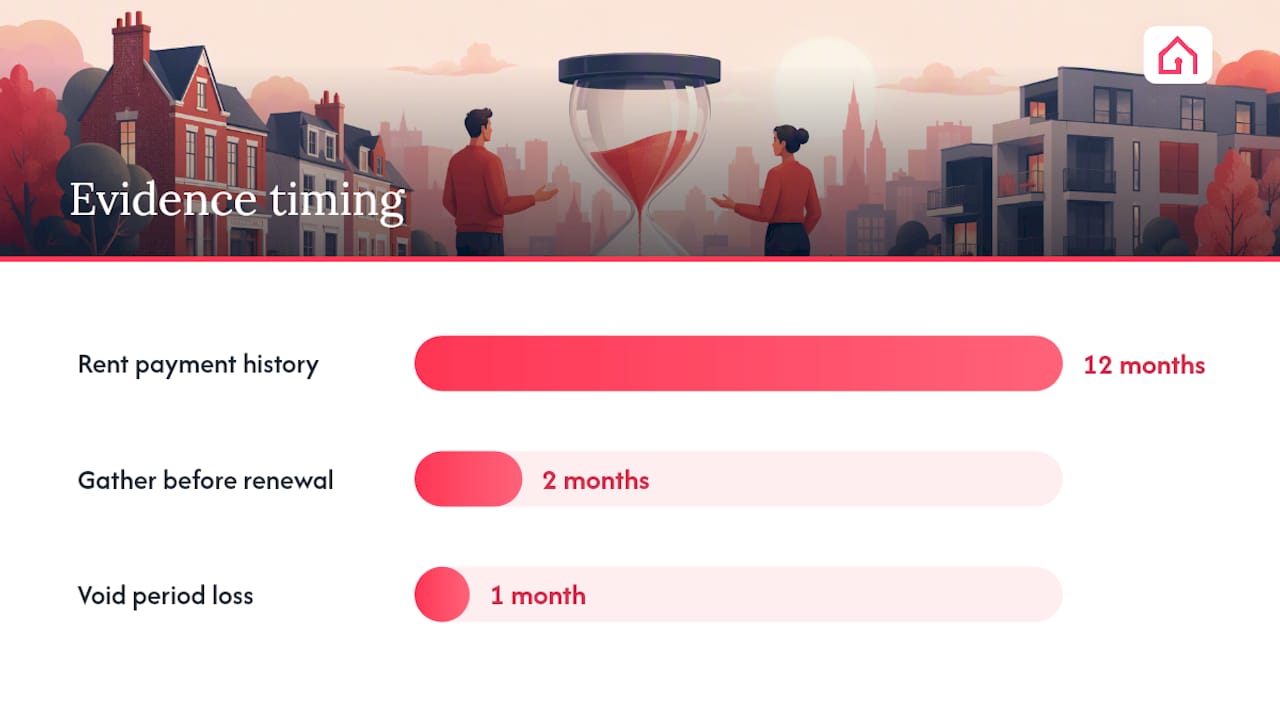
Your rent payment record, ideally showing 12 months of on-time payments.
Photographs of any disrepair or maintenance issues the landlord has not addressed.
Copies of all correspondence with your landlord, including texts and emails.
Receipts for any repairs or improvements you have paid for yourself.
Start gathering this material at least two months before your renewal date, or immediately when you receive a Section 13 notice. Lemonade UK's guidance recommends beginning negotiations at least two months before renewal, when you still have time to find alternatives if talks break down.
Pro Tip:Landlords care about void costs. A property sitting empty for even four weeks costs them a month's rent in lost income, plus re-letting fees. Framing your negotiation around that reality ("I'd like to stay and avoid a void period for both of us") is often more persuasive than comparables alone.
Where to find comparables and what to record
Source
What to capture
Screenshot tip
Rightmove
Asking rent, property type, postcode, date listed
Include the URL and listing date in the screenshot
Zoopla
Asking rent, days on market, floor area
Note "reduced" flags — they signal softer demand
Local letting agents
Advertised rent, property spec
Save the agent's name and branch for credibility
Note how long each comparable has been on the market. Properties sitting unsold for weeks indicate softer demand, which strengthens your case. Winter months tend to see lower rental demand, giving tenants more leverage — RentAndValue notes that void periods create real costs for landlords, and timing your negotiation during quieter periods can make a meaningful difference.
Always follow up any verbal conversation with an email summarising what was discussed and what, if anything, was agreed. A written record prevents disputes later and is normally sufficient to prove an agreement was reached.
How to challenge a rent increase at the First-tier Tribunal
If negotiations fail, you have a statutory right to refer the proposed rent to the First-tier Tribunal (Property Chamber). The tribunal will assess what the open-market rent for your property should be and can set a rent lower than your landlord proposed. Under Sections 14, 14ZA, and 14ZB of the Housing Act 1988 (as amended by the Renters' Rights Act 2025), the tribunal has the power to determine the effective date of any new rent and to adjust its decision where paying the new rent would cause undue hardship.
Who can apply and when
Any tenant who has received a valid Section 13 notice may apply. The critical rule: you must apply before the date the new rent is due to start. Tenant-rights.uk confirms that once the new rent date passes, the proposed rent takes effect and the right to challenge that notice is lost.
Complete the form with your tenancy details, the proposed rent, and your evidence (comparables, payment history, property condition).
Submit before the new rent start date. Fee help is available — check the GOV.UK guidance for eligibility.
The tribunal will notify both you and your landlord and will schedule a hearing or a paper determination.
The tribunal sets the open-market rent. If that figure is lower than the landlord proposed, the lower rent applies from the date the tribunal directs.
Key deadlines at a glance
Stage
Deadline / Timeframe
Section 13 notice served
At least one month before proposed new rent date
Tribunal application
Before the proposed new rent start date
Tribunal decision
Typically several weeks to a few months after filing
Effective date of new rent
As directed by the tribunal (not earlier than application date)
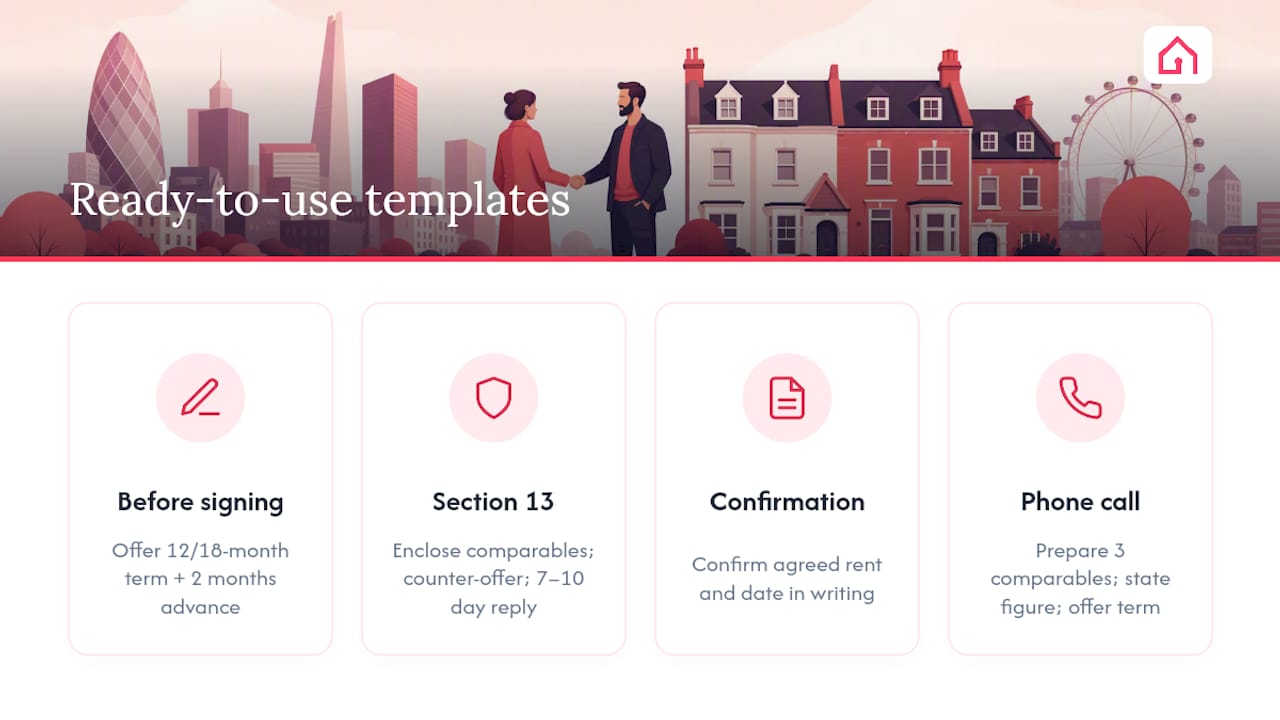
Ready-to-use scripts and templates for rent negotiation
Short, polite, and evidence-backed messages work best. These templates are starting points — adapt the figures and details to your situation.
Template 1: Asking for a reduction before signing
Subject: Tenancy offer — [Property address]
Dear [Landlord/Agent name],
Thank you for accepting my application for [address]. I'm very keen to proceed. Having reviewed comparable properties currently advertised in the area — including [brief description of 2–3 comparables at £X] — I'd like to propose a monthly rent of £[your figure]. In return, I'm happy to sign a [12/18]-month fixed term and pay the first [two] months in advance. Please let me know if this works for you. I can sign and transfer funds by [date].
Kind regards, [Your name]
Template 2: Responding to a Section 13 / Form 4A notice
Thank you for the Section 13 notice dated [date], proposing a new rent of £[amount] from [date]. I've reviewed current market rents for comparable properties in [area] and enclose screenshots showing asking rents of £[X]–£[Y] for similar homes. On that basis, I'd like to propose a revised rent of £[counter-offer] from [date]. I'd welcome a call or email reply by [date, 7–10 days away] so we can agree a way forward without involving the tribunal.
Kind regards, [Your name]
Template 3: Confirming a verbal agreement in writing
Subject: Confirmation of agreed rent — [Property address]
Dear [Landlord name],
Following our conversation on [date], I'm writing to confirm that we agreed a monthly rent of £[amount] from [date], with [any other agreed terms, e.g. 12-month fixed term]. Please reply to confirm this is correct. I'll arrange payment accordingly.
Kind regards, [Your name]
Template 4: Phone script for a renewal negotiation
Before you call, write down your three comparables and your proposed figure. Open with: "I'd love to renew — I've been a reliable tenant and I want to stay. I've looked at what similar properties are renting for locally, and I'd like to discuss the renewal rent before we agree anything." Then state your figure and your offer (longer term, advance payment). Keep it brief and friendly.
What to do if you genuinely cannot afford the new rent
If the proposed rent is simply unaffordable, act early. Waiting until you are in arrears makes every option harder.
Immediate steps:
Contact your landlord as soon as possible. Explain your situation honestly and propose either a temporary reduction or a phased increase over several months.
Ask Citizens Advice or Shelter for a benefits check. You may be entitled to Local Housing Allowance or Universal Credit housing costs that you are not currently claiming.
Contact your local council's housing team if you are at risk of homelessness — they have a duty to assist.
Keep paying your current rent while you negotiate or wait for a tribunal decision.
If you reach a repayment plan with your landlord for any shortfall, get the terms in writing: the amount, the schedule, and what happens if circumstances change. Citizens Advice can help you draft or review that agreement. Shelter's free helpline (0808 800 4444) is available if you need urgent housing advice.
Key takeaways
Tenants in England and Wales can negotiate rent before signing, at renewal, and through the First-tier Tribunal if a Section 13 notice proposes an above-market increase — but you must apply before the new rent date.
Point
Details
Start early
Begin negotiations at least two months before renewal, when your leverage is strongest.
Insist on formal notice
A Section 13 notice on Form 4A is required for any lawful rent increase in a periodic tenancy.
Apply to the tribunal in time
Submit your application before the proposed new rent start date or you lose the right to challenge.
Keep paying current rent
Never withhold rent during a dispute — arrears can lead to possession proceedings regardless of the outcome.
Get everything in writing
Confirm any agreed rent, effective date, or concession by email before you sign or pay.
Why preparation is the real difference-maker in rent negotiations
Most tenants who struggle to negotiate rent do not lack confidence. They lack a folder. A landlord who receives a polite email with three dated comparable listings, a clean payment record, and a specific counter-offer has very little to push back on. A landlord who receives a vague "I think the rent is too high" has every reason to hold firm.
The legal framework in England and Wales genuinely supports tenants who engage with the process properly. The Section 13 route, the tribunal, the bidding ban introduced in May 2026 — these are real protections, not theoretical ones. AdviceNow and Shelter have both published clear guidance confirming that tenants who follow the formal process and apply to the tribunal on time have a realistic chance of having a proposed increase reduced to the open-market rate.
One practical confidence tip: make your first ask specific and small. A request to hold the rent at its current level, or to accept a £50 reduction in exchange for a longer term, is far easier for a landlord to agree to than an open-ended negotiation. Start the conversation early, frame it as a win for both sides, and let the evidence do the persuading.
Yes. You can ask for lower rent before signing a tenancy agreement and at renewal. If your landlord serves a valid Section 13 notice, you can also negotiate a counter-offer or apply to the First-tier Tribunal (Property Chamber) to have the rent assessed independently.
Is it a good idea to negotiate rent?
Generally, yes, particularly if you have evidence of lower comparable rents nearby or a strong payment record. Landlords often prefer a reliable existing tenant at a slightly lower rent over a void period and the cost of finding someone new.
Can my landlord increase my rent by 33%?
A landlord can propose any figure on a Section 13 notice, but you have the right to challenge it at the First-tier Tribunal before the new rent date. The tribunal will set the open-market rent, which is typically lower than a large proposed increase, and that figure becomes your legal rent.
What is the 2% rule for renting?
There is no statutory "2% rule" in England and Wales. Since May 2026, landlords must use the Section 13 prescribed notice process and can only propose an increase once every 52 weeks. The tribunal assesses any challenged increase against open-market comparables, not a fixed percentage cap.
How long does the rent negotiation or tribunal process take?
Direct negotiation can resolve in days or weeks. A tribunal application, once filed, typically takes several weeks to a few months for a decision, depending on the tribunal's caseload and whether a hearing is required.