Renting without an agent in Ireland: your safety-first guide
20 August 2026
16 min read
Learn how to rent without an agent in Ireland. See properties, verify landlords, and ensure safety while saving on fees.
Yes, you can rent directly from a private landlord in Ireland. Your statutory tenant rights apply whether you go through an agent or not, so skipping the middleman is entirely legal and often cheaper. But three things need to happen before you hand over a single euro.
See it, don't just scroll it. Insist on an in-person viewing or, if that's genuinely impossible, a live video tour where you can verify the person you're speaking to.
Check before you commit. Confirm the address, cross-check the landlord's details, and never pay a deposit before you've seen the property and agreed written terms.
Pay traceably. Bank transfer or card only, and always get a receipt. Cash and crypto leave you with no way to prove anything if things go wrong.
Renting directly from a landlord in Ireland is fully legal and keeps your statutory rights intact, provided you verify the listing, the person, and the paperwork before any money changes hands.
Point
Details
Verify before you view
Insist on an in-person viewing or a live video tour, and reverse-image-search suspicious photos.
Know your deposit rights
Deposits for tenancies from 9 August 2021 are capped at one month's rent, always with a receipt.
Understand RPZ rules
The whole country is a Rent Pressure Zone since 20 June 2025, capping increases and requiring 90 days' notice.
Document everything
Keep signed tenancy terms, deposit receipts, and a move-in inventory in case of a later dispute.
Use verified channels
Hauzed lets tenants build a verified profile, save listings, and message landlords directly through secure chat.
#how to rent in Ireland#rent directly from landlord#list properties in Ireland#renting apartments without agency#rent without agent ireland#no agent rental listings#private rent options Ireland#find rental homes Ireland
How do you spot a rental scam before you view the property?
Most rental scams in Ireland fall apart the moment you ask for something real: a face, a key, a proper viewing. Building a habit of asking for those things upfront saves you far more hassle than any amount of polite trust in a stranger's WhatsApp message.
Here's the sequence worth following every time you find a listing that looks promising.
Request an in-person viewing first. If the "landlord" is conveniently abroad, working offshore, or too busy to meet, treat that as your first red flag rather than an inconvenience to work around.
Ask for a live video tour if a viewing genuinely can't happen. The CCPC's guidance on rental scams is explicit here: a live call where you can see the person and the rooms in real time is the next best thing to standing in the flat yourself. Pre-recorded video is not the same thing.
Reverse-image-search the listing photos. Scammers frequently lift pictures from a genuine advert and repost them under a different name and phone number. If the same photos turn up on three separate listings with three separate contacts, walk away.
Verify the address independently. Drop the location into a map and check it matches the description, the photos, and any nearby landmarks mentioned in the advert.
Never transfer money before you've got written terms. No deposit, no "holding fee," no "admin charge" should change hands until you've seen the place and have something in writing.
Ask for the RTB registration number. Every legally let property should be registered. It's a useful check, though not bulletproof on its own since the same CCPC advice notes that scammers can copy real registration details onto a fake advert.
Keep a paper trail. Screenshot messages, save email threads, and photograph any documents exchanged, in case you need them later for a dispute.
A useful statistic to hold onto: the CCPC identifies the in-person viewing (or genuine live video alternative) as the single most effective defence against rental fraud, ahead of any document check or registration number. Verification through a live conversation gives you something a scammer struggles to fake, and it also hands you the evidence you'd need if you ever had to prove a listing was fraudulent.
Pro Tip:Ask the landlord a specific, unscripted question about the property during your call or viewing, something like which way the kitchen window faces. Genuine landlords answer instantly. Scammers running multiple fake listings often hesitate or give vague answers.
Where can you find direct lets without going through an agency?
Direct lets exist in more places than most tenants realise, and each channel comes with a different risk profile worth weighing before you start applying.
College and community noticeboards. Universities and local community centres often carry genuine adverts from landlords who'd rather avoid agency fees themselves.
"To Let" signs. Old-fashioned, but a landlord who puts a physical sign outside their own property is, by definition, someone you can go and knock on the door of.
Verified social media groups. Local renting groups can work well, though they're also where a lot of scam activity concentrates, so treat every contact with the same scrutiny you'd apply anywhere else.
Word of mouth. Ask around your workplace, course, or social circle. A landlord letting to a friend of a friend has less incentive to misrepresent the property.
Trusted marketplaces built for verification. Platforms designed around identity checks reduce the anonymous-message problem that makes the other channels riskier.
Citizens Information lists these as the standard channels tenants use, alongside classifieds and online accommodation sites, and each carries a different level of built-in accountability.
Once you've found a listing worth pursuing, your first message matters more than you'd think. Keep it short and specific: who you are, what you do (student, working, whatever's relevant), when you're available to view, and a direct question about RTB registration. Landlords fielding dozens of vague "hi is this still available" messages respond fastest to the ones that read like a serious application rather than a group text.
If a landlord asks for a holding deposit to secure a viewing slot, treat it cautiously. Get a written receipt specifying the amount, the purpose, and the exact refund terms if the let doesn't proceed, and pay by card or transfer only. A genuine risk assessment of remote renting in Ireland is worth reading if you're applying from abroad and can't view in person straight away.
What are your legal rights when renting directly from a landlord?
Skipping the agent doesn't skip the law. The Residential Tenancies Act 2004, as amended, protects you exactly the same way whether you found your home through an agency or a stranger's Facebook post.
Three legal facts to hold onto before you sign anything:
Deposit limits are capped by law. For tenancies starting on or after 9 August 2021, a landlord can only ask for a deposit up to one month's rent, no matter how competitive the market feels. Get a written receipt for every cent, and avoid handing over cash.
The whole country is now a Rent Pressure Zone. Since 20 June 2025, RPZ rules apply nationwide, which caps how much and how often rent can rise. A landlord must give you 90 days' notice of any rent review, using the proper RTB notice form.
Minimum standards are enforceable. The RTB sets minimum standards for things like heating, sanitation, and fire safety. If a landlord ignores them, you can request an inspection and pursue enforcement through your local authority or the RTB itself.
Before you move a single box, get the following in writing: the landlord's full contact details, the exact rent and payment date, the deposit amount and receipt, an inventory of what's included, and who's responsible for what repairs. A rent book or a simple written summary covers most of this if a full tenancy agreement feels premature at the viewing stage.
One insight worth remembering here: an RTB registration number is a good sign, but it isn't proof on its own. Cross-checking contact details and photos still matters, because registration numbers can be copied onto fake listings just as easily as anything else.
How does Hauzed help you rent directly and more safely?
Cutting out the agent shouldn't mean cutting out every safeguard an agent would normally provide. That's the gap Hauzed is built to close for tenants renting directly in Dublin and beyond.
Verified marketplace participation. Identity verification means the people messaging you and the people you're messaging aren't anonymous strangers in a crowded inbox.
A stronger rental profile. Instead of sending the same scattered message to a dozen listings, you build one profile with your details and preferences that landlords can actually assess properly.
Saved listings, requests, and secure chat. You can shortlist properties, send a request to a landlord, and keep the whole conversation in one place rather than across three apps and a phone number you gave out too freely.
AI-assisted matching. Hauzed's tools help surface suitable lets and invitations to your profile, rather than leaving you to manually trawl through every new advert.
Privacy-first document handling. Any supporting documents you choose to share go through secure, consent-based flows, not a chat thread where they'll sit unprotected.
None of this guarantees you'll land a particular property. The final decision always rests with the landlord. What it does is remove the anonymous, scam-prone first contact that causes most of the trouble tenants run into when going it alone.
Pro Tip:Complete your verification before you start applying, not after you've found "the one." A verified profile responds faster to invitations, and you won't lose a good viewing slot waiting on a check that could've been done days earlier.
Browsing is free, and you can look through listings on Hauzed before creating an account at all.
How do you draft a tenancy agreement without an agent?
A written tenancy agreement is the single document that protects both sides once the viewing's done and you've agreed terms verbally. You don't need a solicitor to get this right, but you do need to cover the same ground an agent's standard template would.
At minimum, put the following in writing: the full names and contact details of landlord and tenant, the address, the rent amount and due date, the deposit amount (capped at one month's rent for tenancies from 9 August 2021), the tenancy start date, and whether it's a fixed-term or Part 4 tenancy. Add who's responsible for utilities, whether pets are permitted, and any house rules specific to shared accommodation.
Threshold and Citizens Information both publish free tenancy agreement templates you can adapt rather than draft from scratch, which removes most of the legal guesswork. Read every clause before signing, and don't accept a term that contradicts your statutory rights under the Residential Tenancies Act, no matter how reasonable it sounds when a landlord explains it verbally. A clause can't legally remove a right the Act already gives you.
Sign two copies, keep one, and make sure the landlord signs the same document you did, not a version amended afterwards. Photograph the signed agreement the same day, before it disappears into a drawer somewhere.
Why does registering your tenancy with the RTB matter?
Landlords are legally required to register every tenancy with the RTB, generally within one month of it starting. This isn't paperwork for its own sake. Registration is what makes your tenancy visible and enforceable, and it's the mechanism that lets you access RTB dispute resolution if things go wrong later.
As the tenant, you can't register the tenancy yourself, but you can and should ask the landlord to confirm it's been done. A landlord who registers pays a modest fee and submits your tenancy details to the RTB. It's a fair signal of a landlord who intends to operate within the rules rather than off the books, though it's worth remembering that this alone doesn't confirm the listing you originally saw was genuine.
If you suspect a tenancy hasn't been registered, you can check with the RTB directly or raise it during your written correspondence before signing. An unregistered tenancy doesn't strip you of your rights under the Residential Tenancies Act, but it does make disputes harder to resolve quickly, since the RTB's processes are built around registered lettings. Keep your own copy of the tenancy agreement and deposit receipt regardless, as your evidence doesn't depend on the landlord having done their part correctly.
What should you check during the move-in inspection?
Do this before you unpack a single box, ideally with the landlord present. An inventory and inspection protects your deposit far more reliably than a verbal assurance that "everything's grand."
Walk through room by room and note the condition of walls, flooring, fixtures, and any furniture included in the let. Test every switch, tap, and appliance, and photograph anything already damaged, scuffed, or not working, with a timestamp visible if your phone allows it. Check smoke and carbon monoxide alarms actually function, since these fall under the RTB's minimum standards for rental properties.
Make a simple written inventory listing what's in the property and its condition, and get the landlord to sign it alongside you. Email yourself a copy the same day so there's a dated record independent of either party's phone. This single document is often what resolves a deposit dispute months later, because it shows exactly what existed before you moved a thing.
How do you handle a dispute with a landlord when there's no agent involved?
Without an agent as a buffer, disagreements land directly between you and the landlord, which makes documentation your best protection from day one. Every conversation you've had in writing, every receipt, and your move-in inventory become the evidence that decides how a dispute resolves.
Start by raising the issue directly and in writing, whether that's a repair that hasn't happened, a deposit dispute, or a disagreement over notice. Give a reasonable timeframe for a response and keep your tone factual rather than confrontational, since a written record of a reasonable request looks far better later than an angry one.
If the landlord doesn't respond or you can't reach agreement, the RTB's dispute resolution service handles the issue formally, covering everything from deposit retention to repairs and notice periods. It's free to use and is the correct route rather than small claims court for most tenancy disagreements. For unresolved standards breaches, your local authority can also carry out an inspection and issue improvement or prohibition notices where the property falls short.
Keep a simple timeline as things unfold: dates, what was said, what was promised. It sounds tedious in the moment, but it's exactly what turns a messy "he said, she said" into a case the RTB can actually adjudicate.
What's a fair rent, and how do you negotiate directly?
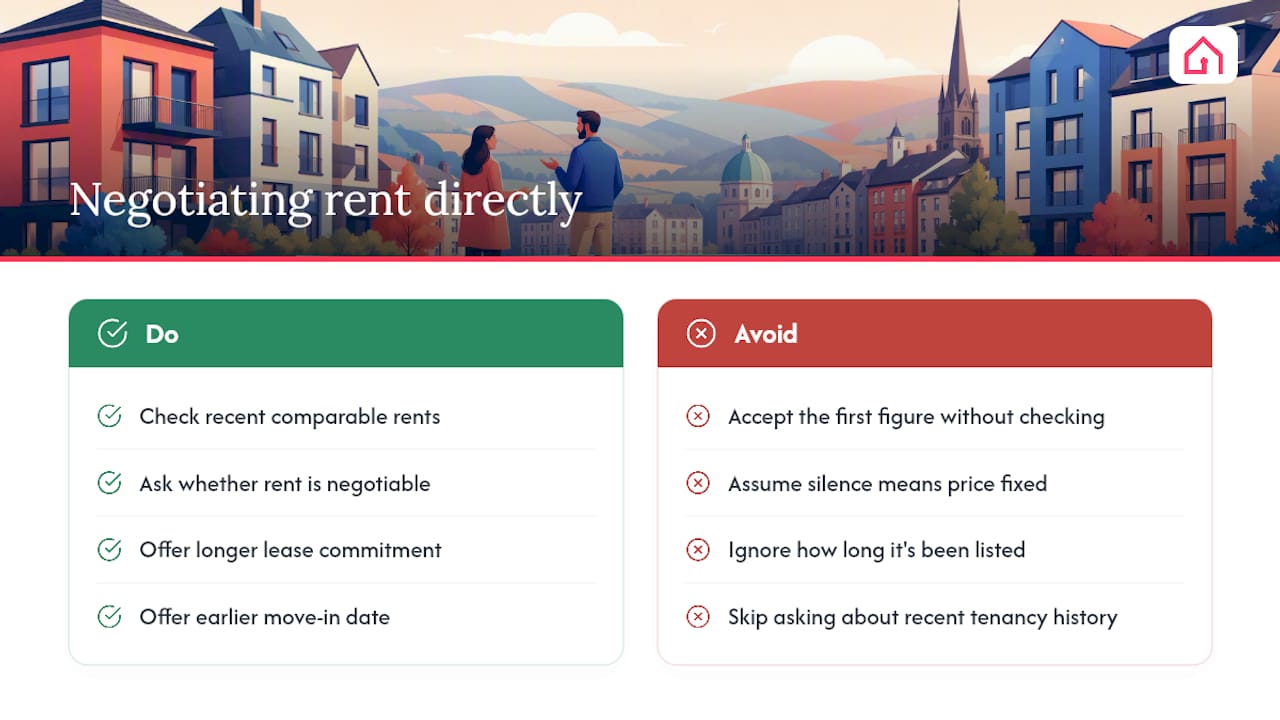
Without an agent quoting you a fixed asking price, you're often dealing with a landlord's own estimate of the market, which can be negotiable in ways an agency listing rarely is. Check recent rents for comparable properties in the same area and property type before you make an offer or accept the first figure mentioned.
Since the whole country became a Rent Pressure Zone, landlords letting a property that's been rented within the previous two years are bound by RPZ increase limits on what they can ask compared to the previous tenancy. A new letting of a property that genuinely wasn't rented in that period isn't bound by the same cap, so asking rents can vary more between similar-looking properties than you'd expect.
Negotiating directly gives you room an agent-managed listing often doesn't. If you can offer a longer lease commitment, an earlier move-in date, or references that demonstrate reliable payment history, say so plainly. A private landlord weighing up tenants without an agency's screening process will often value that certainty more than squeezing out an extra few euros a month. It's reasonable to ask whether the rent is negotiable, particularly if the property has sat listed for several weeks. Silence on price doesn't mean it's fixed, it usually just means nobody's asked yet.
The gap between "no agent fees" and "no agent protection"
Most advice on renting directly focuses entirely on the money saved by skipping agency fees, and barely mentions what you lose alongside it: a professional filtering the worst listings out before you ever see them. That trade-off is real, and pretending otherwise does tenants a disservice.
The conventional advice tends to stop at "check the RTB number and you're fine." It isn't, since a registration number can be copied onto a fake advert as easily as a photo. What actually protects you is the combination of live verification, paper trails, and understanding that your statutory rights don't disappear just because there's no agent in the room.
If there's one priority above the rest, it's this: verify the person before you verify the paperwork. A landlord who's genuinely willing to meet you, show you the flat, and answer a direct question about it has already cleared the hurdle that stops most scams cold. Everything else, deposits, inventories, tenancy terms, matters, but it matters only once you know you're dealing with someone real.
Skip the agent fees without skipping the safeguards
Hauzed exists for exactly this situation: renting directly in Ireland without handing your safety over to an anonymous WhatsApp thread or a Facebook group post you can't verify. Where noticeboards and social groups leave you to check every landlord and every listing yourself, Hauzed builds identity verification into the process from the start, so the person messaging you about a property isn't a stranger with something to hide.
Tenants use it free of charge. You can browse listings without creating an account, and when you're ready to apply, building a verified profile means you're not just another unread message in someone's inbox, you're a candidate a landlord can actually assess. Save the listings you're serious about, send requests, and chat directly with landlords through the platform rather than exposing your personal number to strangers. If you're currently juggling five different channels and getting ghosted by most of them, create a tenant profile on Hauzed and start applying to verified lets today.
Is it legal to rent directly from a landlord in Ireland?
Yes. Your rights under the Residential Tenancies Act apply equally whether you rent through an agent or directly from a private landlord.
How do I know if a rental listing is a scam?
The CCPC advises insisting on an in-person viewing or a live video tour with identity verification, and never paying before you've seen the property and agreed written terms.
What is the maximum deposit a landlord can ask for?
For tenancies starting on or after 9 August 2021, a landlord can require a deposit of no more than one month's rent.
Do I still need to register my tenancy with the RTB if there's no agent?
The landlord, not the tenant, is responsible for registering the tenancy with the RTB, and you should confirm they've done so before or shortly after signing.
Can Hauzed help me find a direct let without an agent?
Yes. Hauzed connects verified tenants directly with landlords through secure chat, saved listings, and AI-assisted matching, without traditional agency fees.