3 Rental Application Messages That Win Viewings in Ireland
9 September 2026
10 min read
Write landlord ready rental messages for Ireland: three templates, affordability lines, a one page tenant CV and verified profile tips to stand out.
Open with your name, the property reference, and one line proving you can afford the rent: "Hi, I'm [Name], interested in [address] — I earn [£X], can move in [date], and have payslips ready to send." That single sentence answers a landlord's three biggest questions before they even reply, which is why it works far better than a vague "Is this still available?"
TL;DR:
Landlords prioritize clear, concise messages that include the property address, household details, move-in date, and affordability statement, ideally within 40 to 60 words.
Providing a ready tenant CV with employment, income, and references alongside secure document-sharing significantly improves chances of securing viewings and quick approval.
Using verified profiles and templates streamlines applications across multiple listings, reducing delays caused by missing paperwork or inconsistent information.
Quick, straightforward follow-ups after two to three days increase response rates, while vague inquiries or late replies often result in losing the opportunity.
Mentioning specific features of the property in initial contact demonstrates genuine interest and helps distinguish your application from mass messages.
A rental application message is any written contact you send to claim interest in a property, from a one-line portal enquiry to a full email cover letter. Each form suits a different moment.
A quick portal or app message gets your name into the queue fast. An email cover letter gives you room to explain affordability, timing, and references properly. A full application packet, with a tenant CV and supporting documents attached, comes once a landlord asks for it or when you want to stand out immediately in a competitive listing.
Paste your tenant CV when a listing invites applications directly; hold documents back until asked, and never send bank details or payslips through an unsecured chat. In a crowded inbox, concise and verified beats long and vague every time, since landlords delete rambling enquiries and favour clarity.
What should your rental application message include?
Landlords and agents are scanning, not reading. Give them the answers to their standard screening questions in the first few lines, and you cut the back-and-forth that slows most applications down.
Your message should cover:
The exact property reference or address, so there's no confusion about which listing you mean
Your full name and best contact number, plus anyone else moving in
Household composition: solo, couple, sharers, or family, and whether you have pets
Your target move-in date and how flexible you are on it
A one-line affordability statement, such as income level or a note that a guarantor is available
A brief nod to rental history and references, even just "two references available on request"
Your availability for a viewing, ideally with two or three specific time slots
Pro Tip:Keep a saved version of this checklist and fill it in fresh for every property. It takes two minutes and stops you sending a message that still mentions the wrong address.
Three ready-to-use rental inquiry templates
Save all three. Swap the placeholders, adjust the tone slightly for the property type, and you've got a rental inquiry template ready for almost any listing.
Portal or app message. "Hi, I'm [Name], very interested in [property address]. There are [number] of us moving in, income sufficient to cover the rent, and we're available to view on [day/time] or [day/time]. Happy to send payslips and references on request. Move-in date: [date]."
Email cover letter (subject + 160–200 words). Subject: "Application for [address] — [Your Name]." Open with the property reference, then one short paragraph each on: who's applying and household size, your income and employment situation, your rental history or current landlord reference, and your availability for a viewing plus move-in date. Close with a line confirming documents are ready to send.
SMS or WhatsApp message. "Hi, saw your listing for [address] on [portal]. Still available? I'm [Name], [job/income summary], can view [day] and move in [date]. Happy to send references." Keep this one to two or three lines; it's for getting a quick reply, not for full context.
After each message, attach or reference documents only once the landlord responds, unless the listing explicitly asks for a tenant CV upfront. Personalise the opening line by naming one feature you noticed, the garden, the location, the parking, so it doesn't read like a copy-paste job even though it partly is.
How do you prove affordability without oversharing?
Landlords need evidence, not a full financial history. The usual documents are recent payslips, two to three months of bank statements, an employer confirmation letter, and, for self-employed applicants, tax return summaries or an accountant's letter.
State affordability in your message with a single confident line: "Income comfortably covers the rent, payslips available on request." That's enough. You don't need to detail your entire budget or explain every outgoing.
A few practical rules make this smoother:
Never paste payslips, bank statements, or ID scans directly into chat or a text message
Use secure upload links or verified document-sharing features where the platform offers them
If a guarantor is requested, have their income proof and ID ready alongside your own
If your income is irregular, offer extra months of bank statements or a guarantor upfront rather than waiting to be asked
Friendly and professional beats either stiff or overly casual. Match the level of detail to the format: a portal message stays lean, an email earns a bit more room.
Portal message: 40 to 60 words is the sweet spot
Email cover letter: 160 to 200 words, split into short paragraphs
SMS or WhatsApp: two to three lines, nothing more
For subject lines, use "Application for [address] — [Your Name]" or "Enquiry: [address] — available from [date]." Both signal instantly what the email is and who it's from, which matters when an agent is triaging fifty unread messages. Mention one specific detail from the listing, a feature, the street, the layout, to show you actually read it rather than mass-messaging every property in the area.
What red flags quietly sink applications?
Vagueness. "Is this still available?" with no name, income, or timing tells a landlord nothing and usually gets ignored.
Missing paperwork. Promising documents "later" when the landlord has already asked for them signals disorganisation, not modesty.
Slow replies. Taking days to respond to a viewing offer often loses the slot to someone faster, regardless of how strong your application is on paper.
Inconsistent facts. Giving a different move-in date or household size across two messages raises doubt before referencing even starts.
If you've got a minor issue, a past late payment, a short credit gap, a pet, address it in one factual sentence with a solution attached: "One late payment two years ago due to a bank error, happy to provide a reference confirming this." Silence on a known issue reads worse than the issue itself.
When should you follow up, and how?
Give agents and landlords two to three working days before chasing a first message; competitive listings sometimes reply within hours, but most take longer during busy periods. One polite follow-up is enough. A second unanswered nudge usually means the property has moved on.
Reference your original message, restate your availability, and keep it short: "Following up on my message about [address] sent [day] — still very interested and available to view this week if helpful."
Why a tenant CV and a verified profile change the outcome
A one-page tenant CV works because it hands over structured facts a landlord would otherwise have to extract from three separate emails. Include your employment status and income, current or recent tenancy history, two references, and your identity verification status if you have one.
Employment and monthly income
Rental history: current address, tenancy length, landlord or agent reference
Two contactable references
Verification status, if your profile carries one
Pairing a tenant CV with a short cover letter answers most standard checks at a glance, which is exactly what a landlord scanning dozens of enquiries wants. A verification badge does something similar from a trust angle: it moves you from "one of many anonymous messages" to a candidate whose identity and documents are already partly confirmed. Upload sensitive files only through secure, consent-based flows, never as chat attachments.
Pro Tip:Build your tenant CV once, save it as a PDF, and attach the same document to every application. Consistency across submissions is itself a small signal of organisation.
What actually separates the applicants who get viewings?
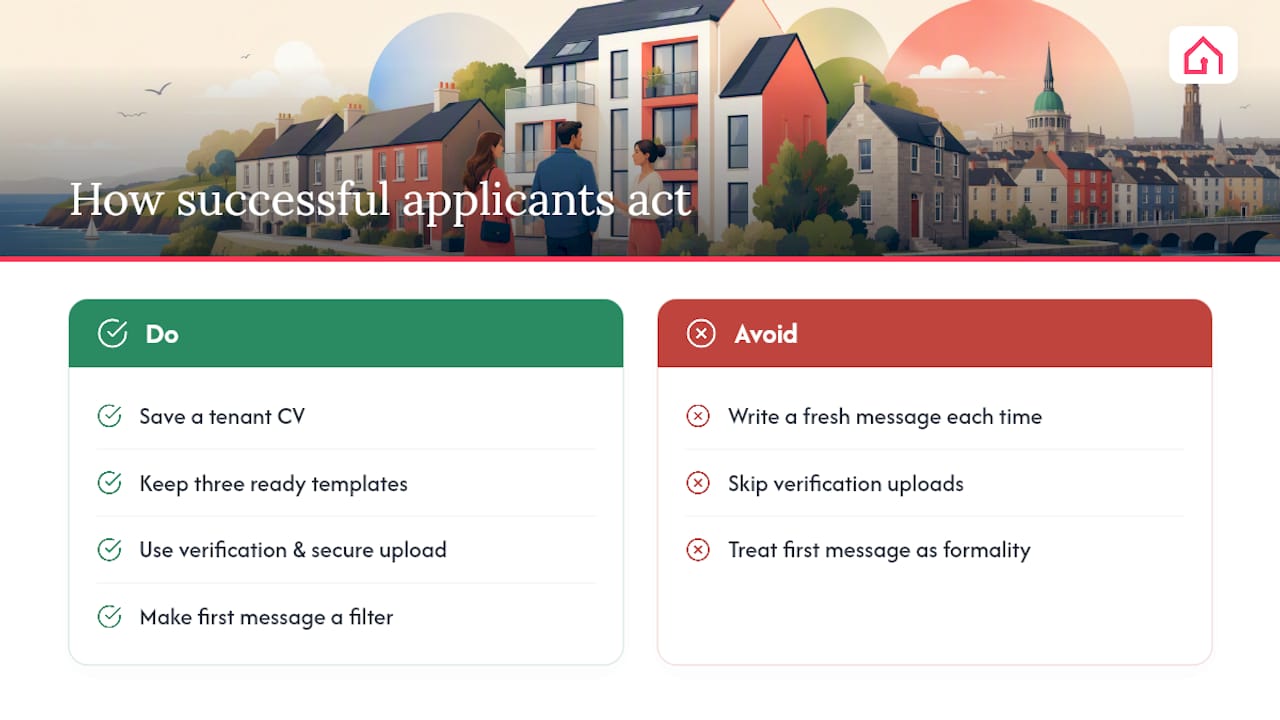
Preparation beats charm. The renters who consistently get replies are the ones with a saved tenant CV and a folder of three templates ready to fire off the moment a listing appears, not the ones writing a fresh, more eloquent message each time.
Verification and secure upload flows exist for a reason: they cut the manual back-and-forth that kills momentum on a good listing. Use them where they're available, and treat your first message as a filter you control, not a formality.
**
Try a verified tenant profile instead of another cold message
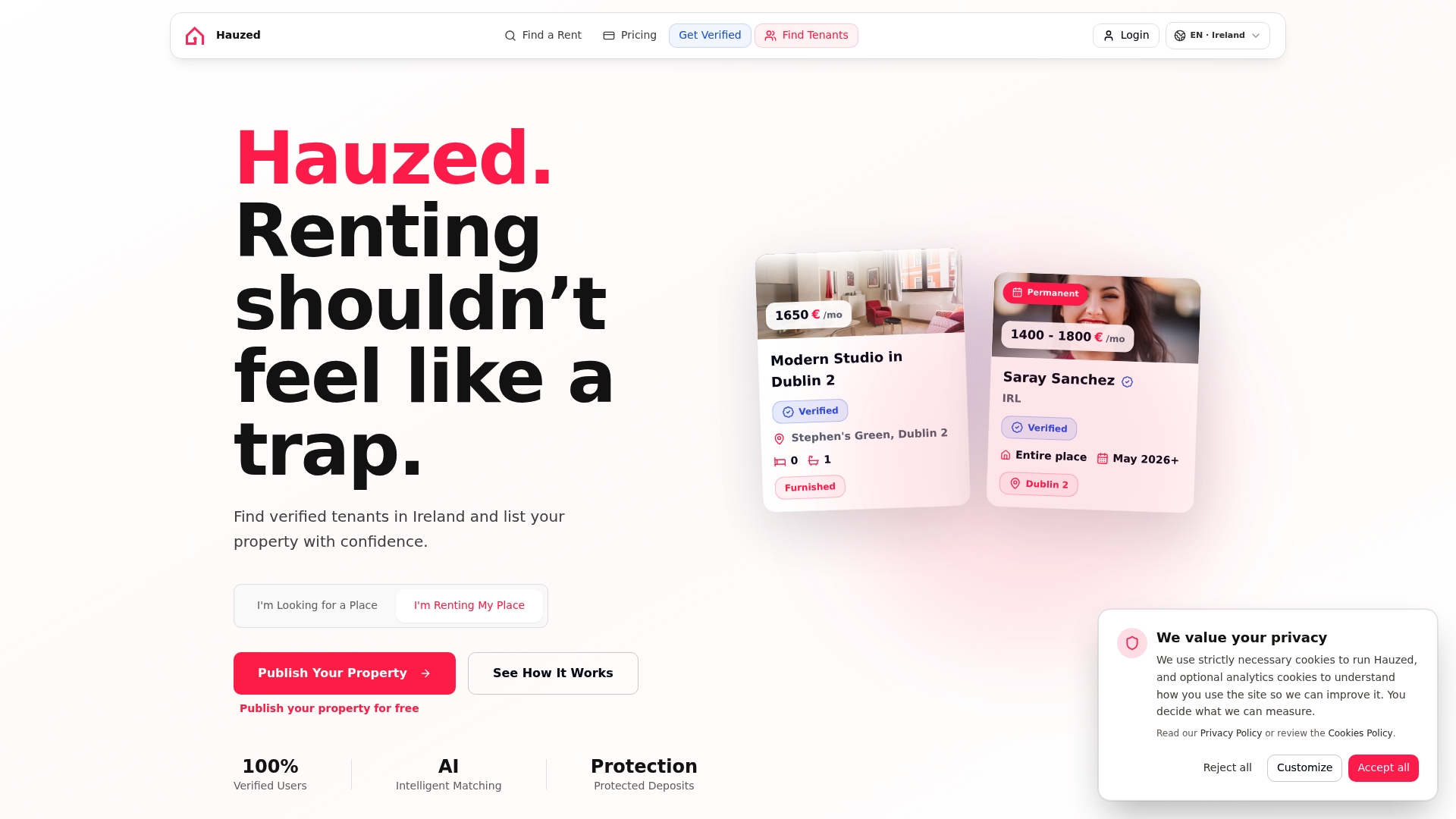
Using a verified tenant profile allows you to upload documents through a secure flow and send applications that carry proof of identity and readiness, reducing the need to start from zero for each application.
Verification signals seriousness to landlords, but it doesn't guarantee acceptance; the final decision always sits with the landlord or agent. What it does is remove the friction of proving who you are and what you can afford on every single enquiry. If you're tired of writing the same rental application message from scratch, set up your profile on Hauzed and start applying with your documents and references already in place.
Sources
Response rates, affordability signals, and tenant CV formats referenced above draw on OpenRent's guide to common enquiry mistakes, Dwellio's tenant CV and offer letter breakdown, Westport Property's landlord screening criteria, and Contend Legal's rental application walkthrough.
A good message names the property, states who's applying and your income level, confirms your move-in date, and offers specific viewing times, all within a few short sentences.
What are red flags for tenants applying to rent?
Vague enquiries with no name or income detail, unexplained gaps in rental history, slow replies to viewing offers, and inconsistent facts across messages all count as red flags landlords notice quickly.
What should you say to welcome a new tenant?
A short welcome message confirming the move-in date, key handover details, and a contact point for early questions sets a positive tone; keeping it brief and practical works better than a long introduction.
How long should a rental application message be?
Portal messages work best at 40 to 60 words, email cover letters at 160 to 200 words, and SMS or WhatsApp messages at two to three lines.
Do I need a tenant CV to apply for a rental?
Not always, but attaching a one-page tenant CV with your employment, income, and references speeds up screening and helps your application stand out among unstructured enquiries.