One Checklist Per Tenancy Phase for Irish Rental Portfolio Workflows
14 September 2026
11 min read
Standardise Irish rental portfolio workflows with one checklist per tenancy phase. Cut vacancy days and keep a timestamped audit trail to defend disputes.
The fastest way to scale a rental portfolio is to run it from a single operating system of documented workflows and recurring checklists. One record per property, one checklist per tenancy phase, and one audit trail for every task, whether you manage two units or two hundred. Standardising rental portfolio workflows this way cuts void days, makes turnover consistent, and gives you evidence you can defend if a dispute lands on your desk. It works for solo landlords and small agencies alike.
TL;DR:
Standardized workflows for each tenancy stage reduce void days and disputes, especially with clear checklists and automatic triggers for moving from one phase to the next.
Building a reliable digital record with consistent naming, ownership, and retention policies ensures inspector evidence and compliance documents hold up in disputes.
Software supporting recurring checklists, task assignment, and conditional logic simplifies portfolio growth and automation without losing control over critical steps.
Automating tenant screening, inspections, and turnover notifications at key points improves efficiency while requiring human oversight for sensitive decisions.
Regular review of KPIs such as vacancy days, turnover costs, and arrears, combined with stress-testing against interest and vacancy shocks, helps manage portfolio risk effectively.
What are rental portfolio workflows and why standardise them?
A rental portfolio workflow is simply the repeatable sequence of tasks, approvals, and records tied to a specific stage of a tenancy. Without one, every property gets managed slightly differently, which is where things unravel. A single rental property can generate 50 to 100 routine maintenance and compliance tasks a year. Multiply that across ten or twenty units and you are running an unstructured business with no consistent process behind it.
The fix is treating each property the same way a well run business treats a client account: same phases, same checklist, same evidence trail. Here is the canonical tenancy lifecycle and the checklist items worth building into each phase.
Pre-listing. Confirm ownership documents, safety certificates (gas, electrical, fire), photos, floor plan, and a draft rent figure benchmarked against local comparables.
Marketing and showings. Publish listing copy and media, schedule viewing slots, log every enquiry, and record who attended each viewing.
Application and screening. Collect identity verification, income evidence, references, and a completed application form before any offer is made.
Move-in. Sign the tenancy agreement, register the deposit, complete a photographed inventory, hand over keys, and issue a welcome pack with utility and bin-collection details.
Active tenancy. Run scheduled inspections (typically every three to six months), log maintenance requests, and track rent payment dates.
Renewal. Review rent against market rates, confirm compliance certificates are still valid, and reissue documentation ahead of the renewal date.
Move-out and turnover. Conduct a move-out inspection against the original inventory, agree deductions, instruct cleaning or repairs, and relist.
Each phase should trigger automatically from the one before it. A signed lease should fire the move-in checklist; a renewal date sixty days out should fire the renewal review; a notice to quit should fire the turnover sequence the same day it lands. The Hauzed onboarding checklist and tenant screening checklist are useful references if you want a ready-made structure for the earliest phases rather than building one from scratch.
How do you build an audit trail landlords can actually rely on?
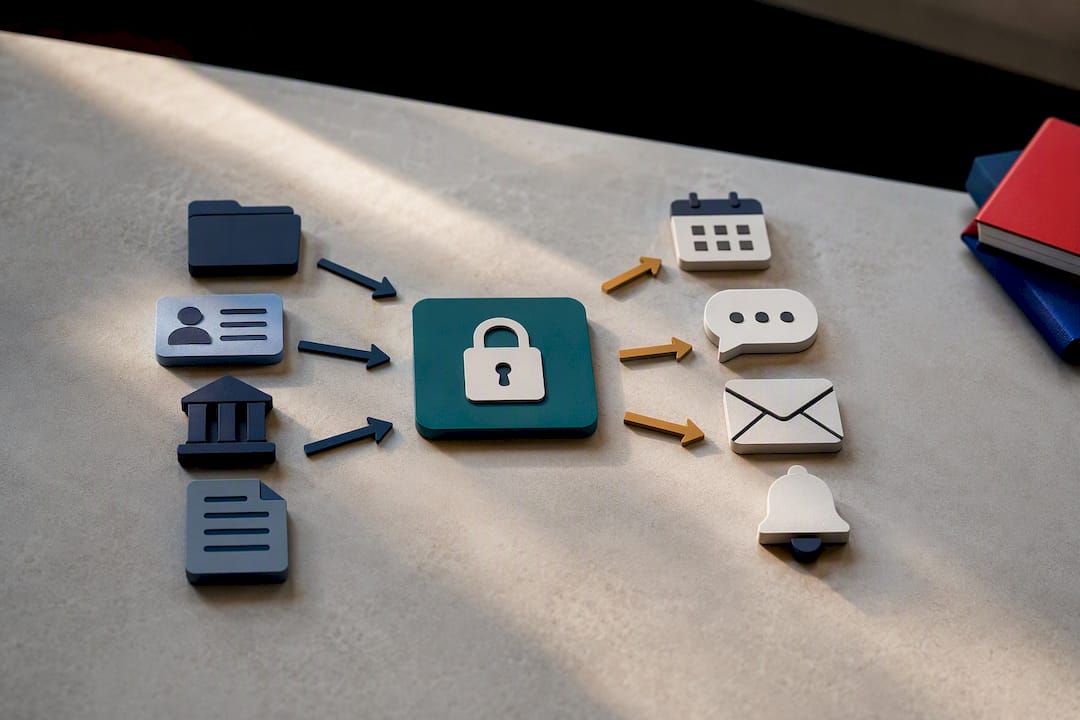
Every property needs one digital home, not three. That means one folder, one naming convention, and one place where every certificate, photo, and message about that address lives. The Residential Tenancies Board treats good record keeping as a practical necessity, not a formality, and a scattered inbox of attachments will not hold up if a deposit dispute reaches adjudication.
Structured checklists with clear ownership and deadlines convert scattered tasks into something repeatable. CheckFlow's property management research identifies recurring triggers, assigned ownership, and a timestamped audit trail as the three features that separate a working system from a pile of spreadsheets.
Build the operating system around these habits:
Name every file with a date prefix and property code (e.g. 2026-03-14_UnitB2_GasCert.pdf), so anyone can find it without asking.
Assign a named owner and a deadline to every checklist step, not just a department.
Set escalation rules: if a step is overdue by 48 hours, it routes to a second person automatically.
Capture evidence at the point of action: photos at move-in and move-out, a signed inventory, a timestamped inspection report.
Retain records for at least the statutory tenancy period, plus a buffer for late-filed disputes.
Pro Tip:Photograph every meter reading and existing defect on the day you hand over keys, not the week before. A dated photo beats a verbal claim every time a deposit gets contested.
Which software features actually support these workflows?
Most property platforms are built to move money and log maintenance requests. Fewer of them handle the operational backbone: the recurring checklist, the conditional branch, the audit trail that proves a step happened on a specific date. Real estate portfolio software is strong on visibility, centralising rent collection and compliance reminders, but it often lacks native SOP documentation and the conditional logic that lets a checklist branch depending on what happens.
That gap matters more as a portfolio grows. Map your needs against this feature list before choosing or configuring a tool:
Document control, so certificates, inventories, and signed agreements sit in one searchable place per property.
Recurring checklists with triggers, so a lease signature or a notice period automatically starts the right sequence.
Task assignment with deadlines, so nothing depends on someone remembering.
Tenant chat tied to the property record, not a personal WhatsApp thread that disappears when someone changes phones.
A rent ledger and a simple profit-and-loss view per unit, so you can see which properties earn their keep.
Bulk import and team accounts, essential once you are managing more than a handful of units or working with more than one person.
For a growing portfolio, mixing a dedicated checklist tool with a property marketplace platform often works better than expecting either to do everything. If you are still self-managing across spreadsheets and group chats, the guide to managing multiple rental properties online walks through where that split typically breaks down.
How do you automate rental workflows without losing control?
Automation earns its keep fastest in three places: tenant screening triage, inspection scheduling, and turnover notifications. Start with these three pilots and measure the effect before expanding further.
Screening triage. Auto-sort applications by completeness (documents present, references confirmed) before a human reviews the shortlist.
Inspection scheduling. Trigger a reminder and calendar invite automatically at fixed intervals, so inspections never rely on memory.
Turnover notifications. Fire a move-out checklist and vendor booking request the same day notice is received, not the week after.
Conditional logic should handle safety-critical branching without waiting on a person. A failed smoke alarm test, for example, should route straight to an emergency contractor and notify the owner. Payment approvals and tenancy decisions should still require a human sign-off, even inside an automated workflow.
Pro Tip:Never ask a tenant or contractor to send identity documents, bank details, or payslips through open chat. Route anything sensitive through a secure upload flow with consent, and keep the chat thread for scheduling and updates only.
What KPIs and meeting rhythm keep a rental team accountable?
A portfolio without a review rhythm drifts. Set a weekly, monthly, and quarterly cadence and stick to it.
Weekly: Review open maintenance tickets, upcoming inspections, and any arrears over seven days.
Monthly: Check net cash flow per unit, vacancy days, and the ratio of reactive to planned maintenance.
Quarterly: Review renewal pipeline, turnover costs per unit, and update SOPs based on what broke last quarter.
The KPIs worth tracking every month are net cash flow per unit, vacancy days, turnover cost, the reactive-versus-planned maintenance ratio, and arrears days. For a small team, a simple role matrix works: one person owns applications and screening, one owns maintenance and vendors, one owns finance and compliance. New staff should onboard against the written SOP, not a verbal handover, so the process survives staff turnover as well as tenant turnover.
How do you stress-test a rental portfolio for risk?
Model your portfolio against interest-rate and vacancy shocks the way professional asset managers do, using scenario modelling around 1%, 2%, and 3% rate movements paired with 30, 60, and 90-day void periods. Run the numbers on your worst three units, not your average, since that is where a shock actually bites first.
Each month a unit sits vacant costs 8 to 10% of its annual rent, and the average baseline turnover cost is roughly $1,750 per unit. A portfolio with weak turnover workflows bleeds money quietly, one empty month at a time.
Build these checks into your compliance calendar:
Track revenue concentration by location and tenant profile, so one bad tenant or one flooded postcode cannot sink the whole portfolio.
Keep a rolling compliance calendar for certificate renewals, deposit registration deadlines, and inspection due dates.
Retain financial and tenancy records well beyond the statutory minimum; disputes rarely surface on schedule.
Budget a maintenance reserve using the reactive-versus-planned ratio as your early warning signal, since reactive spend above roughly 70% of total repairs signals an asset starting to decline.
A rental cash flow calculator is worth running these scenarios through before you commit to a number on paper.
How does Hauzed support these portfolio workflows?
Hauzed is built around the same operating-system logic this guide recommends: one place to run the workflow instead of three disconnected tools. Its features map directly onto the checklist needs above:
Verified tenant profiles reduce the screening workload described in the application phase.
Secure, consent-based document flows keep sensitive uploads out of open chat.
In-app chat and visit scheduling keep the move-in and active-tenancy record in one thread per property.
Hauzer suggests tenant matches, Echo handles follow-up replies, and Lia supports leasing conversations, each reducing manual message handling.
Team accounts and bulk publishing suit agencies managing turnover across several properties at once.
Verification improves trust; it does not guarantee a tenant will be approved or that a message will get a reply. AI suggestions from Hauzer, Echo, and Lia need a human glance before anything gets sent. Check current plan limits on the product page before you commit, and pilot the change on two properties before rolling it across the whole portfolio.
What success looks like after you standardise workflows
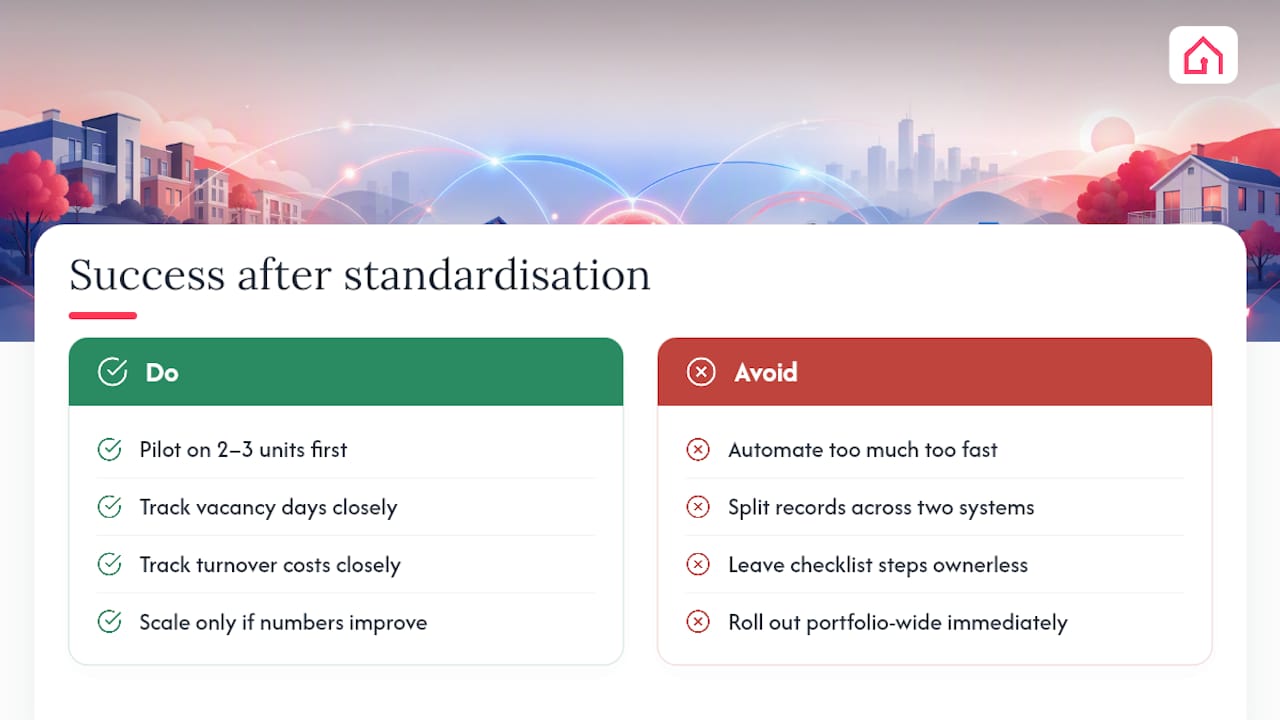
Standardised rental portfolio workflows tend to show up first in turnover speed and second in fewer disputes, since a photographed inventory and a signed checklist settle most deposit arguments before they start. The common failure mode is not too little automation. It is automating too much too fast, splitting records across two systems, or leaving a checklist step with no named owner.
Run the change on a small cohort first, perhaps two or three units, and watch vacancy days and turnover cost before scaling. If the numbers move in the right direction there, they will move the same way across the rest of the portfolio.
— Hauzed
Try mapping your workflows with Hauzed
Hauzed gives you a faster route to the same operating system this guide describes, without stitching together a checklist app, a listings site, and a group chat. It handles verified tenant leads, in-app chat and scheduling, and AI-assisted matching and follow-up through Hauzer and Echo, so the screening and communication steps in your workflow run from one place instead of three.
If you manage more than a handful of units, team accounts and bulk publishing features are built for higher turnover and onboarding loads. Start smaller if you are not sure: pilot one or two properties on the Free or Pro plan, watch how much manual filtering and follow-up disappears, and decide from there whether to move the rest of the portfolio across.
Sources
For statutory obligations, see the Residential Tenancies Act. For a practical checklist framework, see CheckFlow's property management guide. For the cost trade-off of hiring an agent, see Howley Souhan's 2025 landlord cost breakdown.
The 2% rule suggests monthly rent should equal roughly 2% of a property's purchase price for strong cash flow, though it is a rough screening tool rather than a guarantee of profitability, and few properties in high-demand urban markets meet it.
What is a good cash flow model for a rental property?
A solid model tracks net cash flow per unit after mortgage, maintenance reserve, and vacancy allowance, then stress-tests that figure against 30 to 90-day void scenarios and one to three percentage point interest-rate rises.
Do portfolio landlords get better rates from letting agents?
Larger portfolios often negotiate lower percentage fees than a single-property landlord because agents value the recurring volume, though the typical range still sits around 5% to 15% of collected rent depending on the service level.
What are the four main types of portfolio management services?
Portfolio management services generally split into self-management with software support, full-service letting agents, hybrid models where an agent handles specific tasks like screening or maintenance, and marketplace platforms such as Hauzed that combine verified tenant matching with landlord-controlled workflows.
How often should rental property inspections happen?
Most active tenancy checklists schedule inspections every three to six months, timed to coincide with routine maintenance checks so a single visit covers both safety and condition review.