Reverse search rental photos: your scam-busting guide
11 July 2026
10 min read
Learn how to reverse search rental photos to verify listings and avoid scams. This quick guide helps you spot fraudulent rentals easily.
Reverse image search is the fastest method available to verify whether rental property photos are genuine, recycled, or stolen. The technique, formally called reverse image lookup, takes less than one minute and can expose fraudulent listings before you hand over a single penny. Rental scams are a serious and growing problem across the UK and Ireland, with bodies such as Action Fraud and The Property Ombudsman regularly warning renters about fake listings. This guide walks you through every step of the process, from choosing the right tool to interpreting your results and knowing what to do if something looks wrong.
What tools do you need to reverse search rental photos?
Three free tools cover the vast majority of property photo lookup needs: Google Images, TinEye, and Bing Visual Search. Each works slightly differently, and using more than one gives you a more complete picture.
Google Images is the most widely used option. You can upload a photo directly, paste an image URL, or drag and drop a file into the search bar at images.google.com. Google's index is enormous, so it catches recycled photos that appear across multiple listing sites, estate agent pages, and social media. TinEye specialises in exact image matching and is particularly good at finding older copies of the same photo. It shows you when an image first appeared online, which is useful for spotting photos that predate the current listing by months or years. Bing Visual Search rounds out the trio with strong results for property and interior images.
Before you search, you need the image in the right format. Save the photo to your device, copy its URL directly from the listing, or take a screenshot if the site prevents downloading. All three tools accept uploaded files and URLs.
Pro Tip:On a mobile device, open Chrome, press and hold the listing photo, then select "Search image with Google." This skips the download step entirely and gets you results in seconds.
How to reverse search rental photos step by step
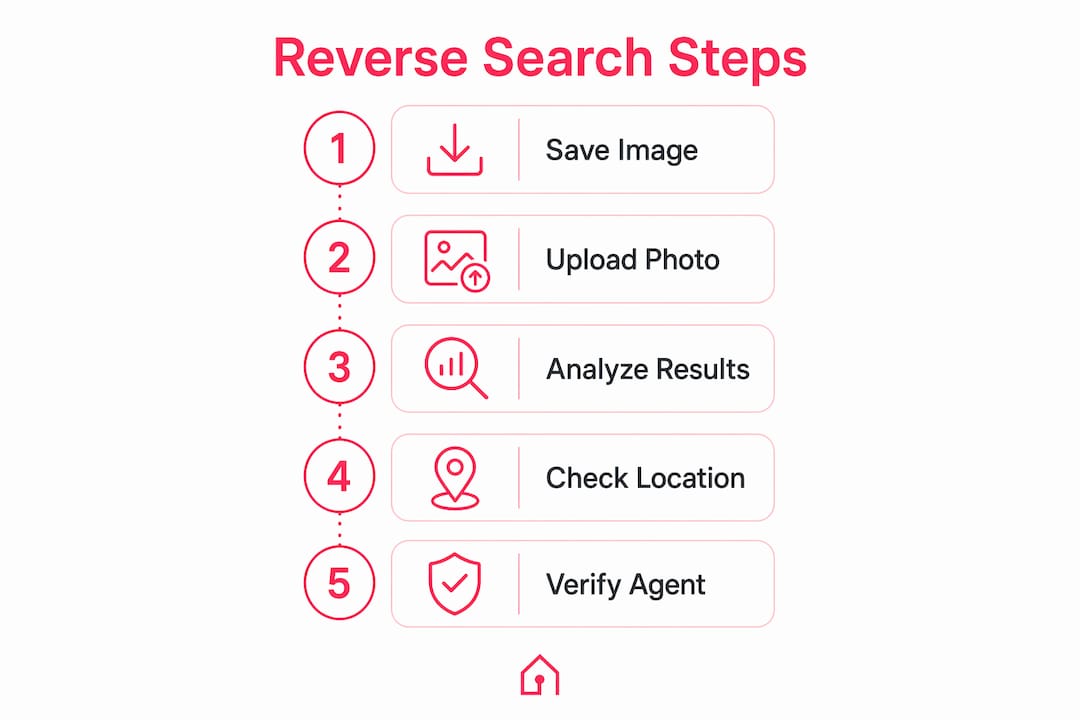
A clear process makes the difference between a quick check and a thorough one. Follow these steps each time you want to find rental images and verify their origin.
Open the listing and identify the photos. Look at every image in the gallery, not just the hero shot. Scammers sometimes use genuine photos for the exterior and recycled images for the interior.
Save or copy each photo. Right-click and save the image, or copy the image URL from your browser's address bar after opening the photo in a new tab.
Open Google Images at images.google.com and click the camera icon in the search bar.
Upload the image or paste the URL. Google will return visually similar results within seconds.
Scan the results carefully. Look for the same photo appearing on unrelated websites, furniture showroom catalogues, stock photo libraries, or listings in a completely different city or country.
Repeat with TinEye for any photo that raises doubt. TinEye's date history tells you whether the image existed long before the current listing was posted.
Cross-reference with satellite and street view tools. Open Google Maps or Apple Maps, search the listed address, and compare the exterior photo in the listing against the street view image.
Interpreting your results correctly is just as important as running the search. A photo appearing on a furniture retailer's website or a holiday rental platform is a strong sign it has been lifted and reused. A photo that appears in listings for two different addresses in two different cities is an almost certain indicator of fraud.
Pro Tip:If the listed address does not match the building visible in street view, stop immediately. Do not contact the advertiser further until you have independently verified the property exists at that location.
What are the red flags to watch for in your results?
Scammers reuse genuine photos across multiple fake listings in different locations. Finding the same image attached to a property in Dublin and another in Manchester is a definitive warning sign.
The trickier problem is AI-generated imagery. Sophisticated fraudsters now create images with no online footprint at all, meaning a reverse image search returns zero results. A clean result does not automatically mean the listing is genuine. If the photos look unusually perfect, with flawless lighting and no personal items visible anywhere, treat that as a reason to dig deeper rather than a reason to relax.
Watch for these specific red flags in your search results:
The same photo appears on a furniture showroom, hotel, or holiday rental site.
The image is attached to a listing in a different city or country.
The photo appears on a property portal under a different address.
The listing image was first indexed online years before the current advert was posted.
The reverse search returns no results at all for a photo that looks professionally staged.
Pressure to pay quickly is one of the clearest scam signals you will encounter. Legitimate landlords never rush tenants past formal viewing and contract processes. Any request for an immediate deposit transfer, before you have viewed the property in person and signed a tenancy agreement, is a major red flag. Treat urgency as a warning, not a reason to act fast.
UK councils can fine landlords or agents up to £7,000 for prohibited rental bidding practices. That regulatory context matters because it shows the UK government takes deceptive rental tactics seriously, and you have official channels available to you if things go wrong.
How do you verify a landlord or agent alongside photo checks?
Photo verification is one layer of protection. Verifying the person behind the listing is equally important. Listings on reputable portals can still be fake. The platform itself is not a guarantor of the landlord's identity.
Legitimate letting agents are registered with official redress schemes. Check the agent's name against the registers of The Property Ombudsman, Propertymark, or SafeAgent. These are publicly searchable databases, and the check takes under two minutes. If the agent's name does not appear, do not proceed.
The table below compares the main verification methods by reliability and ease of use.
Verification method
Reliability
Time required
Reverse image search
High for recycled photos
Under 1 minute
Agent redress scheme check
Very high
Under 2 minutes
In-person property viewing
Definitive
Varies
Satellite and street view check
Moderate
Under 2 minutes
Tenancy deposit scheme confirmation
Very high
Under 5 minutes
Never transfer a deposit or advance rent for a property you have not viewed in person. Requests for early payment before a viewing are a primary scam indicator. Genuine landlords and agents follow a clear process: viewing first, references second, contract third, deposit last.
Understanding deposit protection is also part of this layer. In the UK, landlords must place deposits in a government-backed tenancy deposit protection scheme within 30 days of receipt. If a landlord cannot name the scheme they use, that is a serious concern.
Pro Tip:Always find the agent's or landlord's contact details independently. Search the agency name on Companies House or Google, then call the number you find there. Do not rely solely on the contact details provided in the listing itself.
What should you do if you suspect a rental scam?
Act quickly and do not transfer any money. The steps below give you a clear path forward.
Stop all communication with the suspected fraudster. Do not share any further personal information, documents, or financial details.
Report the listing to the platform where you found it. Most major portals have a "report this listing" button.
Contact Action Fraud on 0300 123 2040 or via actionfraud.police.uk. Keep all evidence of communications, screenshots, and any payment records before reporting.
Consider Cifas Protective Registration if you have already shared personal documents. This service alerts lenders and organisations to check more carefully before opening accounts in your name.
Monitor your credit file through a credit reference agency for any unusual activity in the weeks following the incident.
Share your findings with trusted friends, family, or online renter communities. Alerting others reduces the chance that the same scam catches someone else.
Learning to identify fake rental listings is a skill that protects you throughout your entire rental search, not just on one occasion.
Key takeaways
Reverse image search, combined with agent verification and an in-person viewing, is the most reliable defence against rental photo fraud.
Point
Details
Use multiple search tools
Run checks through Google Images and TinEye to catch both broad and exact image matches.
AI images need extra scrutiny
Zero search results for a staged photo is a warning sign, not a clean bill of health.
Verify the agent independently
Check The Property Ombudsman or Propertymark registers before sharing any personal data.
Never pay before viewing
Any request for a deposit before an in-person viewing is a definitive scam indicator.
Report immediately
Contact Action Fraud on 0300 123 2040 and keep all evidence of suspicious communications.
The honest truth about photo verification
At Hauzed, we see renters make the same mistake repeatedly. They run a reverse image search, find nothing suspicious, and assume the listing is safe. That assumption is the gap that sophisticated scammers now exploit.
AI-generated property images have no online history. They will not appear in any reverse image search because they were never published anywhere before. The tool that catches recycled photos is blind to images that were created specifically for one fraudulent listing. That is a real limitation, and pretending otherwise does renters a disservice.
The honest approach is to treat photo verification as the first filter, not the final one. It removes the obvious fakes quickly. What it cannot do is confirm that a real property exists at the listed address, that the person advertising it has the right to rent it, or that the price is legitimate. Those questions require an in-person viewing, an agent registration check, and a signed tenancy agreement through proper channels. Layered verification is not overcaution. It is the only approach that actually works. Scam tactics evolve faster than any single tool can keep up with, and the renters who stay safe are the ones who treat every unverified listing with the same healthy scepticism, regardless of how professional it looks.
— Hauzed
Safer rental searching starts with Hauzed
Knowing how to verify rental photos is a powerful skill. Applying it consistently while searching through anonymous, unverified channels is still exhausting and risky.
Hauzed is a trust-first rental marketplace built for renters who want more than a list of photos and a phone number. Every listing on Hauzed connects you with verified landlords and agents, so the person behind the property is real before you even start a conversation. You can search verified rentals and build a stronger tenant profile that helps you stand out to landlords, all without relying on anonymous portals or informal channels. If you want a rental search that starts with trust rather than hoping for it, Hauzed is built for that.
FAQ
How long does a reverse image search take?
A reverse image search on rental photos takes less than one minute. Upload the photo or paste its URL into Google Images or TinEye and results appear within seconds.
Can reverse image search detect AI-generated rental photos?
No. AI-generated images have no online footprint, so they return zero results. Always combine a photo lookup with satellite map checks and an in-person viewing.
What does it mean if the same rental photo appears in multiple listings?
Finding the same photo across multiple listings or in different cities is a strong indicator of fraud. Genuine landlords do not reuse the same photos for different properties or addresses.
How do I verify a letting agent is legitimate?
Check the agent's name on the registers of The Property Ombudsman, Propertymark, or SafeAgent. Legitimate agents are registered with at least one official redress scheme, and the check is free and publicly available.
Where do I report a suspected rental scam in the UK?
Report to Action Fraud on 0300 123 2040 or at actionfraud.police.uk. Also report the listing directly to the platform where you found it, and keep all evidence of communications and any payments made.