Tenant profile for renters: how it improves applications
27 July 2026
19 min read
Discover the role of tenant profile in renting: speed up your applications, boost your appeal to landlords, and streamline the process.
A tenant profile is a reusable, evidence-based rental CV that bundles your identity documents, affordability evidence, and references into one portable record you can share with multiple landlords or agents. The role of a tenant profile in renting is straightforward: it shortens the time a landlord needs to make a decision, signals that you are a prepared and serious applicant, and reduces the repetitive document-gathering that slows down most applications.
Three immediate benefits for you as a renter:
Speeds decisions — landlords and agents can assess your suitability before a viewing, not after.
Signals readiness — a completed profile tells a landlord you are organised and unlikely to drop out.
Reduces duplicated checks — one verified record replaces repeated submissions across multiple applications.
For landlords, a verified tenant profile acts as a trust signal before any formal referencing begins. It does not replace a credit check or a Right to Rent check, but it meaningfully reduces the administrative friction of early-stage screening.
#what is a tenant risk profile#role of tenant profile in renting#what is a tenant profile#how tenant profile affects leases#tenant screening process#evaluating tenant profiles#profile checks for renters#landlord and tenant relationships#tenant character assessments#why tenant profiles matter#importance of tenant profile#tenant demographics and renting#impact of tenant reputation
A tenant profile is not the same as a one-off rental application or a simple covering letter. Think of it as a rental passport: a pre-assembled, portable document set that you build once and reuse across multiple applications. According to Property Passport UK, a rental passport consolidates identity verification, affordability evidence, credit checks, and landlord references into a single shareable record, with validity lasting several months depending on the provider.
Common formats include:
Portable rental passport — a platform-hosted profile with a secure shareable link; ideal for fast-moving markets where properties re-let within days.
PDF portfolio — a self-assembled document pack; useful for international applicants who need to share credentials across borders.
Agent-hosted referencing report — a formal report produced by a referencing agency such as a letting agent's preferred provider; common in professional lets.
Platform profile — a digital profile on a rental marketplace where identity and documents are verified in-app.
Student lets often accept lighter-touch profiles (guarantor letter plus student ID), while professional and family lets typically require the full set. If you are applying in a high-demand city where properties move fast, a pre-verified platform profile gives you the clearest advantage.
Pro Tip:Build your profile before you start searching, not after you find a property you like. In competitive markets, the window between viewing and offer can be under 48 hours.
What to include in a UK tenant profile
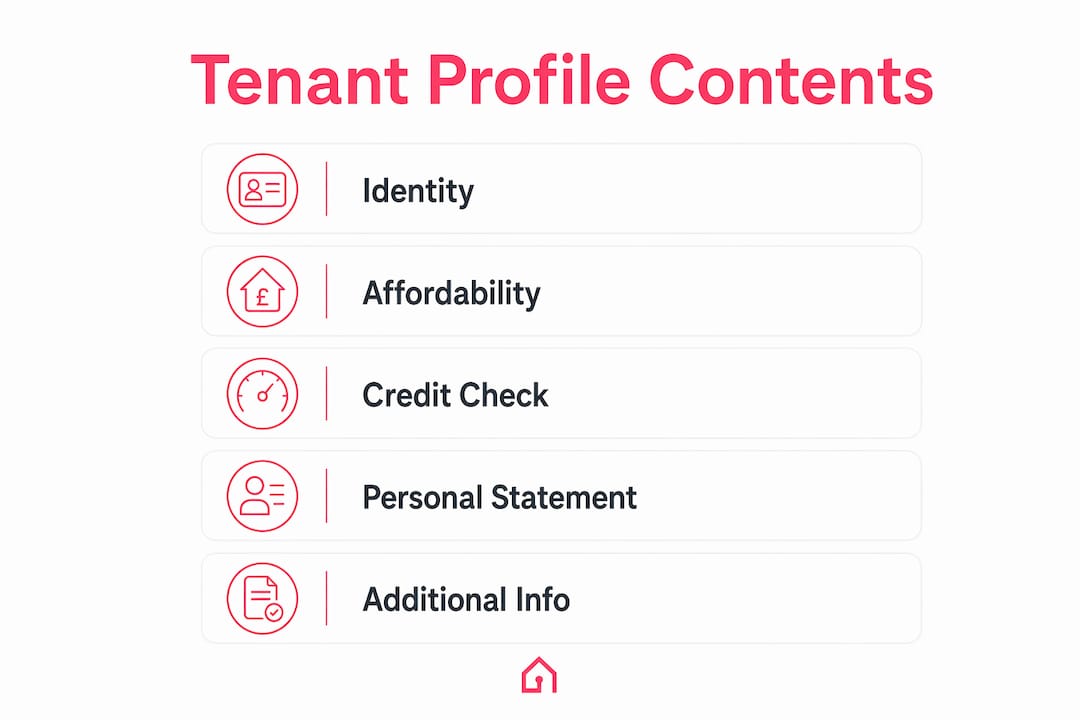
A well-built profile covers five core areas. The table below maps each document to its purpose and what landlords typically look for.
Document
Purpose
What landlords check
Passport or driving licence
Identity and Right to Rent
Photo matches applicant; document is in date
UKVI share code (where applicable)
Right to Rent for non-UK nationals
Home Office status confirmed online
3 months' payslips
Affordability
Net pay consistent; matches bank credits
3 months' bank statements
Income and outgoings
No payday loans; salary credits match payslips
SA302 or accountant letter
Self-employed income
Two to three years of confirmed earnings
Employer reference
Employment status
Permanent contract; salary matches application
Previous landlord reference
Tenancy behaviour
Rent paid on time; no formal notices served
Credit check report
Financial history
No undisclosed CCJs, IVAs, or active insolvency
Guarantor details (if needed)
Affordability backstop
Guarantor income typically 30x monthly rent
A common affordability threshold used by referencing agencies is that your gross annual income should be at least 30 times the monthly rent, ensuring your earnings comfortably cover rental costs. If you fall short, a guarantor or additional months' rent in advance can bridge the gap.
Beyond the financial documents, a short personal statement (three to five sentences) and a note about any pets or additional occupants rounds out the picture. Landlords are not just assessing risk; they are also trying to imagine who will be living in their property.
Pro Tip:For sensitive documents such as bank statements and SA302 tax extracts, always upload via a secure provider portal rather than attaching them to an email. Keep a redacted copy for your own records and explain to the landlord why certain fields are redacted.
The second table below shows which documents are legally required versus strongly recommended.
Document
Status in UK lettings
Right to Rent evidence
Legally required in England before tenancy starts
Photo ID
Required for identity verification
Payslips or income proof
Required by most referencing agencies
Bank statements
Required by most referencing agencies
Previous landlord reference
Strongly recommended; most predictive single check
Credit check
Required by most agents; tenant can self-supply
Personal statement
Optional but useful in competitive markets
What does an example tenant profile look like?
A concise tenant profile summary might read like this:
Paired with that summary, your document list would include:
Passport (copy, dated and signed)
UKVI share code (if applicable)
Three months' payslips
Three months' bank statements (PDF originals)
Employer reference on company letterhead
Previous landlord reference with contact details
Credit check report (self-supplied or via a referencing provider)
Tailor the profile to the letting type. A student applying for a house share needs a guarantor letter and proof of enrolment rather than payslips. A family applying for an unfurnished property might add a note about long-term plans and school catchment preferences. A furnished short-let applicant may need to show a higher income multiple to offset the premium rent.
Pro Tip:Save your profile as a clearly named PDF ("YourName_TenantProfile_2026.pdf") and keep a master folder with originals. When you update a document, replace it in the folder and re-export the PDF so the version you share is always current.
How landlords and agents use tenant profiles during screening
Landlords and agents follow a broadly consistent sequence when reviewing applications. Understanding that sequence helps you see exactly where your profile makes a difference.
The typical screening steps are:
Identity verification — confirm the applicant is who they say they are, using photo ID cross-checked against the application.
Right to Rent check — a separate legal duty in England; every adult occupier must be checked before the tenancy begins, using a passport, driving licence, Biometric Residence Permit, or a UKVI share code for an online check.
Affordability check — payslips, bank statements, and employer reference are reviewed together; inconsistencies between the three are a common reason for referral.
Credit and reference checks — a formal check via Experian, Equifax, or TransUnion flags CCJs, IVAs, and active insolvency; referencing providers commonly pull three years of credit history.
Previous landlord reference — widely regarded as the most predictive single check; agents verify the landlord's identity against the Land Registry before treating the reference as reliable.
A pre-assembled profile compresses the early stages of this process. When an agent can see verified ID, a credit report, and a landlord reference before the first conversation, the time to decision shrinks considerably. That matters most in portfolios where an agent is managing several properties simultaneously.
Even with a strong profile, landlords will still run their own formal checks. Thorough tenant referencing remains the single most effective way to reduce rent arrears and tenancy disputes, and with Section 21 no-fault evictions abolished under the Renters' Rights Bill, pre-tenancy checks carry more weight than ever.
Screening stage
What your profile provides
What landlords still run independently
Identity
Verified photo ID
Right to Rent check (legal duty)
Affordability
Payslips, bank statements
Employer reference verification
Credit history
Self-supplied credit report
Formal bureau check (Experian, Equifax, TransUnion)
Tenancy behaviour
Previous landlord reference
Cross-check against Land Registry
AML / fraud
Platform verification
AML search where required
Practical ways a strong tenant profile improves your chances
The importance of a tenant profile becomes clearest in a competitive market. Pre-verified profiles can be decisive when properties re-let in under 48 hours, because agents interpret a completed profile as lower administrative risk and are more likely to prioritise that applicant for a viewing.
Concrete tactics that make a real difference:
Pre-verify your documents before you start applying, not mid-process. A profile that is 90% complete creates more friction than no profile at all.
Obtain your landlord reference before you move out. Once you have handed back the keys, chasing a reference becomes harder and slower.
Include a short cover note with each application explaining any anomalies — a gap in employment, a CCJ that has been satisfied, a period of self-employment. Transparency handled upfront is far less damaging than a landlord discovering it during a check.
Address non-standard income early. If you are self-employed, include your SA302 and an accountant's letter alongside bank statements showing consistent credits. If your income is variable, show a 12-month average rather than the most recent three months.
A strong profile also gives you modest negotiation leverage. When a landlord has confidence in your finances and references, there is more room to agree a preferred start date, negotiate a minor repair before move-in, or discuss a longer tenancy term. None of that is guaranteed, but it is far more likely when the landlord is not still waiting on documents.
Pro Tip:If you have a thin credit file (common for recent graduates or international arrivals), screen tenants before renting guides explain how open banking statements showing consistent salary credits can carry more weight than a sparse credit report. Ask your referencing provider whether they accept Open Banking verification.
Common red flags landlords find and how to address them
Most red flags are manageable when you address them honestly and early. Hiding a problem rarely works; referencing checks are thorough, and a landlord who discovers an undisclosed issue during a check is far less likely to proceed than one who was told about it upfront.
Frequent issues and their remedies:
Recent CCJs or defaults — provide a written explanation with supporting evidence (settlement letter, proof of payment). A CCJ that has been satisfied and disclosed is treated very differently from one discovered during a check.
Short or patchy rental history — supply character references from an employer or a professional contact, and consider offering one to two months' additional rent in advance to reduce perceived risk.
Inability to prove income — self-employed applicants should provide SA302 forms, an accountant's letter, and 12 months of bank statements. Open Banking checks, where a provider has direct read-only access to transaction history, can also demonstrate consistent income.
Missing Right to Rent evidence — if your documents are with the Home Office (e.g., a pending visa renewal), use the Landlord Checking Service to obtain a Positive Verification Notice before applying.
Guarantor concerns — if your guarantor is also self-employed or has a thin credit file, provide their SA302 and bank statements alongside the deed of guarantee.
Hybrid referencing models are common in practice: agents frequently override an automated rejection when an applicant supplies secondary evidence or a clear written explanation. The key is to give the agent something concrete to work with rather than leaving a gap in the file.
UK legal and privacy points every renter should know
Right to Rent is a legal requirement in England. Before granting a tenancy, landlords must check that every adult who will live in the property as their only or main home has the right to rent in the UK. Acceptable documents include a valid passport, a UK driving licence, a Biometric Residence Permit, or a UKVI share code for an online check. Landlords must keep a dated copy of the check. Scotland, Wales, and Northern Ireland operate under separate arrangements.
GDPR responsibilities apply to landlords and agents as data controllers. They must tell you what personal data they are collecting, why they need it, and how long they will keep it. You have the right to request deletion of your data once a tenancy application concludes. Referencing agencies registered with the ICO and FCA, such as RentProfile (ICO and FCA registered, GOV.UK recognised), operate under these obligations.
Key legal points for tenants and small landlords:
Tenant Fees Act 2019 — landlords and agents cannot charge tenants for referencing checks. Any referencing cost must be borne by the landlord or agent.
Equality Act 2010 — landlords cannot refuse an application on grounds of race, sex, religion, disability, sexual orientation, or other protected characteristics. Blanket "no benefits" policies are likely to constitute indirect discrimination and should be avoided.
Secure document submission — bank statements and tax documents should be submitted via secure portals, not unsecured email. If a landlord asks you to send sensitive documents by email, ask whether they have a secure upload option instead.
Pro Tip:Ask any referencing provider or agent for their data retention policy before you submit documents. Under UK GDPR, they must provide this on request. If they cannot, treat that as a warning sign about their data-handling practices.
Research note: algorithmic screening, fairness, and what it means for you
Algorithmic tenant profiling is increasingly common, particularly among larger agencies managing high volumes of applications. Speed and consistency are the main advantages: automated tools can cross-reference identity, credit, and income data in minutes rather than days.
University of York research highlights a significant concern alongside those benefits: data-driven risk profiling can create "digital exclusion" for applicants who do not fit the typical "ideal professional" data profile. Tenants with non-standard income, thin credit files, or gaps in rental history may be automatically flagged or rejected by systems that were not designed with their circumstances in mind.
Statistic callout: Practitioners report that pre-verified rental passports often shift the initial burden of referencing to the tenant and can be the decisive factor in high-demand markets where agents are processing dozens of applications simultaneously.
The practical implication for you: a strong, pre-verified profile gives you more control over how you are presented to an automated system. Rather than waiting for an algorithm to pull incomplete data, you supply the complete picture upfront.
For landlords and agents, the AI matching and algorithmic profiling tools that speed up screening work best when paired with consistent human review for edge cases. Automated flags should prompt a conversation, not an automatic rejection.
Pro Tip:If you receive an unexplained rejection after submitting a strong profile, ask the agent in writing whether an automated system was used and whether a human reviewed your application. Under UK GDPR, you have the right to request that a decision with significant effects on you is not made solely by automated means.
How to create your tenant profile step by step
Follow this sequence to build a profile you can reuse across multiple applications.
Gather your core documents — passport or driving licence, UKVI share code if applicable, three months' payslips, three months' bank statements (original PDFs), and your most recent P60 or SA302.
Verify your identity — use a platform that offers identity verification (such as Hauzed) or a referencing provider that issues a verified ID report you can share.
Request references — contact your current employer for a reference on company letterhead and ask your current landlord for a written reference before you give notice. Both take time; start early.
Run a soft credit check on yourself — services such as Experian or ClearScore allow you to view your own credit file without affecting your score. Resolve any errors before a landlord sees them.
Package your profile — compile documents into a clearly named PDF or upload them to a secure platform profile. Include a one-paragraph personal statement at the front.
Share securely — use a secure link from a platform profile, or send documents via a referencing provider's portal. Avoid attaching sensitive files to a standard email.
When sharing with an agent or landlord directly, a suggested subject line for your covering email is: "Tenant profile — [Your Name] — [Property Address]". Open with one sentence confirming your move-in timeline and income, then note that your full profile is attached or linked.
Rental passports typically remain valid for 3–6 months. Set a calendar reminder to refresh payslips, bank statements, and your credit report at the three-month mark, especially if you are in an active search.
Documents to refresh regularly:
Bank statements (rolling three months)
Payslips (rolling three months)
Credit check report (every three months)
Employer reference (if your role or salary has changed)
Key takeaways
A tenant profile is the single most practical step you can take to shorten the time between application and offer in the UK rental market.
Point
Details
Build before you search
Compile and verify your profile before applying so you can respond to listings within hours, not days.
Landlord reference is critical
The previous landlord reference is the most predictive single check; secure it before you move out.
Transparency on red flags
Disclose CCJs, gaps, or non-standard income upfront with supporting evidence — agents can override automated rejections when given context.
Know your legal rights
Under the Tenant Fees Act 2019, referencing costs cannot be passed to you; under UK GDPR, you control your data.
Hauzed supports verified profiles
Hauzed's trust-first marketplace lets tenants build verified profiles and share them with landlords, reducing anonymous applications and improving screening quality.
Hauzed's perspective on tenant profiles and trust
The rental market has a trust problem that no amount of listings solves on its own. Tenants send dozens of messages into a void; landlords sift through unverified enquiries hoping to find someone reliable. A verified tenant profile is the most direct fix for both sides of that equation.
At Hauzed, the focus on verified participation comes from a straightforward observation: the rental process works better when both parties are real and prepared before the first serious conversation. Identity verification increases trust, but it does not replace judgement. A verified profile tells a landlord that you exist and that your documents are genuine; it does not tell them whether you will be a considerate neighbour or pay on the first of the month without a reminder. That is why the most effective screening still combines a strong profile with a genuine previous landlord reference and a human review of any anomalies.
One thing worth saying plainly: automated screening tools are genuinely useful for managing volume, but they carry a real risk of excluding tenants who do not fit a narrow data template. Self-employed applicants, recent graduates, international arrivals, and anyone with a non-linear career history can look like a risk to an algorithm that was trained on salaried professionals. The answer is not to avoid automation; it is to pair it with consistent human review and written selection criteria that can be explained and defended. That is the approach Hauzed takes with its AI matching tools, and it is the approach any responsible landlord or agent should take.
Further reading and useful UK sources
Short, annotated references for tenants and landlords who want to go deeper.
GOV.UK — RentProfile case study — explains how landlord verification and tenant checks work in practice, with context on fraud prevention in the private rented sector.
Property Passport UK — rental passport guide — practical walkthrough of what a rental passport includes, how long it stays valid, and how to share it securely.
LetSafe UK — tenant referencing guide — covers affordability checks, Right to Rent, GDPR obligations, and the impact of the Renters' Rights Bill on referencing practice.
University of York — digital tenant research — academic research on algorithmic profiling in the private rented sector and the fairness risks for non-standard applicants.
Renting Evidence — algorithmic referencing — practitioner analysis of how automated referencing tools are used and where human oversight remains necessary.
Hauzed — tenant screening checklist — step-by-step checklist for landlords applying consistent vetting criteria and maintaining lawful referencing processes.
Source
Best for
GOV.UK RentProfile case study
Understanding fraud prevention and landlord verification
Property Passport UK
Building and sharing a portable rental passport
LetSafe UK referencing guide
Landlord legal duties and affordability thresholds
University of York research
Algorithmic screening risks and fairness considerations
Renting Evidence blog
Practitioner insight on automated versus human review
Hauzed screening checklist
Practical landlord checklist for consistent, lawful vetting
Verified renting, without the chaos
Most tenants spend weeks sending the same documents to different landlords, each time starting from scratch. Hauzed is built around a different idea: that a verified, pre-assembled profile should travel with you, not get rebuilt for every application.
On Hauzed, tenants can verify their identity, strengthen their rental profile, and connect with landlords who are already expecting verified applicants. There is no anonymous message in a crowded inbox; there is a profile that speaks for you before the first conversation. Landlords and agents on the platform use AI matching tools to find suitable tenants faster, which means your verified profile gets seen by the right people rather than buried under unverified enquiries.
Hauzed is free for tenants. If you are ready to build a profile that actually works in a competitive market, start your search on Hauzed and complete your verification in the onboarding flow.
FAQ
What is a tenant profile?
A tenant profile is a reusable, pre-verified record that bundles your identity documents, affordability evidence, credit history, and landlord references into one portable file you can share with multiple landlords or agents. It is sometimes called a rental passport.
What should you include in a tenant profile?
A complete UK tenant profile includes photo ID (passport or driving licence), Right to Rent evidence, three months' payslips and bank statements, an employer reference, a previous landlord reference, and a credit check report. Self-employed applicants should also include an SA302 or accountant's letter.
What are the most common red flags landlords look for?
Undisclosed CCJs, active insolvency, inconsistencies between payslips and bank statements, a previous landlord who confirms arrears or formal notices, and a refusal to provide standard documents are the most common reasons an application is declined.
How does RentProfile work?
RentProfile is an ICO and FCA registered referencing service, recognised by GOV.UK, that verifies landlord identity using Land Registry records and provides tenant referencing checks. Tenants can verify a landlord's property ownership for free; landlords can run tenant checks through the platform.
How long does a tenant profile stay valid?
A pre-verified rental passport typically remains valid for 3–6 months, depending on the provider. You should refresh payslips, bank statements, and your credit report at the three-month mark if you are still actively searching.