5 Steps to Shortlisting Tenants Landlords Can Defend
30 August 2026
12 min read
A five-step checklist landlords can apply to every applicant: set written eligibility rules, verify ID, assess affordability and references, use weighted...
Shortlisting tenants comes down to one discipline: write your screening criteria before you meet a single applicant, then apply them in the same order every time. Run identity verification, affordability checks, and previous landlord references concurrently, before viewings where you can. If you're staring at a pile of applications right now, pull out your criteria sheet and score each one against it today, not tomorrow.
TL;DR:
Running identity, affordability, and reference checks concurrently before viewings significantly reduces time wasted on unqualified applicants.
Consistent, written screening criteria and documented decisions protect landlords from legal risks and help defend against discrimination claims.
The most reliable indicator of tenant reliability is comprehensive reference checks, including verification from the penultimate landlord, combined with thorough identity validation.
Using weighted scoring for applicants ensures fair comparison, with deposit size or lease length as acceptable tie-breakers and avoiding decisions based on personal bias.
Automated tools like Hauzed facilitate verified tenant profiles, streamline communication, and support fair, compliant screening processes without added administrative burden.
#tenant no shows#tenant evaluation checklist#how to choose tenants#criteria for tenant screening#screening applicants for rental#shortlisting tenants#landlord tenant interview questions#best practices for tenant shortlist#tenant selection process
Related Articles
5 Steps to Shortlisting Tenants Landlords Can Defend | Hauzed
A proper tenant selection process is a written, repeatable sequence you apply to every applicant without exception. It's the difference between "I liked them" and being able to explain, months later, exactly why you chose the tenant you did. Landlords who skip this step tend to make decisions on gut feeling during a viewing, then scramble to justify it afterwards. That's backwards, and it's also where legal exposure creeps in.
Here's the sequence that holds up under scrutiny:
Draft your eligibility rules first and keep them written down. Minimum income multiple, acceptable credit history, right to rent status, pet policy. Decide this before you see a single face.
Use a standard application form for everyone. Request identity documents and proof of income upfront, not halfway through negotiations.
Run identity verification and a basic affordability screen before viewings, where your process allows it. This filters out unqualified enquiries before you've spent an evening showing the property.
Request previous landlord and employment references concurrently, not sequentially. Waiting for one before starting the other wastes days you don't have in a competitive market.
Record timestamps and keep a single evaluation sheet per applicant. Note when documents arrived, when you called referees, and what they said.
This isn't bureaucracy for its own sake. A consistent, written set of screening criteria reduces both bias and legal exposure, while also making your final decision more reliable. Landlords who improvise per applicant tend to end up defending inconsistent decisions, which is exactly the position you don't want to be in if a rejected applicant challenges your reasoning.
Pro Tip:Print or save one evaluation sheet template and reuse it for every applicant on the same property. If two files look different, you'll struggle to prove you treated everyone the same way.
What checks should you run when screening applicants for rental?
Reference checks are the single most reliable way to judge whether a prospective tenant will actually pay rent on time and look after your property, and they work best when identity, affordability, credit, employment, and previous landlord checks all feature together, not just one or two of them.
Identity verification
Ask for a passport or driving licence alongside a recent utility bill or bank statement showing the applicant's current address. Don't just accept a photo of a document sent over WhatsApp. Where possible, verify the document independently, matching the name against a second piece of evidence rather than trusting a single source.
Credit checks
A credit report flags historic defaults, County Court Judgments, and existing debt levels, but treat it as one data point rather than a verdict. Newer renters, especially younger applicants or recent arrivals, often have thin credit files simply because they haven't built much history yet. A thin file is not the same as a bad file, and conflating the two shuts out perfectly good tenants.
Affordability assessment
Many landlords use a benchmark of 2.5 to 3 times the annual rent in gross income as a starting guide. For self-employed applicants, ask for two years of accounts or an accountant's reference rather than a single month's bank statement, which tells you almost nothing about seasonal income. For applicants on benefits, assess total household income against the same benchmark rather than excluding the income source outright.
What are red flags for tenants, and how should you respond?
Not every red flag means an automatic decline. The right response depends on severity, and treating every warning sign the same way is how landlords end up either taking on risk they can't afford or rejecting perfectly viable tenants over minor issues.
Inconsistent or forged documents. Names that don't match across forms, blurred dates, or payslips with mismatched fonts. Seek independent confirmation directly from the employer or issuing body before proceeding further.
Short tenancy history or frequent moves. Ask why directly. A job relocation or a landlord selling up is a reasonable explanation; a string of unexplained short tenancies is not. Always request the penultimate landlord's reference in these cases.
Recent CCJs or loan defaults. A single default from years ago, since resolved, is very different from multiple recent judgments. Consider a guarantor or a larger deposit for the former; lean towards decline for the latter.
Reluctance to provide references or proof of income. This is one of the clearest warning signs available. A genuine applicant with nothing to hide rarely resists a standard, clearly explained request.
When a check turns up something borderline rather than disqualifying, conditional acceptance is often the fairest middle ground: a shorter initial fixed term, rent paid a month or two in advance, or a guarantor added to the tenancy agreement. Professional referencing catches far more of these issues than informal checks alone, which is one reason paid services consistently outperform DIY screening on risk detection.
How do you choose between two equally good applicants?
Weighted scoring is the fairest way to break a tie between closely matched applicants, and it's also the method most likely to survive a challenge if a rejected applicant asks why they weren't chosen.
Score every applicant against the same set of weighted factors:
Affordability (the heaviest weight): income multiple against rent, stability of income source.
References: quality and consistency of landlord and employer feedback.
Tenancy history: length of previous tenancies, reasons for moving.
Communication: responsiveness and completeness of the application, since this often predicts how a tenancy will run day to day.
Right to rent status: confirmed and documented for every adult occupant.
Apply identical weights to every applicant on the same property. The moment you adjust criteria mid-process, "I just preferred them" starts creeping into decisions that should be objective, and that's exactly the gap where discrimination claims take hold.
When scores land close together, acceptable tie-breakers include earliest confirmed move-in date, willingness to commit to a longer initial lease term, or a marginally stronger set of references. Unacceptable tie-breakers include anything touching family status, nationality, or receipt of benefits. Write down the final scores and your reasoning for every applicant, not just the one you accepted; that record is what protects you if a decision is ever questioned.
How should you document decisions and stay compliant?
Store, for every applicant, a copy of the ID check, the completed application form, reference responses, your scoring sheet, and a brief note on the final decision. Keep this file for as long as your local data protection guidance recommends, and no longer than necessary.
Two compliance habits matter more than any other:
Apply criteria uniformly, every time. Blanket exclusion policies such as "no children" or "no benefits income" are not objective criteria; they're shortcuts that expose you to legal risk. Assess applicants on objective, individual criteria instead of a category-wide rule.
Collect only what you need, and store it securely. Get explicit consent before running any check, keep documents in a system with restricted access, and delete records once your retention period ends.
If a rejected applicant asks why they weren't chosen, or requests a copy of the data you hold on them, you should be able to answer within a reasonable timeframe using the file you've already built. Documenting every decision and retaining evidence of checks is what makes that possible without a scramble.
Pro Tip:Keep scoring sheets in a shared, dated folder rather than scattered across email threads. If you're ever asked to justify a decision six months later, you want that answer in thirty seconds, not thirty minutes.
How Hauzed supports each step of the shortlisting process
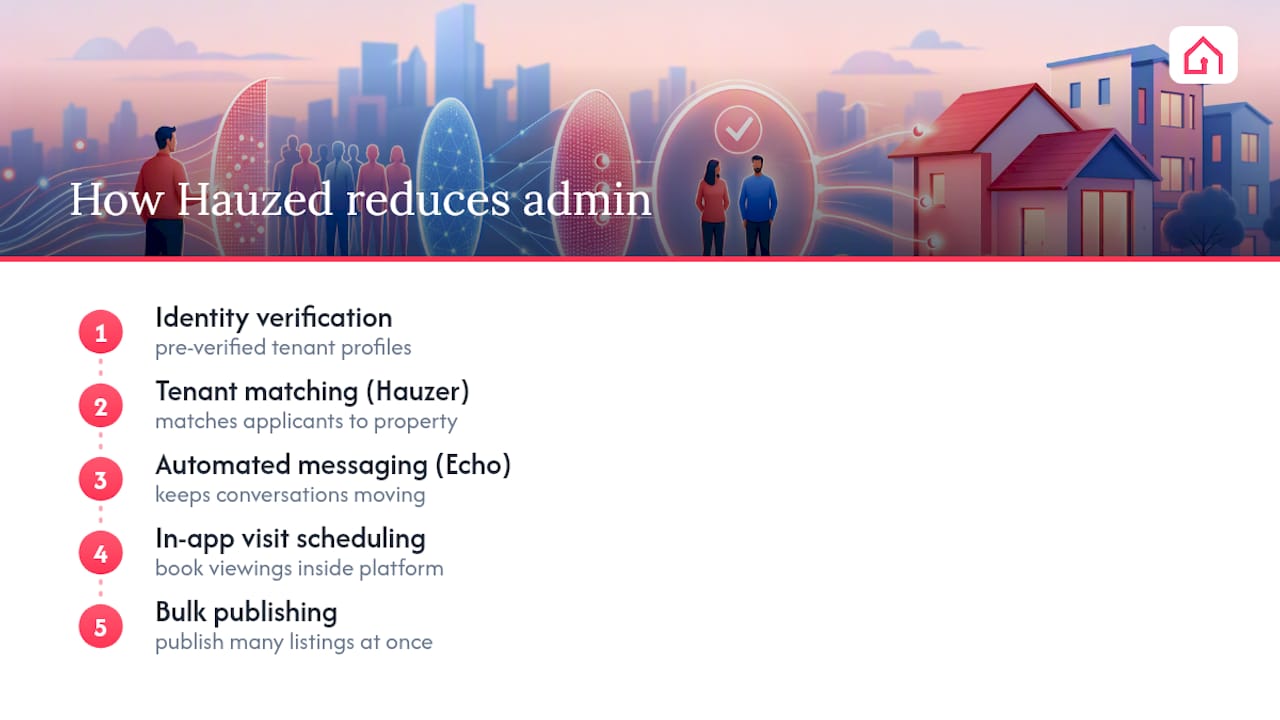
Hauzed doesn't replace your judgement, but it removes a lot of the manual grind from getting to a shortlist in the first place. Verified tenant profiles mean identity checks are already partly done before an applicant even messages you, and the tenant directory lets you see rental history and preferences before agreeing to a viewing.
Hauzer surfaces tenant matches for your property based on stated preferences and profile completeness, so you're not manually opening dozens of low-quality enquiries.
Echo handles routine chat follow-up and smart replies, freeing you to focus on the applicants worth a proper reference check.
Lia supports leasing conversations and WhatsApp-style coordination where enabled, keeping scheduling friction down once you've picked your shortlist.
Verification increases trust in who you're dealing with, but it doesn't guarantee an applicant's financial solvency or good behaviour once they're in the property. That final judgement, and the reference checks behind it, still sit with you.
A landlord's perspective: common mistakes and practical corrections
The biggest mistake landlords make isn't skipping checks. It's running them inconsistently, tightening the rules for one applicant and relaxing them for another because the second one "seemed nicer" at the viewing. Instinct is a poor substitute for a documented process, and it's the first thing that falls apart under any kind of dispute.
Always verify references independently rather than trusting the number written on the form. Where you can, call the penultimate landlord, not just the current one, since they have less reason to inflate a reference to get rid of a problem tenant. Respond quickly to serious applicants, because good tenants don't wait around, but never let speed replace the checks themselves. Conditional offers and guarantors exist precisely for the applicants who sit in the grey area between "yes" and "no". Use them.
— Hauzed
Rent with less admin and more verified interest
Hauzed is the practical alternative to sorting through dozens of unverified messages one by one. It's built for landlords with one to several properties who want stronger, better-qualified tenant interest without paying traditional agency fees for every enquiry that goes nowhere.
Instead of manually filtering leads from listing portals, WhatsApp groups, and cold emails, Hauzed surfaces tenants who've already completed identity verification and built out a proper rental profile. Hauzer matches suitable applicants to your property, Echo keeps conversations moving without you replying to every message individually, and visit scheduling happens inside the same platform rather than across three different apps. Property agents managing multiple listings can also use bulk publishing to move away from spreadsheet-and-WhatsApp chaos entirely.
If you're currently working through a pile of low-quality enquiries, set up your property on Hauzed and see how many verified, better-matched applicants reach your shortlist without the manual sorting.
Sources
Ask the current landlord about payment punctuality, property condition, and whether they'd rent to this tenant again. Then, where you can, contact the penultimate landlord too. A landlord about to get rid of a difficult tenant has every incentive to give a glowing reference just to move them on. The landlord before that one usually has nothing to gain by lying.
Professional referencing services bundle these checks together and typically cost between £15 and £40 per applicant, depending on the provider, and they reach credit bureau data and adverse tenancy registers that a DIY check simply cannot access. For a full walkthrough of what to ask each referee, Hauzed's tenant reference check best practices guide covers the exact questions worth asking.
FAQ
What are red flags for tenants?
The clearest ones are inconsistent or forged documents, unexplained short tenancy history, recent CCJs or defaults, and reluctance to provide references or proof of income. Each warrants a proportionate response, from independent verification through to a guarantor request or decline, rather than an automatic rejection.
What is the 6 year rule on rental property?
This refers to a specific tax or capital gains provision that varies by jurisdiction and property type, so it isn't a universal tenant screening rule. If it's relevant to your situation, check current guidance from your national tax authority rather than relying on a general figure.
How much notice do you need to give a tenant if you're selling?
Notice periods for ending a tenancy depend on the type of agreement in place and the jurisdiction's current tenancy legislation, so always check the specific statutory notice period that applies to your tenancy type before serving notice.
What are the new rules for tenants in Ireland?
Irish tenancy rules are updated periodically by the Residential Tenancies Board, covering areas like rent pressure zones, notice periods, and tenant protections. Landlords letting property in Ireland should check the current guidance directly with the RTB rather than relying on older summaries, since thresholds and notice periods do change.
Do I need to run identity checks before shortlisting tenants?
Yes. Identity verification should happen early, ideally before or alongside affordability and reference checks, so unqualified applicants are filtered out before you invest time in viewings. Platforms with built-in verified profiles, such as Hauzed, let you see this evidence before an enquiry even reaches your inbox.