Student accommodation: your complete guide for 2026
18 June 2026
10 min read
Explore your options with our complete guide to student accommodation for 2026. Find the best choices for your budget and lifestyle!
Student accommodation is the collective term for all housing options available to students and young professionals, ranging from university dormitories and shared houses to purpose-built student accommodation (PBSA) and private rentals. Choosing the right option shapes your finances, your safety, and your day-to-day wellbeing. In competitive university cities like Dublin, London, and Manchester, the stakes are high. Providers such as Scape UK and Xior Student Housing have expanded the market considerably, but the sheer volume of choices can feel overwhelming. This guide cuts through the noise and gives you a clear, honest picture of what is available, what it costs, and how to protect yourself.
What are the main types of student accommodation?
The four main categories of student housing options each suit a different budget, lifestyle, and stage of study.
Living at home is the most affordable route. You save on rent, utilities, and food costs, but you trade independence and proximity to campus. For students commuting to city universities, travel time and transport costs can quietly erode those savings.
Shared houses and flats are the most common form of off-campus student housing. You split rent and bills with two to five housemates, which keeps costs manageable. The critical detail here is the lease type. Joint liability leases mean that if one housemate stops paying, the remaining tenants must cover the full shortfall. Individual liability leases protect you from that risk entirely. Always confirm which type you are signing before you commit.
Purpose-built student accommodation (PBSA) is a professionally managed housing model designed specifically for students. Providers like Scape UK and Xior Student Housing offer en-suite rooms, communal study spaces, and onsite support staff within a single monthly fee. PBSA contracts are typically all-inclusive, covering Wi-Fi, utilities, and building security. The trade-off is cost: PBSA sits at the higher end of the price range.
University dormitories and campus halls offer structured social support that provides, which is particularly valuable for first-year students adjusting to independent life. Halls are generally more expensive than shared private rentals, but the pastoral care, organised social events, and guaranteed proximity to lectures make them worth considering for your first year.
Related Topics
#student accommodation#off-campus student housing#affordable student housing#shared student apartments#temporary student accommodation#student housing options#how to find student accommodation#best places for students to live#student housing near campus#student rental properties#university dormitories
Beyond these four, non-profit and public-private housing projects are growing. UTILE in Montreal is one example of a model that keeps rents below market rates through government land grants and subsidised funding.
Pro Tip:If you are considering shared housing, ask the landlord directly whether the tenancy agreement uses joint or individual liability. That single question can save you thousands of pounds if a housemate defaults.
How do the costs of student accommodation options compare?
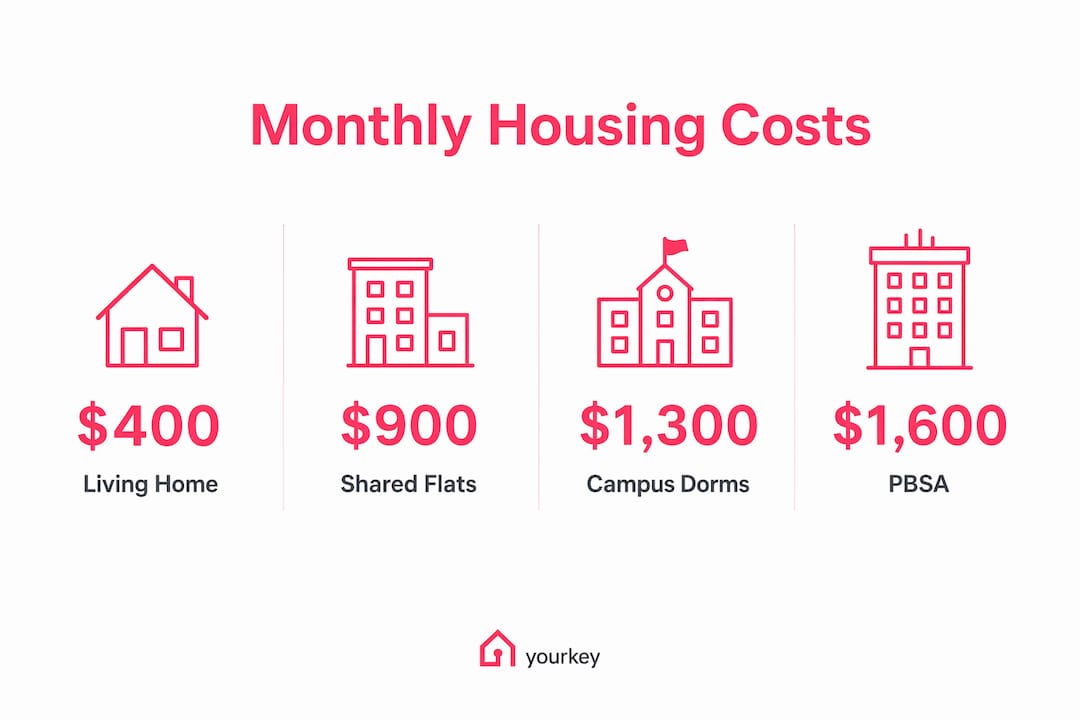
The financial gap between housing types is larger than most students expect. Living at home costs around $400 per month, while PBSA and dormitories reach up to $1,600 per month, and renting with housemates in major cities averages $1,850 per month. That creates an annual financial spread of roughly $17,400 between the cheapest and most expensive options. The right choice for your budget depends on more than the headline rent figure.
Housing type
Approximate monthly cost
Key cost factor
Living at home
~$400
Transport and food costs apply
University dormitories
Up to $1,600
Includes meals and support
PBSA
Up to $1,600
All-inclusive but premium priced
Shared private rental
~$1,850
Varies sharply by city and location
Hidden costs catch many students off guard. All-inclusive rent typically covers utilities, but mandatory service charges and admin fees can add a meaningful sum each month. Always request a full written breakdown of every charge before signing.
Contract length also affects your total spend. A standard private tenancy runs for 12 months, which means you pay rent through summer even if you are not in the city. PBSA providers like Scape UK now offer 44-week flexible contracts aligned with the academic year. That flexibility can save you two months of rent compared to a traditional 51-week lease.
City size matters too. Dublin, London, and Edinburgh consistently rank among the most expensive cities for student rental properties. Smaller university towns offer lower base rents, but fewer transport links and fewer part-time job opportunities can offset those savings.
Pro Tip:Calculate your true monthly cost by adding rent, utilities, internet, transport to campus, and any mandatory fees. Students often focus on base rent but overlook total cost of living, which changes the affordability picture entirely.
What lease and safety factors should students be aware of?
Lease terms and safety standards are the two areas where students most commonly make costly mistakes. Understanding both before you sign protects your money and your wellbeing.
Lease pitfalls to watch for:
Joint vs individual liability. Joint liability leases expose you to your housemates' financial behaviour. Individual liability leases do not. This distinction is the single most important clause in any shared tenancy.
Early termination fees. Early termination typically costs 1–2 months' rent. If your circumstances change mid-year, that penalty can be significant. Check whether the agreement includes a subletting clause, which gives you an exit route without paying the full fee.
All-inclusive definitions. Ask exactly what "all-inclusive" covers. Some agreements exclude contents insurance, parking, or a gym fee that appears mandatory on arrival.
Scarcity bias. High demand in competitive markets pressures students to rush lease decisions, leading to compromises on quality, location, or financial terms. Take 24 hours before signing anything.
Safety features to prioritise:
Secure key fob or coded entry to the building
CCTV in communal areas and car parks
Onsite or on-call management staff
A clear process for reporting maintenance and safety issues
Landlord accreditation schemes, such as those run by Manchester Student Homes, provide an additional layer of assurance. Accredited landlords meet defined safety and management standards, so tenants know what to expect before they move in.
Pro Tip:Never transfer a deposit or sign a lease for a property you have not viewed in person or via a verified video call. Fraudulent listings are most common in september and october, when demand peaks and students are under time pressure.
How are student housing providers innovating in 2026?
The student housing market has shifted noticeably in the past two years. Affordability and flexibility are now the primary selling points for new developments, not just location and amenities.
Flexible contract lengths. Scape UK now offers 44-week leases at its Wembley development, aligned with the academic calendar rather than the calendar year. Students avoid paying for empty rooms in june, july, and august.
Non-profit affordable housing models. UTILE's 2026 Montreal project uses public-private partnership funding to keep rents below market rates. Similar models are being explored in Irish and UK university cities.
Technology-enabled matching. PBSA providers increasingly offer digital roommate matching tools and online lease management portals. These reduce friction at the start of a tenancy and make it easier to resolve issues quickly.
Community and wellbeing programmes. Providers like Scape UK have moved beyond bricks and mortar. Purpose-built developments now integrate regular community events and wellbeing resources, recognising that student retention depends on more than a comfortable room.
These changes make PBSA a more competitive option than it was five years ago, particularly for students who value predictability and support over the lower cost of a shared private rental.
What practical steps help you find safe, affordable accommodation?
Finding the right place takes preparation. Students who start early and research thoroughly consistently secure better deals than those who begin their search in september or november under time pressure.
Start your search at least three months before your move-in date. The best listings in Dublin, London, and Edinburgh are taken quickly. Early movers have more choice and more negotiating power.
Use verified platforms. Platforms that verify landlord identities and moderate listings actively reduce your exposure to scams. Hauzed, for example, uses ID verification and AI-driven fraud detection to protect renters in competitive Irish markets. Browse affordable student rooms in Dublin to see verified listings within a student budget.
Prioritise safety features. Secure entry, onsite management, and accredited landlords are non-negotiable. A cheaper room in an unaccredited property is rarely worth the risk.
Check transport links. A flat that is 20 minutes from campus by foot or public transport is often better value than one directly adjacent to the university. Factor in the daily commute cost and time.
Negotiate where possible. Private landlords are often open to negotiating lease start dates, included furnishings, or a small rent reduction for a longer commitment. PBSA providers rarely negotiate on price, but they may offer a free parking space or a reduced admin fee.
Budget for the full picture. Include rent, bills, food, transport, and any mandatory fees in your monthly budget. Students who plan for total accommodation costs avoid the mid-year financial stress that forces rushed decisions.
Key takeaways
Finding safe, affordable student accommodation requires comparing housing types, understanding lease terms, and using verified platforms to avoid scams and hidden costs.
Point
Details
Know your lease type
Individual liability leases protect you from housemates' unpaid rent. Always confirm before signing.
Calculate total cost
Add rent, fees, transport, and utilities to find your true monthly spend.
Use flexible contracts
44-week PBSA leases save two months of rent compared to standard 51-week agreements.
Prioritise safety features
Secure entry, accredited landlords, and onsite staff reduce risk significantly.
Start your search early
Beginning three months ahead gives you more choice and stronger negotiating position.
The honest truth about finding student housing
The biggest mistake I see students make is treating the housing search as a box to tick rather than a decision that shapes their entire academic year. Rushing into a lease because "everywhere else is taken" is how you end up in a poorly maintained flat with a joint liability agreement and a landlord who ignores maintenance requests.
The market has genuinely improved. Flexible contracts from providers like Scape UK, verified platforms like Hauzed, and accreditation schemes like Manchester Student Homes have raised the floor for what students can reasonably expect. But those tools only help you if you use them before the pressure sets in, not after you have already transferred a deposit.
My honest advice: treat your accommodation search with the same rigour you would apply to choosing your course. Read every clause. View every property. And never let scarcity pressure you into a decision you have not thought through properly. The right place exists. You just need to find it before someone else does.
— Hauzed
Find safe, scam-free student accommodation with Hauzed
Searching for a room or flat in a competitive city like Dublin is stressful enough without worrying about fraudulent listings or hidden fees. Hauzed is built specifically for that problem.
Every listing on Hauzed is moderated, and every landlord is ID-verified before their property goes live. You can filter by budget, room type, and location, so you see only the options that genuinely fit your needs. Whether you are looking for a shared room under €1,000 or a studio near your university, Hauzed gives you a clear, trustworthy search experience. Start your search today on Hauzed's student accommodation listings and find a verified home without the stress.
FAQ
What is purpose-built student accommodation?
Purpose-built student accommodation (PBSA) is professionally managed housing designed exclusively for students, typically offering en-suite rooms, communal spaces, and all-inclusive billing. Providers like Scape UK and Xior Student Housing are among the largest operators in Europe.
What is the difference between joint and individual liability leases?
A joint liability lease makes all tenants responsible for the full rent if one housemate defaults. An individual liability lease limits each tenant's responsibility to their own share only.
How much does student accommodation typically cost per month?
Costs range from around $400 per month for living at home to up to $1,600 per month for PBSA or dormitories, with shared private rentals in major cities averaging around $1,850 per month.
What should I check before signing a student tenancy agreement?
Check whether the lease uses joint or individual liability, confirm what "all-inclusive" covers, review early termination fees, and verify that the landlord is accredited or verified through a trusted platform.
How can I avoid accommodation scams as a student?
Use platforms that verify landlord identities and moderate listings actively. Never transfer a deposit without viewing the property in person or via a verified video call, and be especially cautious during peak search periods in september and october.