Landlords: Run This 7 Question Tenant Pre Screen Before You Book
28 August 2026
17 min read
Use a copyable 7 question pre screen script to filter tenants before viewings. Includes tailored follow ups, red flags, and verification tips.
Ask a short, scripted set of pre-screening questions before you book a single viewing. A five-minute call or chat covering move-in date, income, occupancy, pets and consent to referencing filters out mismatches immediately, saving you wasted viewing slots and letting you focus on applicants worth your time.
TL;DR:
Confirming the number of residents, pets, and smoking habits early helps prevent misunderstandings and addresses policy issues upfront.
Refusals to consent to references or ID checks, or major discrepancies in rental histories, are clear signals to decline applications immediately.
Using a standardized script and documenting answers ensures fair treatment and provides legal protection during disputes.
Formal references and credit checks should only follow after pre-screening filters most unsuitable candidates, reducing legal and operational risks.
Which tenant pre-screening questions should you ask first?
Every serious enquiry deserves the same short script. You're not running a full background check at this stage; you're gauging whether someone can plausibly afford the property, move in on your timeline, and live within its rules. Sift's guidance on qualifying tenants frames this as six pre-viewing signals: affordability, right to rent, employment type, timeline, rental history and occupancy. Ask these seven questions, in this order, and you'll cover all of them.
"When would you need to move in, and is that date fixed or flexible?" A mismatch here ends the conversation fast. If someone needs a property in three weeks and yours isn't free for two months, there's no point discussing anything else.
"What's your employment situation, and roughly what income supports this rent?" You're not asking for payslips yet. You want a plausible answer, such as "full-time, permanent contract, salary covers the rent three times over."
"How many adults will be living in the property, and will anyone else stay regularly?" This tells you whether the household matches what you advertised and whether HMO rules might apply.
"Do you have any pets, and does anyone in the household smoke?" Ask this even if your listing states a policy. Applicants skim adverts, and this question stops arguments after a viewing.
"Who's your current landlord, and how long have you lived at your present address?" A short, vague, or evasive answer here is worth noting. A long, stable tenancy history is one of the strongest positive signals you'll get at this stage.
"Are you comfortable providing references and identification, and consenting to a credit and background check if you proceed?" Hesitation matters more than the answer itself. Most legitimate applicants expect this question and answer it without pause.
"How long are you looking to stay, and is there anything specific you need, such as parking or outdoor space?" This clarifies fit beyond the basics and often reveals whether someone read your listing properly.
Pro Tip:Send these as a short numbered list by email or WhatsApp if you can't get someone on the phone. You'll get more complete answers than a verbal exchange, and you'll have a written record for free.
OpenRent's advice on vetting tenants before viewings makes the same point from a different angle: use these questions to filter enquiries early, then hand the qualified shortlist to a proper referencing service. Pre-screening earns its keep by removing the obviously unsuitable applicants before you spend an evening showing round six people, only for five of them to be non-starters.
How do you adapt questions for students, freelancers, and groups?
The seven core questions work for most applicants, but some situations need a follow-up or two.
Students: Ask about course dates and whether the tenancy needs to run through the summer or just term time. Most student tenancies require a guarantor, usually a parent, so ask early whether one is available.
Self-employed and freelance applicants: Ask how long they've been trading and whether they can provide two years of accounts or an SA302 tax summary. Irregular income isn't automatically a red flag, but you need proof rather than an estimate.
Benefit claimants: State plainly whether you accept housing benefit or Universal Credit housing element payments, then ask what evidence they can provide of entitlement. Don't assume; ask directly and consistently with every applicant.
Groups and house-shares: Confirm every adult who will live there, not just the lead applicant. Ask whether they want individual references or a single group guarantor, and check whether the total occupant count triggers HMO licensing rules in your area.
When documentation feels thin: Ask for additional advance rent or a guarantor before booking a viewing, rather than after an application. It's a fairer, more transparent way to manage risk from the outset.
What questions must you never ask, and how do you rephrase them?
Some questions are illegal or discriminatory regardless of how innocently they're meant. Avoid asking directly about race, nationality, religion, sexual orientation, pregnancy, family planning, or the specifics of a disability or health condition. These fall under equality and discrimination protections, and even a well-intentioned question here can expose you to a legal claim.
You can still screen for the practical concerns behind these questions, just phrased differently:
Instead of asking about health conditions, ask: "Is the property suitable for your needs, or is there anything about the layout or access you'd want to discuss?"
Instead of asking about family plans, ask: "How many people will be living at the property, based on current plans?"
Instead of asking about immigration status directly, ask the standard right to rent question you ask every applicant: "Can you provide the documents needed for a right to rent check?"
The safest habit is running the same script with every applicant and writing down the answers. Consistency is your best defence if anyone ever questions your process, and Landlord Zone's guidance on tenant verification singles out documented, methodical screening as the standard that holds up under scrutiny.
What answers should stop or slow down an application?
Some answers end the conversation immediately. Others simply mean you ask for more before proceeding.
Refusal to consent to referencing or ID checks. This is close to an automatic decline; legitimate applicants rarely object.
A major mismatch on move-in date. If the gap can't be bridged, there's no benefit to either side continuing.
Inconsistent or evasive rental history. Vague answers about a previous landlord, or an inability to name one, deserve a follow-up question before you rule someone out.
Income that falls short with no mitigation offered. This isn't necessarily a decline. A guarantor, a larger deposit, or a family member as co-signer can offset it.
Irregular income with no documentation offered. Ask for a longer proof period, such as six months of bank statements, rather than declining outright.
Pro Tip:Decide your minimum income multiple (commonly two and a half to three times the monthly rent) before you start taking calls, so you're applying the same bar to every applicant rather than making it up as you go.
Once you've made a decision, either invite the applicant to submit a full application and start referencing, or decline politely and briefly. Log the reason either way.
How do you record and document your pre-screening process?
A consistent process protects you as much as it protects the applicant. Keep it simple:
Use one short script or form for every enquiry, whether it comes by phone, email, or chat, and fill it in as you go rather than trying to remember answers afterwards.
Get explicit consent before you request or store any documents, and only ask for what you actually need at this stage. Full ID and financial documents belong in the formal application, not the pre-screen.
Keep a basic log: who you asked, what they said, and whether you invited them to apply or declined. This is your evidence of fair, consistent treatment if a dispute ever arises.
Phone and structured chat both work well for gauging tone and consistency in real time; email works better when you want a written record without needing to press for answers on the spot.
Pro Tip:Recording answers at the time of enquiry rather than reconstructing them later is one of the simplest habits that separates landlords who never face a discrimination dispute from those who do.
Practical note: how a trust-first platform supports pre-screening
Running this script manually across a dozen enquiries a week is where most landlords lose time. A platform built around identity verification and structured tenant profiles removes a chunk of the repetitive checking, without pretending to replace your judgement.
Faster identity checks. Verified applicants have already confirmed who they are before they message you, cutting one step from your script.
Standardised profiles. Instead of chasing seven answers across a scattered thread, you see occupancy, income bracket, and move-in date laid out consistently for every applicant.
In-app consent and secure uploads. Applicants agree to share documents through the platform rather than emailing sensitive files back and forth.
Hauzed's tenant screening checklist walks through building this script into a repeatable form. Verification builds trust; it doesn't replace formal referencing or your own read on an applicant.
What verification does
What it doesn't do
Confirms identity before you engage further
Guarantee an applicant will pass a credit check
Standardises how profile information is presented
Replace formal referencing or right to rent checks
Speeds up the early filtering step
Make the final rental decision for you
Why does reason for moving and tenancy length matter?
An applicant's reason for moving tells you far more than the fact itself; it's the follow-up detail that reveals reliability. "My contract ended and I need a longer-term base" signals stability. "My landlord is selling" is common and neutral. "I need to leave quickly" without explanation deserves a gentle follow-up rather than immediate suspicion, since plenty of legitimate reasons (a relationship ending, a job relocation) sound abrupt on first mention.
Tenancy length matters just as much, because it determines whether the applicant fits your plans for the property. If you want a stable two-year let and someone tells you they're job-hunting and might move again within six months, that's a genuine mismatch, not a red flag, and it's better surfaced now than after a lease is signed.
Ask both questions together: "What's prompting the move, and how long are you hoping to stay this time?" You'll often get a fuller answer than asking them separately, because people naturally explain the "why" and the "how long" in the same breath. Someone moving for a new job nearby will usually mention wanting to settle for a while; someone between short lets will often say so unprompted.
Treat short answers here as an invitation to ask one more question, not as an automatic red flag. The goal is fit, not suspicion.
What should you leave to formal referencing?
Pre-screening filters for fit. Formal referencing verifies fact, and the two shouldn't be confused. Credit checks, eviction history and criminal record checks all require specific consent, proper handling of sensitive data, and, in most cases, a professional referencing service rather than a landlord's own enquiries.
OpenRent's advice on pre-viewing questions is explicit on this point: use pre-screening to filter enquiries, then leave detailed checks to referencing professionals once an applicant has been shortlisted. Trying to run a credit check yourself, or asking directly about criminal convictions before an application is even submitted, exposes you to both legal risk and unreliable results.
Criminal record disclosure in particular carries specific legal nuance. Legal guidance on criminal records and housing applications explains that how a conviction is treated can depend on its nature, age, and disclosure requirements, which is exactly the kind of judgement a referencing service or legal adviser is better placed to make than a landlord working from a phone call.
The practical rule is straightforward: pre-screening asks whether someone is willing to consent to these checks; formal referencing actually runs them. Keep the boundary clear, and don't let a pre-screening conversation drift into territory that belongs later in the process.
How do you interpret and compare tenant answers effectively?
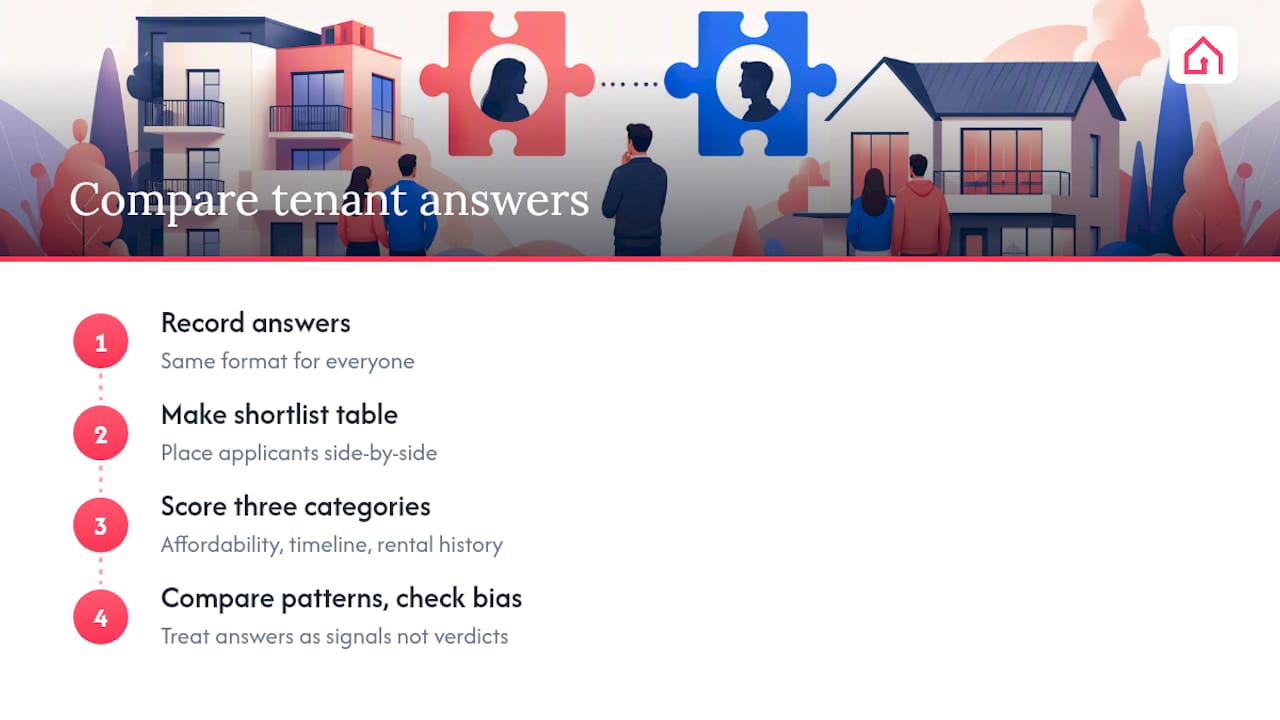
The value of a scripted pre-screen only shows up when you compare answers side by side rather than judging each applicant in isolation. Write down every response using the same format, then look at patterns across your shortlist rather than reacting to any single answer.
Weigh answers as signals, not verdicts. A tenant with slightly lower income but a long, stable rental history and a guarantor on offer often represents lower risk than one with higher income but a string of short tenancies and vague answers about previous landlords. Numbers alone don't tell the full story.
Comparing consistently also protects you from unconscious bias. If you find yourself more forgiving of vague answers from one applicant than another, that's usually a sign you're reacting to something other than the actual content of their response. A written log, scored the same way for everyone, keeps you honest.
Pro Tip:Give each applicant a simple three-point rating (strong, borderline, weak) across affordability, timeline fit, and rental history, rather than a single overall impression. It forces you to weigh the specifics instead of going on gut feel alone.
What cultural and communication factors affect tenant screening?
Not every applicant communicates the same way, and reading unfamiliarity or brevity as evasiveness is a common mistake. Someone recently arrived in the country, or answering in a second language, may give shorter or more literal answers than a native speaker would, without that meaning anything about their reliability as a tenant.
Written communication styles vary too. Some applicants will send a detailed paragraph in response to a single question; others will answer in a single line even when they have plenty more to say. Neither style is inherently more trustworthy, so judge the content of the answer rather than how much of it there is.
If a response feels thin, ask a clarifying follow-up before drawing a conclusion. "Could you tell me a bit more about your current living situation?" often surfaces detail that a first answer simply didn't include, for entirely ordinary reasons, such as assuming you only wanted a short reply.
The same scripted questions, asked the same way to everyone, remain your best safeguard here. It stops communication style from being mistaken for a red flag, and it keeps your process fair regardless of who's answering.
How should you phrase sensitive or complex questions?
Wording matters more than most landlords expect. A question that sounds like an interrogation gets defensive, guarded answers; the same question, framed as a practical check, usually gets an honest and complete one.
Frame every question around the practical requirement, not the personal detail behind it. Instead of "Can you afford this?", try "What's your approximate income, so I can check it covers the rent comfortably?" Instead of "Why are you moving?", try "What's prompting the move, just so I understand the timeline?" The information you get is the same; the tone that produces it is entirely different.
For consent and referencing, be direct rather than apologetic. "As part of our standard process, I'll ask every applicant to consent to a credit and reference check if they proceed. Are you comfortable with that?" signals that this is routine and applies to everyone, which tends to produce a more relaxed answer than a question that sounds like it's specifically targeting the person you're speaking to.
Sift's research on tenant qualification makes this point well: framing the conversation as a quick compatibility check, rather than a test the applicant might fail, increases cooperation and produces more honest answers across the board.
What do common tenant responses actually indicate?
Certain answer patterns come up repeatedly, and it's worth knowing roughly what each tends to mean before you react to it.
A confident, specific answer to the income question ("I'm on £38,000 as a permanent employee, three years in the role") is a strong positive signal on its own. A vague one ("it varies, but it's enough") isn't necessarily bad, but it needs a follow-up rather than an assumption in either direction.
An applicant who names their current landlord and offers the contact details unprompted is showing you they expect to be checked and have nothing to hide. One who says "I'd rather you didn't contact my current landlord" deserves a direct, polite question about why, since there are legitimate reasons (a dispute unrelated to conduct) as well as concerning ones.
Enthusiastic, detailed answers about move-in date and tenancy length usually indicate genuine interest and planning. Extremely brief, non-committal answers across the whole script, on the other hand, often mean the applicant is enquiring about several properties at once and hasn't seriously considered yours yet, which is useful to know before you invest time on a viewing.
When should you follow up on an ambiguous answer?
Ambiguity is common and rarely means dishonesty. It usually means the applicant didn't understand what level of detail you wanted, or gave you a quick answer while multitasking. The fix is nearly always the same: ask one more specific question rather than filling the gap with assumption.
If someone says their income "should cover it," ask for the actual figure. If someone says they're moving "because of personal reasons," accept that without probing further, since you don't need the reason itself, only whether the timeline works for you. If a rental history answer is vague ("I've lived in a few places recently"), ask directly how long the most recent tenancy lasted and why it ended.
The rule that keeps this fair is simple: ask the same style of follow-up question to every applicant who gives a similarly vague answer, rather than pressing some applicants harder than others based on a hunch. Document the follow-up and the answer exactly as you would the original question, so your record stays complete and consistent.
What changed after I started pre-screening properly?
A scripted set of pre-screening questions cut my wasted viewings dramatically. Before I ran a proper script, I'd book four or five viewings and lose an entire afternoon to no-shows and applicants who clearly hadn't read the listing. A five-minute phone call before booking anything changed that almost immediately.
The single habit worth copying is this: never book a viewing off the back of a message alone. Call, even briefly, and run through the same seven questions every time.
— Hauzed
Where can you read more on tenant screening and referencing?
For deeper legal detail, Landlord Zone's verification guidance and Hauzed's reference check guide cover the formal referencing stage this article deliberately leaves aside.
Sources
Ask for a previous landlord's name and contact details, plus an employer reference contact, at pre-screening stage, even though you won't chase these down until the applicant progresses further. Simply asking reveals a lot: an applicant who can produce a name and number instantly is a different proposition to one who can't recall their previous landlord's details.
Consent works the same way. Ask directly: "Are you happy for me to carry out reference and credit checks if your application proceeds?" Alan Boswell's guidance for landlords recommends gauging this in a live conversation, whether by phone or structured chat, because tone and hesitation carry information that a written form doesn't always capture.
Consent at this stage isn't the same as running the check. You're establishing whether the applicant is willing, in principle, before you invest time collecting full documentation. A "yes, of course" delivered without hesitation is a good sign. A long pause, a change of subject, or an outright refusal is worth noting and following up on directly rather than ignoring.
Keep the language consistent across every applicant: same question, same phrasing, same moment in the conversation. That consistency is what makes your process defensible later, and it costs you nothing extra to maintain.
A typical pre-screen covers move-in date, income and employment type, household size, pets and smoking, rental history, and consent to referencing and ID checks.
What are some good questions to ask when screening potential tenants?
Ask about affordability, timeline, occupancy, previous landlord details, and whether they'll consent to a credit and reference check if they proceed.
What are red flags for tenants?
Refusal to consent to referencing, a major move-in date mismatch, and vague or inconsistent answers about previous landlords are the strongest early red flags.
What not to say to your landlord?
Avoid vague or evasive answers about income, rental history, or willingness to be referenced. These raise more concern than a straightforward, honest answer, even when the underlying situation is imperfect.