Cut No-Shows 30–50% with Viewing Capacity Planning for Landlords
20 September 2026
10 min read
An actionable playbook for landlords and agencies: pre-qualify tenants, set slot caps, and use confirmations and reminders to cut no-shows and run safer,...
Viewing capacity planning means limiting and scheduling who attends a property viewing, so you reduce no-shows, protect your safety, and spend time only on serious applicants. The single most effective approach is to pre-qualify enquirers before you ever offer a slot, then control attendance with scheduled bookings, a firm confirmation and reminder sequence, and a hard cap on numbers per visit. This workflow can be supported through tenant verification and built-in scheduling, avoiding management from a notebook and multiple chat apps.
TL;DR:
Pre-qualify applicants using clear questions about move-in date, budget, and living situation to significantly reduce no-shows and improve conversion rates.
Schedule slots with fixed lengths and attendee limits before advertising, and offer flexible times to match tenant availability and demand.
Implement a structured confirmation and reminder sequence, including an immediate booking confirmation, a 24-hour reminder, and a same-day reminder, to cut no-shows by up to half.
Use a combination of virtual and in-person viewings, prioritizing in-depth one-to-one screening for quality applicants when demand is manageable.
Leverage tenant verification and automation tools to streamline screening, scheduling, and follow-up, thereby reducing manual filtering and improving viewing efficiency.
#invite only viewings#viewing capacity analysis#how to plan viewing capacity#viewing capacity planning#capacity planning for viewing#optimizing viewing capacity#streaming capacity management
A good plan is really a short sequence of decisions made before you open your diary, not during it. Get these five right and you avoid the two classic failure modes: empty slots because nobody confirmed, or crowded slots because you said yes to everyone.
Choose your format first. A high-demand two-bed near a train station suits back-to-back ten-minute slots. A slow-moving rural property might justify one relaxed open house instead.
Set slot length and attendee limits before you advertise. Fifteen minutes per household with a five-minute buffer between slots is realistic for most flats; larger houses need longer.
Offer evening and weekend times. Most prospective tenants work standard office hours, so daytime-only slots quietly filter out your best applicants before they even see the listing.
Write your pre-qualification questions before the first enquiry lands. Decide what disqualifies someone (wrong move-in date, budget mismatch) so you are not improvising on the phone.
Draft your confirmation template. It should carry directions, the exact meeting point, who will be attending from your side, and a note on parking or access.
Open house, one-to-one slots, or virtual-first: which suits you?
None of these methods is universally correct. The right choice depends on how many enquiries you are fielding and how much screening you have already done.
Batched one-to-one slots trade a little efficiency for a much better read on each applicant. You get a proper conversation, you can ask follow-up questions, and you build a clearer sense of who will look after the place.
In practice, combining methods often beats picking one. A short video call to filter out time-wasters, followed by a tight in-person slot for the shortlist, gives you both throughput and proper selection quality. For a property in genuine demand, that hybrid approach usually beats either method run alone.
How do you pre-qualify applicants before booking a viewing?
Build your screen around a short, fixed set of fields:
Desired move-in date, checked against your actual availability.
Budget confirmation, stated plainly rather than assumed from the listing price.
Current living situation (renting, with family, relocating).
Number of people who will attend and who will actually live there.
Specific requirements: pets, parking, accessibility needs.
Collection method matters as much as the questions themselves. A structured online form works for most enquiries; a short phone screen suits higher-value lets where you want to hear tone and detail; an automated chat or AI assistant catches out-of-hours traffic that would otherwise sit unanswered until morning. Where you need real identity confidence, ask for ID verification through a secure, authorised upload flow rather than over chat or email, and Hauzed's tenant screening checklist is a useful reference for what to ask and in what order.
Be honest about the trade-off: the stricter your qualification bar, the fewer viewings you will book, but the ones you do book convert far better.
Pro Tip:Ask for the move-in date and budget confirmation in the same message. People who dodge either question are usually the ones who cancel.
What confirmation and reminder sequence actually cuts no-shows?
Timing is not a minor detail here. It is most of the fix.
Send an immediate confirmation the moment a slot is booked, including the full address, meeting point, listing link, and who will be showing the property.
Send a 24-hour reminder and explicitly ask for a reply to confirm. This single tactic, replying to confirm attendance, is disproportionately effective at cutting no-shows.
Send a same-day reminder for afternoon and evening slots, since morning-only reminders lose their effect by 5pm.
Make cancellation painless. A one-line "reply CANCEL to free your slot" message means people who were never coming actually tell you, rather than just vanishing.
What safety and capacity rules should govern in-person viewings?
Decide your maximum attendees per slot before you advertise, not on the day, and log who actually shows up at the door against who booked.
Cap numbers per household or per slot, and stick to it even when someone asks to "just quickly bring a friend."
Space arrivals with a genuine buffer, five to ten minutes minimum, so one group is not queuing on the doorstep while another is still inside.
If the property is tenanted, respect notice periods and confirm timing with the current tenant well in advance; never treat their home as available on your schedule alone.
Put basic house rules in your confirmation message: no shoes indoors, no photographing the current tenant's belongings, that kind of thing.
Handle any ID or contact information you collect with the same care you would want applied to your own data, and only through flows designed for it.
Pro Tip:If you are showing a tenanted property, tell viewers in the confirmation message that someone currently lives there. It avoids awkward doorstep surprises and keeps the visit shorter and more respectful.
How do you measure and improve your viewing capacity plan?
Three numbers tell you almost everything: no-show rate, viewing-to-application rate, and viewing-to-offer rate. Track them per property, not just in aggregate, because a good average can hide a badly performing listing.
High no-shows clustered around a specific time slot usually mean your hours do not match tenant availability, add an evening or weekend option before you change anything else.
Low viewing-to-application conversion despite decent attendance points to a pre-qualification gap; you are letting the wrong people through the door.
Strong applications but slow offers suggest your decision process, not your viewing process, needs attention.
Run a short monthly review: adjust slot length, top up your waitlist, and tighten or loosen qualification questions based on what the last month actually showed you. Small, regular adjustments beat one big overhaul every quarter.
How Hauzed supports each step of this plan
Every step above is easier with the right tooling behind it, and that is where the platform choice starts to matter.
Tenant profiles and identity verification give you a pre-qualification layer before a single message is exchanged, so you are reviewing a verified applicant rather than an anonymous enquiry.
Hauzer, Hauzed's matching agent, surfaces suitable tenant matches for a property and helps prepare invitations, cutting down the manual sorting through low-quality leads.
Echo handles chat follow-up and smart replies, so a Sunday evening enquiry does not sit unanswered until Monday afternoon.
Lia supports leasing conversations and WhatsApp-style workflows where available, useful for the back-and-forth that usually precedes a confirmed slot.
Team accounts and bulk-publishing tools help agencies managing several properties keep capacity decisions consistent across a whole portfolio rather than reinventing the process for each listing.
None of this replaces judgment. Verification tells you an applicant is real; it does not tell you they are the right tenant. But it removes a great deal of the manual filtering that eats into a landlord's week, and Hauzed's own tenant screening guidance walks through how to combine the two.
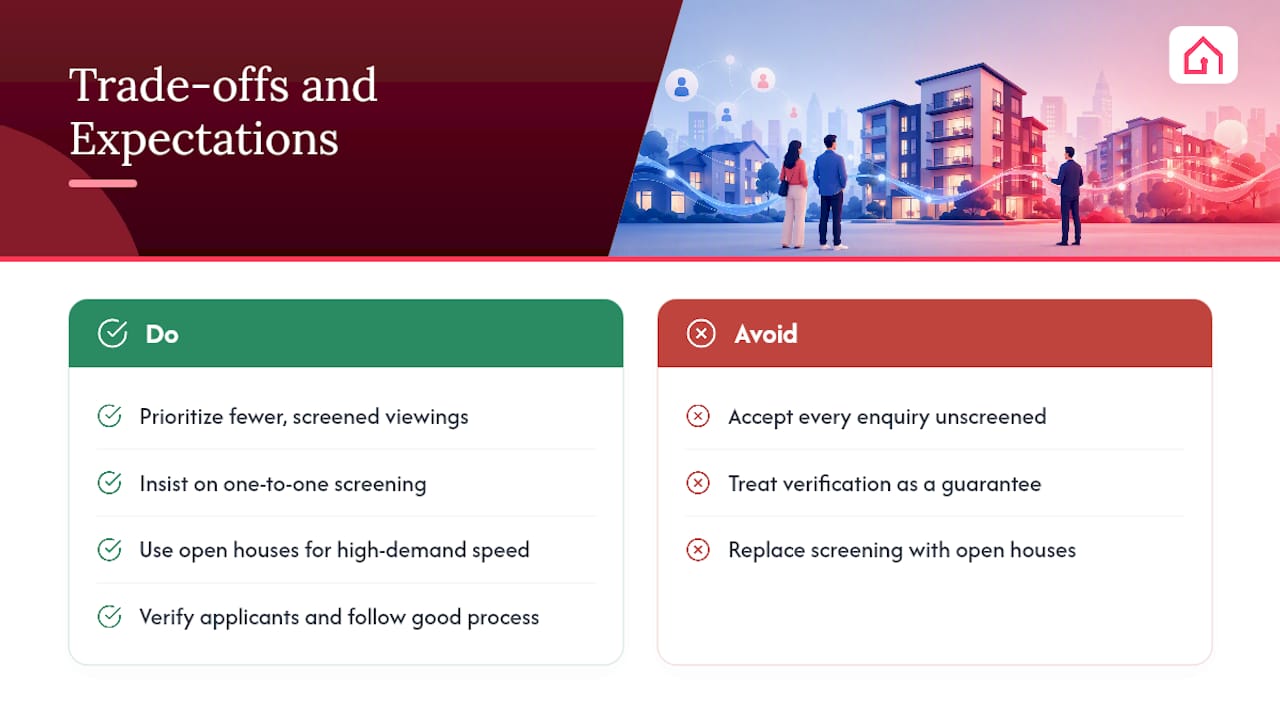
A short note on trade-offs and realistic expectations
Fewer, better-qualified viewings almost always convert faster than a full diary of unscreened ones. That is the trade-off worth accepting even when it feels counterintuitive to turn enquiries away.
Open houses have their place, particularly for high-demand listings where speed matters more than depth. However, insist on one-to-one screening whenever you need a genuine read on who someone is. And keep this in mind: verification and good process raise trust, they do not guarantee a good tenancy. Nothing does.
— Hauzed
Get your viewing process working the way this guide describes
A practical approach puts pre-qualification, scheduling, and confirmations into a single workflow instead of juggling multiple tools. Landlords use tenant verification to screen before booking, AI-based matching tools to surface matches, and automated chat handling to manage enquiry traffic.
If you manage one property or several, it is worth comparing the Free Plan against the paid options, including the Full Assistance Pack at €99.90 one-off for landlords who want extra hands-on support, and the AI Team plan at €19.90 per month for those ready to automate matching and follow-up. Agencies managing multiple listings can also look at Hauzed's multi-property management workflows to see how capacity planning scales across a whole portfolio. Visit the pricing page to see which plan fits your current viewing volume.
Viewing capacity planning is the process of deciding how many people attend a property viewing, when, and under what conditions, using scheduled slots, attendee caps, and confirmations. It exists to reduce no-shows, protect safety, and keep your time focused on serious applicants rather than casual browsers.
How Many People Should Attend a Viewing at Once?
There is no fixed legal cap, so the right number depends on the property's size and your own comfort managing the space. Most landlords showing a standard flat find one household group at a time, with a five to ten minute buffer before the next, keeps things orderly without slowing down throughput.
Do Reminders Really Reduce No-Shows?
Yes. A confirmation and reminder sequence, sent immediately, then again at 24 hours, then on the same day, meaningfully reduces no-show rates, particularly when you ask the recipient to reply and confirm rather than sending a one-way notice.
Should I Pre-Qualify Applicants Before Every Viewing?
Yes, pre-qualification before booking is the single most effective step you can take. Agencies that add a qualification step before booking report no-show rates below 10%, compared with much higher rates for open, unscreened bookings.
How Does Hauzed Help With Viewing Capacity Planning?
Hauzed combines tenant identity verification with scheduling and AI-assisted follow-up, so landlords can screen applicants before offering a slot and manage confirmations from one place. Pricing runs from a Free Plan up to paid options like the AI Team plan at €19.90 per month for landlords who want automated matching and chat follow-up.