Rental onboarding for landlords: 2026 checklist guide
29 July 2026
20 min read
Discover how rental onboarding works for landlords in our 2026 checklist guide. Ensure compliance and protect your rights from day one!
Rental onboarding is the ordered sequence of compliance checks, statutory documents, and move-in steps that makes a tenancy legally sound from day one. Get the order wrong and you risk losing possession rights, facing fines, or handing a tenant grounds to challenge you in court.
Complete Right to Rent checks for every adult occupier before the tenancy begins, with the check done in the 28 days prior to the start date for time-limited rights.
Protect the deposit in a government-approved scheme within a legally prescribed period after receiving it, then serve the required information.
Skipping or misordering any of these steps does not just create paperwork headaches. Failure to serve the Information Sheet in the required form can trigger fines up to £7,000, and deposit protection breaches can result in a court ordering repayment plus a penalty of 1–3 times the deposit amount.
Tenant onboarding, from a landlord's perspective, is the full process of taking a property from vacant to legally occupied. It covers everything from pre-marketing compliance checks through to the first weeks of a live tenancy. It is not the same as a tenant-facing welcome pack, though that is part of it.
The distinction matters because the order of steps has legal consequences. Serving documents late, signing agreements before handing over the Information Sheet, or skipping the inventory walk-through are not minor admin oversights. They can affect whether you can recover possession, whether your deposit protection is valid, and whether you have a statutory excuse if a Right to Rent breach is later alleged.
Done correctly, onboarding gives you three things: a legal defence if a dispute arises, a smoother tenancy because expectations are set clearly from the start, and a better relationship with your tenant because they feel informed rather than rushed. Authoritative guidance from GOV.UK, the Written Statement of Terms regulations, and the Renters' Rights Act Information Sheet are the official reference points you should keep to hand throughout.
How does the rental onboarding process work, step by step?
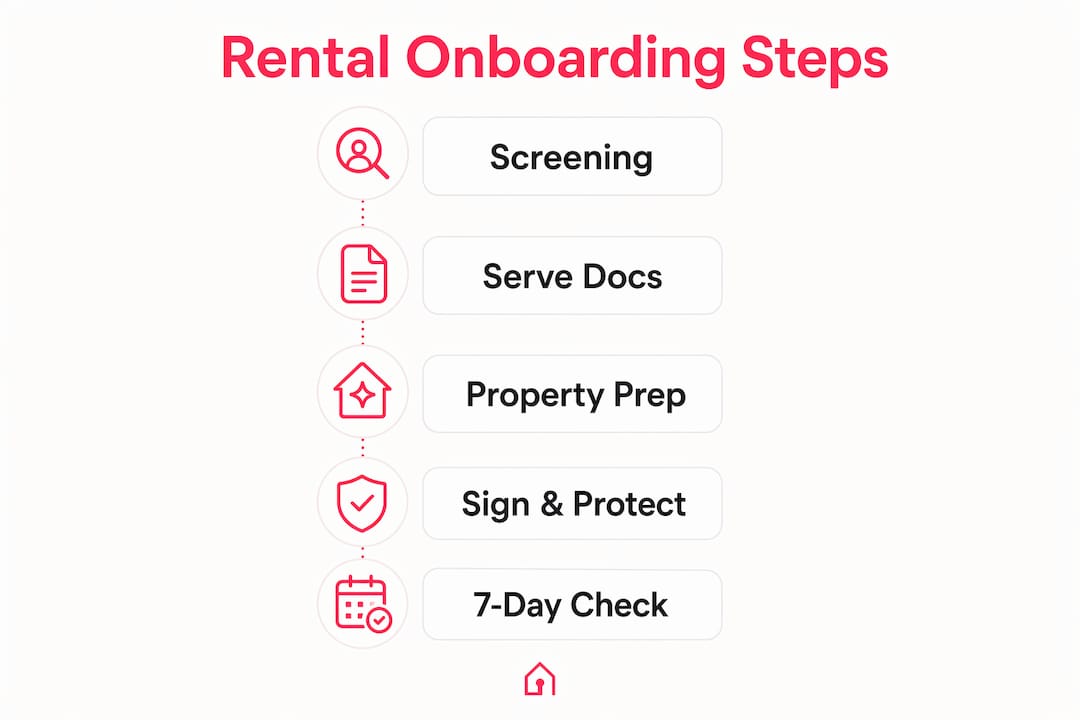
From listing to move-in, the tenant onboarding process has six distinct stages. Each one feeds the next, and the legal validity of later steps often depends on earlier ones being completed correctly.
Pre-marketing compliance checks. Before you advertise, confirm your Energy Performance Certificate (EPC) is valid and rated E or above (or that you hold a valid exemption). If the property has gas, book the annual Gas Safety inspection and obtain the CP12 certificate. Check whether the property requires a selective, HMO, or additional licence in your local authority area. From 1 May 2026, all new tenancies in England default to periodic assured tenancies, so your tenancy template must reflect that.
Compliant marketing. Publish a single asking rent. MHCLG guidance from March 2026 makes clear that bidding language is banned and adverts must not contain exclusionary wording. Disclose material information (known defects, service charges, parking restrictions) at this stage, not after an offer is made.
Applicant screening and Right to Rent checks. Run identity, affordability, and credit checks on every applicant before proceeding to offer. For Right to Rent, complete the check shortly before the tenancy start date for applicants with time-limited leave. Use the GOV.UK share code service or a certified digital identity service provider (IDSP) for online verification. Save every output. For joint tenants, every adult occupier needs a separate check. If you are using a guarantor, treat their referencing as a parallel process, not an afterthought. A full tenant screening checklist can help you track each applicant's documents systematically.
Service of statutory documents in the correct order. This is where most landlords trip up. The Written Statement of Terms and the Renters' Rights Act Information Sheet must both be given to the tenant before they sign the tenancy agreement or otherwise agree the tenancy. The Information Sheet must be the exact PDF from GOV.UK, not a paraphrase or a link. Signing before service, or providing documents late, can invalidate your compliance position and affect possession rights.
Contract signing, deposit protection, inventory, and key handover. Once documents are served, the tenancy agreement can be signed. Protect the deposit in a government-approved scheme within 30 days and serve the prescribed information. Conduct the inventory check-in with the tenant present, photograph every room and fitting, record meter readings, and log the keys handed over. Both parties should sign the inventory.
Day-one actions and the day-7 follow-up. On move-in day, test smoke and carbon monoxide alarms with the tenant present and record the result. Take a final meter reading. Then, seven days later, carry out a brief check-in call or visit to catch minor issues before they become disputes.
Pro Tip:The compliance-first sequence in steps 4 and 5 is not just good practice. Serving the Information Sheet and Written Statement before signature preserves your statutory grounds for possession and your right to rely on the deposit protection scheme. Reversing the order, even accidentally, can cost you far more than the time it takes to get it right.
What statutory documents must UK landlords serve?
The landlord onboarding checklist for statutory documents is longer than most landlords expect, and each item carries its own renewal interval and penalty regime.
Document
Frequency / Validity
Key Deadline
Penalty for Non-Compliance
Gas Safety Certificate (CP12)
Annual
Before tenancy starts; renewed yearly
Civil or criminal penalty
Electrical Installation Condition Report (EICR)
Every 5 years
Before new tenancy
Civil penalty
Energy Performance Certificate (EPC)
—
At point of advertising
Cannot legally market without it
Smoke and CO Alarms
Test on move-in day
Day 1 of tenancy
Civil penalty
Right to Rent check
Before tenancy start; repeat for time-limited rights
28 days before start date
Civil penalty up to £7,000 per occupier
Renters' Rights Act Information Sheet
Once per tenancy (new tenancies from 1 May 2026)
Before signing
Fines up to £7,000
Written Statement of Terms
Once per tenancy (new tenancies from 1 May 2026)
Before signing
Civil penalties
Deposit protection + prescribed information
Within 30 days of receipt
30 days from receipt
1–3× deposit penalty
Fines up to £7,000 apply for failing to serve the exact GOV.UK PDF of the Renters' Rights Act Information Sheet. Systemic non-compliance across a portfolio can attract civil penalties up to £40,000.
Proving service is as important as completing it. A timestamped PDF sent via a tracked email, a signed receipt from the tenant, or a tamper-evident document vault all constitute acceptable evidence. A verbal confirmation does not. The PRS Database rollout, expected from late 2026, will increase local authority auditing capability, so preparing upload-ready, timestamped certificates now is worth doing.
How do tenant referencing and Right to Rent checks work?
Referencing and identity checks are the gatekeeping stage of the rental onboarding process. They protect you legally and practically, but they need to be proportionate and consistently applied to every applicant.
Core referencing pillars:
Identity verification: Passport, driving licence, or biometric residence permit. For online checks, a GOV.UK share code is valid for 90 days and provides a 12-month statutory excuse for time-limited rights.
Affordability: Standard practice is to confirm gross income at roughly 2.5 times the annual rent, though the exact threshold is yours to set. Payslips, bank statements, or an employer reference letter are typical evidence.
Previous landlord reference: A direct call to the previous landlord (not just an email) is more reliable. Ask specifically about rent arrears, property condition, and notice given.
Credit check: Use a regulated referencing agency. A county court judgement (CCJ) or a pattern of missed payments is a material finding, not a minor flag.
For Right to Rent, the GOV.UK guidance is clear: you must check all tenants aged 18 and over before the tenancy begins, even if they are not named on the agreement. It is unlawful to check only those you suspect are not British citizens. Where an agent accepts written responsibility for Right to Rent checks, the civil penalty liability transfers to the agent, but you should still hold a written agreement confirming that arrangement and keep copies of the checks.
Documents and outputs to retain:
Share code screenshots with the date of the check
Copies of ID documents (front and back where applicable)
Referencing agency reports
Signed affordability declaration or payslip copies
For joint tenants, run a full check on every adult, not just the lead applicant. For guarantors, treat the referencing as a parallel track: identity, affordability (typically 3 times the annual rent), and a signed guarantor deed before the tenancy starts. More detail on why screening matters is worth reading before you set your own thresholds.
How should you prepare the property and market it compliantly?
Property preparation is where onboarding starts to feel tangible. A clean, well-documented property reduces friction at every later stage.
Before marketing, arrange a professional clean, confirm all keys are cut and accounted for, and take meter readings. Safety checks should be complete before viewings begin, not scheduled for the week before move-in. An EPC must be published at the point of advertising, not supplied later.
Marketing copy must show a single asking rent. Bidding language ("offers over", "best offer") is no longer permitted. Disclose material facts upfront: known damp, parking restrictions, service charges, or any planned works. Withholding these invites disputes and, in some cases, legal challenge.
The inventory is your most important pre-tenancy document. A photo-led, room-by-room inventory signed by both parties at check-in is the clearest way to resolve deposit disputes at the end of a tenancy. Use a professional inventory clerk if the property is furnished or high-value. For viewings, block-book slots to reduce no-shows and give each applicant a fixed window rather than an open-ended tour. Confirming viewings by text or email the day before cuts cancellations noticeably.
What happens at signing, deposit protection, and the 7-day check?
Move-in day is the most document-heavy point in the steps for tenant onboarding, and the sequence matters.
Move-in checklist:
Confirm the Written Statement of Terms and Information Sheet were served and acknowledged before signing.
Sign the tenancy agreement (periodic assured tenancy for all new lettings from 1 May 2026).
Protect the deposit in a government-approved scheme (Deposit Protection Service, MyDeposits, or Tenancy Deposit Scheme) within 30 days and serve the prescribed information to the tenant.
Walk through the inventory with the tenant, photograph every room, record meter readings, and log every key handed over.
Test smoke alarms and any carbon monoxide detector with the tenant present; note the result in writing.
Hand over all keys, fobs, and access codes.
Deposit protection is non-negotiable. Failure to protect within 30 days and serve prescribed information can result in a court ordering repayment of the deposit plus a penalty of 1–3 times the deposit amount. That exposure is entirely avoidable.
Pro Tip:Schedule a brief call or short visit seven days after move-in. Industry guidance consistently points to the 7-day check as the single most effective way to catch small maintenance issues before they become formal complaints. It also signals to the tenant that you are an attentive landlord, which tends to set a constructive tone for the whole tenancy.
How do you keep compliance records and certificate renewals on track?
Ongoing recordkeeping is where good intentions often fall apart. A tenancy that starts compliantly can drift into non-compliance if renewal dates are missed or documents are stored inconsistently.
A simple annual reminder schedule covers most of it. Gas Safety certificates need renewing every year, typically timed to the tenancy anniversary. EICR reports are valid for five years but should be diarised well in advance, as qualified electricians book up quickly. EPC certificates last ten years, but if you carry out significant works, you may want to commission a new one earlier to reflect an improved rating.
For document service, keep timestamped records of every statutory document you send. A confirmation email with the PDF attached, a read receipt, or a tenant's signed acknowledgement all work. The key is that the evidence is tamper-evident and retrievable quickly. Storing everything in a single digital folder per property, named by address and tenancy start date, is a practical minimum. A dedicated property management platform adds audit logging and expiry alerts on top of that.
Maintenance reporting works best when tenants have one clear channel: a dedicated email address or an in-app messaging thread, not a personal mobile number. Set a written SLA for routine repairs (48 hours to acknowledge, 5 working days to resolve non-urgent issues) and stick to it. If a tenant reports something and you do not respond, that silence can be used against you in a disrepair claim. For guidance on managing multiple properties with these workflows in place, the Hauzed guide to managing multiple rentals covers the digital side in more depth.
What should you look for in digital onboarding tools?
The right digital tools do not just save time. They reduce the specific risks that manual onboarding creates: missed renewal dates, unsigned documents, unprotected deposits, and gaps in the audit trail.
Selection criteria to prioritise:
Tamper-evident audit trails: Every document served, every message sent, and every signature collected should carry a timestamp and be stored in a format that cannot be edited after the fact.
Right to Rent IDSP integration: Tools that connect directly to a certified digital identity service provider let you complete and log Right to Rent checks without switching between systems.
Document automation: Templates for the Written Statement, Information Sheet, and prescribed deposit information reduce the risk of serving an outdated or incomplete version.
Deposit scheme integration: A direct connection to one of the three government-approved schemes means protection happens within the workflow, not as a separate manual step.
Calendar and workflow automation: Renewal reminders for Gas Safety, EICR, and EPC, plus automated follow-up prompts for the 7-day check, remove the reliance on memory or spreadsheets.
Tenant communication tools: A single in-app channel for maintenance requests and tenancy queries keeps conversations documented and out of personal inboxes.
Platforms worth considering include Goodlord, which focuses on the full tenancy workflow from referencing through to move-in; Landlord Vision, which is built around portfolio management and compliance tracking for individual landlords; and Tenancy Managers, which offers document automation and audit trail features suited to smaller portfolios. Each covers different parts of the workflow, so the right choice depends on whether your priority is referencing, document serving, or ongoing management.
A common digital workflow looks like this: identity verification triggers a Right to Rent check, which is logged automatically; the system then generates the Written Statement and Information Sheet for the tenant to acknowledge; once acknowledged, the deposit protection step is prompted with a 30-day countdown; the signed inventory is uploaded and timestamped; and the 7-day check reminder fires automatically. That chain of connected steps is what digital audit trails are designed to support.
Pro Tip:A single platform that links identity checks to document serving and deposit protection in one workflow cuts the number of manual touchpoints significantly. Each handoff between separate tools is a point where a step can be missed, a date can slip, or evidence can be lost. Connecting those steps reduces penalty risk more than any individual feature on its own.
What does onboarding cost and how long does it take?
A typical timeline from listing to move-in for a straightforward let often spans several weeks, assuming the property is ready and applicants respond promptly.
Stage
Typical Duration
Pre-marketing compliance checks
typically several days
Marketing and viewings
typically one to two weeks
Applicant screening and referencing
typically up to around one and a half weeks
Document service and agreement signing
usually a few days
Move-in and inventory
typically takes a day
Typical cost items to budget:
Gas Safety Certificate (CP12): £60–£120 depending on the number of appliances and your location.
EICR: £150–£300 for a standard property; higher for larger or older properties.
EPC: £60–£120 if yours has expired or you need a new one.
Professional inventory: £80–£200 depending on property size and whether it is furnished.
Referencing fees: Variable; some landlords absorb these, others pass them to a referencing agency at cost.
Professional cleaning: £150–£400 for a thorough pre-tenancy clean.
Letting agent fees: Where applicable, typically a percentage of the first month's rent or a fixed fee for tenant-find services.
Where you can reduce costs safely: DIY inventory for an unfurnished property is reasonable if you are thorough and photograph everything. Where spending is non-negotiable: Gas Safety, EICR, and deposit protection. Cutting corners on statutory certificates does not save money; it creates liability. For a broader view of property management service models and when outsourcing makes financial sense, that is worth reading before you decide how much to handle yourself.
What red flags should you watch for in applications?
Most application problems are visible before you sign anything, if you know what to look for.
Common red flags and what to do:
Inconsistent ID: Name spelling differs between documents, or dates of birth do not match. Ask for a third document to reconcile the discrepancy before proceeding.
Short employment history: A candidate who has changed jobs every three months may not have stable income. Request three months of bank statements alongside payslips to verify actual income patterns.
Rapid moves between properties: Multiple addresses in 12 months can indicate tenancy disputes or evictions. Call each previous landlord directly rather than relying on written references.
Unverifiable references: A reference from a personal email address rather than a business domain, or a referee who does not answer a direct call, is a material concern. Ask for an alternative contact or a formal employer letter.
Affordability that only just meets the threshold: If gross income is exactly 2.5 times the annual rent with no margin, consider whether a guarantor would reduce your risk, particularly for a longer tenancy.
When you ask for a guarantor, run the same referencing process you would for a tenant: identity check, affordability check (typically 3 times the annual rent), and a credit check. The guarantor deed should be signed before the tenancy agreement, not after. A guarantor who has not been properly referenced provides limited practical protection.
Key takeaways
Rental onboarding for UK landlords is a compliance-first process: the order in which you serve documents, complete checks, and protect the deposit determines whether your tenancy is legally sound from day one.
Point
Details
Serve documents before signing
The Information Sheet and Written Statement must be given to the tenant before the agreement is signed or verbally agreed.
Protect the deposit within 30 days
Failure to protect and serve prescribed information can result in a court penalty of 1–3 times the deposit amount.
Complete Right to Rent checks on time
For time-limited rights, the check must be done in the 28 days before the tenancy start date; a share code gives a 12-month statutory excuse.
Conduct a 7-day post-move-in check
A brief follow-up one week after move-in surfaces minor issues early and reduces formal disputes.
Hauzed for verified tenant workflows
Hauzed connects landlords with verified tenants and supports the matching, communication, and scheduling steps that sit around the onboarding process.
Where most landlords go wrong, and how a connected workflow helps
The single most common onboarding mistake is not ignorance of the rules. It is the gap between knowing what to do and having a system that makes it hard to do it in the wrong order. Most landlords who serve documents late, miss a deposit deadline, or skip the 7-day check are not being careless. They are managing the process across a spreadsheet, a personal email inbox, and a phone, with no prompts and no audit trail.
What changes when you connect the steps is not the rules. The rules are the same. What changes is that the sequence becomes the default rather than something you have to remember. Identity verification triggers the Right to Rent log. Document serving is prompted before the signing step is available. The deposit countdown starts automatically. The 7-day check fires as a reminder. None of that requires a large agency or an expensive platform. It requires choosing tools that treat the compliance sequence as a workflow rather than a checklist you fill in after the fact.
The landlords who consistently avoid penalties are not necessarily more knowledgeable. They are more organised, and their organisation is usually built into their tools rather than held in their heads.
Useful sources and official guidance
These are the primary sources to consult for statutory requirements, official forms, and current guidance:
GOV.UK: Right to Rent checks — the definitive guide to who you must check, acceptable documents, and the share code process.
GOV.UK: Renting out a property — the central hub for landlord obligations covering safety certificates, deposit protection, and tenancy agreements.
GOV.UK: Renters' Rights Act Information Sheet 2026 — download the exact PDF you must serve to new tenants. A link to the document is not sufficient; the PDF itself must be provided.
Deposit protection schemes: Deposit Protection Service (DPS), MyDeposits, and Tenancy Deposit Scheme (TDS) — each publishes its own prescribed information templates and guidance on the 30-day requirement.
Shelter and Citizens Advice — both publish plain-English guides to tenancy rights and landlord obligations that are useful for understanding how tenants may interpret your documents.
Hauzed helps landlords work with verified tenants from the start
If the compliance checklist in this guide feels like a lot to manage manually, that is because it is. The rental onboarding process involves at least eight distinct statutory steps, each with its own deadline, document, and evidence requirement.
Hauzed is a trust-first rental marketplace built for landlords who want to spend less time sorting through unverified enquiries and more time working with tenants who are already prepared. On Hauzed, tenants complete identity verification before they make contact, so you are reviewing qualified interest rather than anonymous messages. The platform's AI matching tool, Hauzer, helps you identify suitable tenant profiles for your property. Echo handles follow-up and smart replies so conversations do not stall. For agencies managing larger portfolios, bulk publishing and team workflows reduce the per-property overhead considerably.
What are the four main steps of tenant onboarding?
The four core steps are: applicant screening and Right to Rent checks, service of statutory documents (Information Sheet and Written Statement) before signing, tenancy agreement and deposit protection within 30 days, and the inventory check-in with a 7-day follow-up.
What are the biggest red flags in a rental application?
Inconsistent ID across documents, unverifiable references, rapid moves between properties, and affordability that barely meets the threshold are the most common warning signs. Each warrants a specific verification step before you proceed.
Does starting the onboarding process mean the tenant is approved?
No. Beginning referencing or serving pre-tenancy documents does not constitute an offer or guarantee of approval. The final decision remains with the landlord after all checks are complete and satisfactory.
What happens if I miss the 30-day deposit protection deadline?
A court can order you to repay the deposit and pay a penalty of between 1 and 3 times the deposit amount. You may also lose the ability to serve a valid possession notice until the deposit is protected and prescribed information is served.
Do I need to check Right to Rent for every adult in the property?
Yes. GOV.UK guidance requires you to check all adults aged 18 and over before the tenancy begins, including those not named on the agreement. Checking only some occupiers does not satisfy the requirement and does not provide a statutory excuse.