Subletting in Ireland: Get Written Consent and Register with RTB1
10 September 2026
13 min read
Lawful subletting in Ireland: who's barred, how to get written landlord consent, register the RTB1 form, and avoid eviction.
Subletting is legal in Ireland only with your landlord's written permission, unless your tenancy type bans it outright. If you sublet without consent, you risk eviction and losing your own tenancy rights. Once permission is granted, the head-tenant must register the arrangement with the Residential Tenancies Board (RTB), and both sides carry statutory duties that don't disappear just because a friend moved into the spare room.
TL;DR:
Subletting in Ireland requires written landlord permission unless the tenancy explicitly bans it or if the arrangement involves only a licence, not a sub-tenancy.
Unauthorized subletting can lead to eviction, liability for unpaid rent and damages, and a sub-tenancy agreement that may not be enforceable in legal disputes.
Registering the sub-tenancy with the RTB using the RTB1 paper form and providing clear disclosure to the sub-tenant are essential steps that protect both parties' rights.
Creating a detailed written agreement, screening the sub-tenant, and keeping thorough records are crucial for ensuring the arrangement is legally sound and manageable.
Unauthorized or undisclosed subletting risks breaking tenancy laws, jeopardizing your security of tenure, and voiding insurance coverage.
Subletting rules in Ireland: how a sub-tenancy differs from a flatmate arrangement
A sub-tenancy exists when you, the tenant, let out all or part of your rented home to someone else while you remain the person legally answerable to the landlord. The RTB defines subletting this way: your sub-tenant has no contract with your landlord at all. You do. That means if the sub-tenant stops paying rent, damages the property, or simply disappears, you're still on the hook.
This is different from assignment, where the original tenant hands over the entire tenancy and steps out of the picture, and the landlord deals with the new tenant directly from then on.
It's also different from taking in a flatmate under a licence arrangement. A few points that decide which one you're in:
If you stay living in the property and simply rent out a room, that's often a licence, not a subtenancy.
If you move out entirely and someone else takes over your space, that's a sublet, or possibly an assignment.
Your tenancy agreement may still ban room-sharing even where the law itself wouldn't call it subletting, so check the actual wording rather than assuming.
When subletting is banned outright in Ireland
Some tenancies rule out subletting entirely, no matter how reasonable your request sounds. If you fall into one of these categories, permission isn't something to negotiate. It simply isn't available.
Approved Housing Body (AHB) tenancies: subletting is generally prohibited under the terms these bodies operate.
Student Specific Accommodation (SSA): these licences and tenancies are tied to your enrolment and identity, and subletting typically breaches the agreement.
Cost rental tenancies: eligibility for cost rental housing is means and situation tested, so subletting undermines the scheme's purpose and is not permitted.
There's also a specific statutory bar worth knowing. Under the Residential Tenancies Act 2004, creating a sub-tenancy of part only of a Part 4 tenancy is prohibited and void. You can't carve off a room of a Part 4 tenancy and sublet just that portion. If you're a local authority or housing body tenant, subletting can also jeopardise your place on a housing list or your existing allocation, separate from anything in tenancy law.
How to request landlord permission, step by step
Getting this right on paper protects you if a dispute ever comes up later. Follow a clear sequence rather than sending a vague text message and hoping for the best.
Check your tenancy agreement first. Many agreements, as Citizens Information notes, state outright that you "may not assign or sublet the tenancy." If that clause exists, permission may not even be on the table.
Put the request in writing. Include who the prospective sub-tenant is, how long the arrangement will run, what rent they'll pay, and their contact details. Attach a reference if you have one.
Get consent in writing before anyone moves in. A verbal "yeah, that's grand" from your landlord isn't something you can rely on if a dispute arises six months later.
If refused, know your options. Landlords aren't obliged to give a reason for saying no. If subletting matters enough to you, serving a Notice of Termination on your own tenancy is one lawful route, though obviously a drastic one.
Pro Tip:Give your landlord a reasonable window to respond, ideally in writing, and follow up by email so there's a timestamped record either way. Silence isn't consent.
Informing your sub-tenant and registering with the RTB
Two statutory duties kick in once permission is granted, and skipping either one weakens your legal position considerably.
First, section 185 of the Residential Tenancies Act requires you to tell your prospective sub-tenant, clearly, that what they're signing is a sub-tenancy and not a standard tenancy directly with the landlord. Failing to disclose this is an offence, and it can make the whole arrangement unenforceable if it ever ends up in dispute.
Second, the sub-tenancy has to be registered with the RTB. Here's the detail that catches people out: this can't be done through the RTB's normal online registration system. It requires the RTB1 paper form specifically.
Registration gives both the head-tenant and the sub-tenant access to RTB dispute resolution if things go wrong.
Skipping registration doesn't just risk a fine. It can leave the RTB with limited or no jurisdiction to help either party.
The RTB1 form covers the same core details as any tenancy registration: parties, address, rent, and term.
An unregistered sub-tenancy sits in a legal grey zone. You've created an arrangement the law recognises in principle, but haven't given it the paperwork that makes it enforceable through the RTB's own process.
What happens if you sublet without permission
Subletting without consent is one of the more common ways tenants unravel their own tenancy, often without realising how exposed they've become until something goes wrong.
Eviction risk: subletting in breach of your agreement is grounds for a landlord to serve a Notice of Termination.
Financial liability: you remain responsible for unpaid rent and property damage caused by a sub-tenant, permission or not.
Unenforceable agreements: if you skip the section 185 disclosure or RTB registration, your sub-tenancy agreement may not hold up if disputed.
Limited RTB protection: the RTB has flagged that unregistered or undisclosed sub-tenancies can restrict its ability to resolve disputes, leaving both sides less protected.
No direct rights for the sub-tenant: because they have no contract with the landlord, an unauthorised sub-tenant can end up with genuinely nowhere to turn if the arrangement collapses.
Building a simple sub-tenancy agreement that actually holds up
A short written agreement does more work than most tenants expect, and it costs nothing beyond the time it takes to write it properly.
State the rent and who pays what. Specify the amount, due date, and whether bills are split separately or bundled in.
Cover the deposit. Note the amount, how it's held, and the conditions for its return, mirroring the protections you'd expect from your own landlord.
Set the term and notice period. Even an informal arrangement needs a clear end date or a notice clause both sides understand.
Record the property's condition. A simple inventory with photos, dated, protects you if there's a dispute over damage later.
Note access and repair responsibilities. Clarify who calls a tradesperson for what, and how much notice is needed before entering the room or property.
Screening matters just as much as paperwork. Ask for photo ID, take a reference from a previous landlord or employer where possible, and keep written proof the person is eligible to rent in Ireland. None of this is bureaucratic overkill. It's the same diligence your own landlord almost certainly applied to you.
Pro Tip:Keep a dated copy of every message, form, and receipt tied to the sub-tenancy. If a dispute ever reaches the RTB, a paper trail matters far more than your memory of what was agreed.
Rent, repairs, and eviction: what a sub-tenant can and can't expect
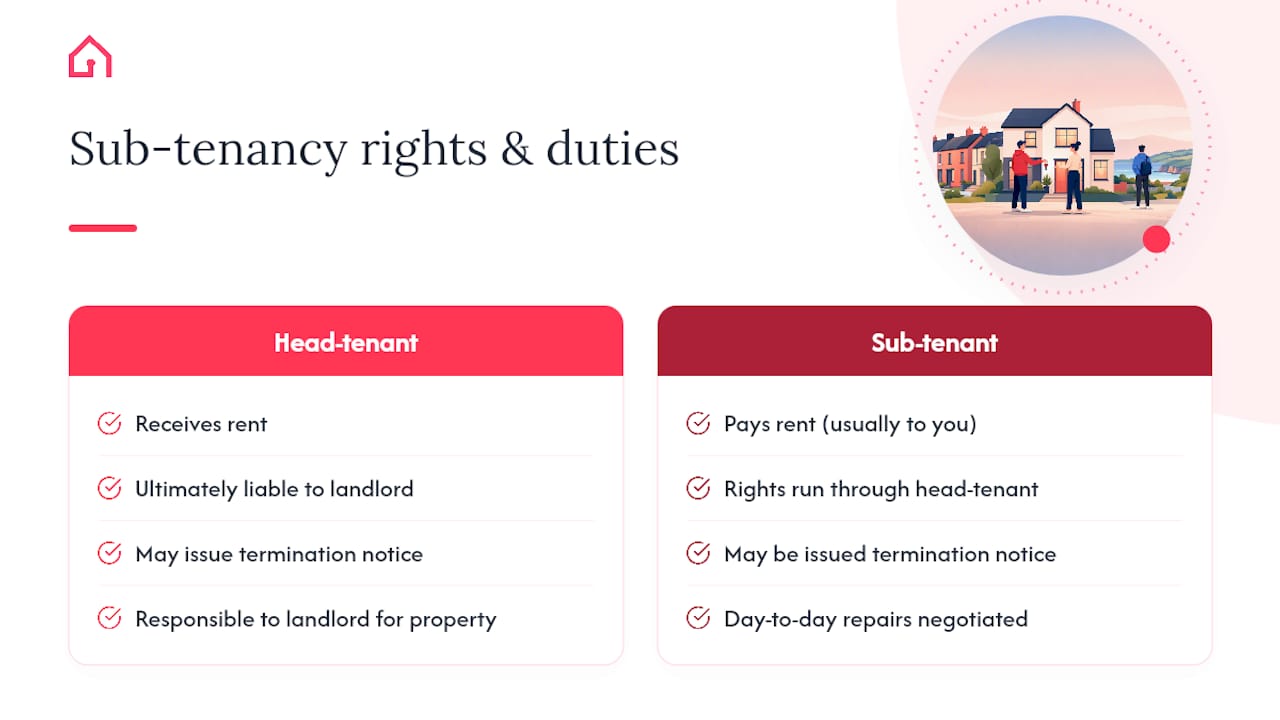
A sub-tenant's rights run through you, the head-tenant, not through the landlord directly. That single fact shapes almost everything else about the arrangement.
On rent, the sub-tenant pays you (or, in some agreed cases, pays the landlord directly with everyone's knowledge), and you remain the party ultimately liable if that rent doesn't get passed on. If a sub-tenant falls behind, you're within your rights to issue warnings and, eventually, a Notice of Termination against the sub-tenancy, provided it follows the same fair process a landlord would use against you: valid notice periods, a stated reason, and proper written notice.
Maintenance obligations split unevenly. You, as head-tenant, remain responsible to your landlord for the property's condition overall, while day-to-day repairs inside the sublet space are typically negotiated between you and your sub-tenant in the written agreement. If something structural breaks, such as a boiler or a leak, that request still needs to go through you to the landlord. A sub-tenant generally has no standing to contact the landlord directly, which is exactly why registration and a clear written agreement matter so much.
Eviction of a sub-tenant follows the same statutory notice periods that apply to any tenancy, scaled to how long they've lived there. A registered sub-tenancy gives both of you access to RTB dispute resolution if the eviction is contested. An unregistered one may leave the sub-tenant with no forum to challenge it at all, which sounds like an advantage for you until you remember the disclosure obligation under section 185 that's meant to prevent exactly that imbalance.
How subletting affects your own tenancy and your rights as head-tenant
Bringing in a sub-tenant doesn't replace your tenancy. It sits on top of it. You remain the legal tenant named on the original agreement, with every obligation to your landlord unchanged, rent, condition of the property, and behaviour clauses included.
This has a practical consequence many tenants miss: your Part 4 rights (the security of tenure that builds up the longer you stay) continue accruing exactly as before, because you haven't handed the tenancy over to anyone. Assignment would end your relationship with the landlord; subletting does not. That's precisely why the law treats the two so differently and why section 32 blocks part-only subletting of a Part 4 tenancy so firmly: it's designed to stop tenants fragmenting a protected tenancy into pieces that dodge the landlord's oversight.
Your standing with your landlord can still shift, though. A landlord who discovers an undisclosed or unauthorised sub-tenancy is entitled to treat it as a breach of the tenancy agreement, which can trigger termination proceedings against you, the original tenant, not just against the sub-tenant. In other words, an unauthorised sublet doesn't just put your sub-tenant's position at risk. It puts your own tenancy on the line too, along with any Part 4 rights you'd built up over years in the property.
Insurance and liability: the part tenants forget until it matters
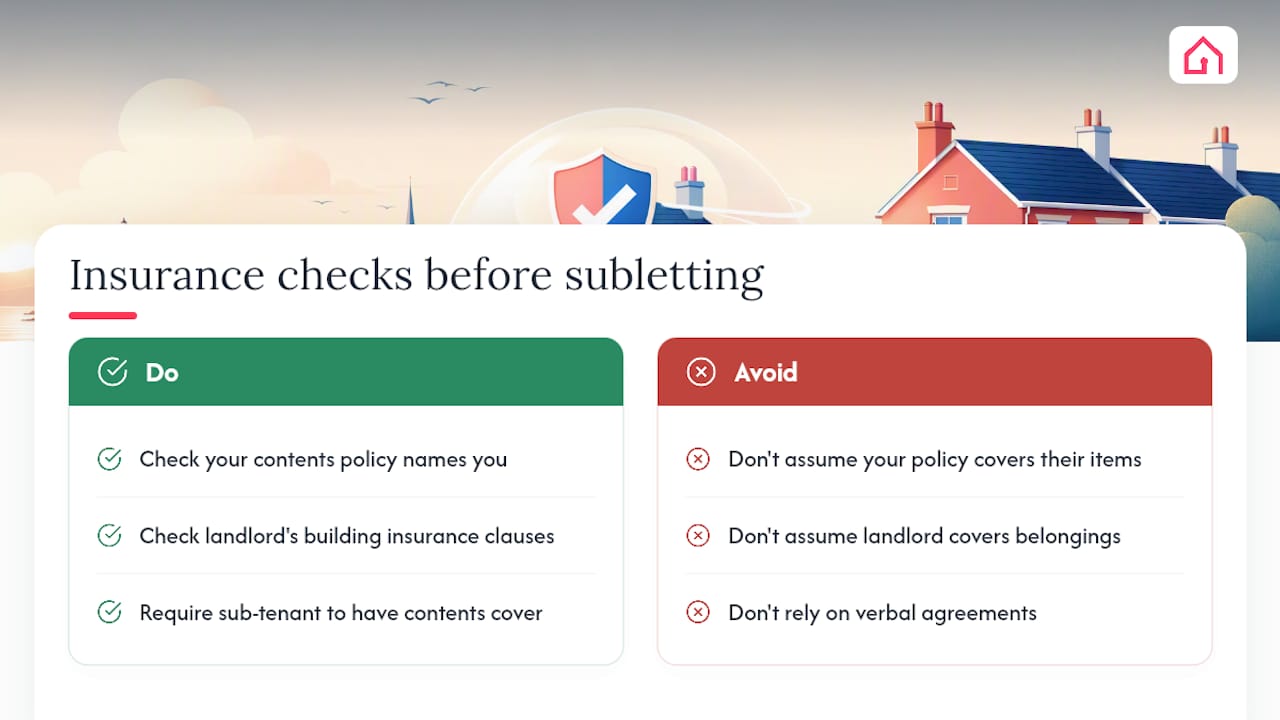
Most tenant contents insurance policies are written around a single named policyholder living in the property, and bringing in a sub-tenant without telling your insurer can quietly void your cover.
Check three things before anyone moves in. First, whether your own contents insurance names you specifically and whether adding an occupant who isn't a spouse or named dependant breaches the policy terms. Second, whether the landlord's building insurance (which covers the structure, not your belongings) has any occupancy clauses that assume the property is occupied only by tenants named on the tenancy agreement. Third, whether you need the sub-tenant to hold their own contents cover for their belongings, since your policy almost certainly won't extend to theirs.
Liability runs in a similar pattern to the legal obligations already covered. If a sub-tenant causes damage, floods a bathroom, starts a kitchen fire, you're the one your landlord will pursue first, because you're the party they have a contract with. Whether you can then recover that cost from your sub-tenant depends entirely on having a written agreement that actually says who's responsible for what. This is one more reason the simple written sub-tenancy agreement covered earlier isn't just good practice. It's the document that decides who pays when something goes wrong.
A publisher's take: subletting works best when nobody has to guess
Tenants sublet for good reasons: a job abroad for six months, a partner moving in, a friend needing a room fast. Landlords resist for good reasons too: an unknown occupant, an unregistered arrangement, a liability they can't see. Neither side is being unreasonable.
What actually resolves the tension is unglamorous: written consent, RTB registration, and a paper trail. The whole approach to renting rests on that same idea. Fewer verbal promises, more verifiable ones.
— Hauzed
A tool for tenants asking a landlord for subletting permission
Asking a landlord to approve a sub-tenant is easier when you can show, not just tell, who that person is. Some platforms give tenants verified profiles with identity checks and supporting documents handled through secure flows, so a request for consent comes with real evidence attached rather than a name and a hopeful message.
If you're the one being asked to vouch for a prospective sub-tenant, or you're trying to find a room yourself while sorting out a sublet, Hauzed centralises the messaging, scheduling, and profile-sharing that normally gets lost across text threads and WhatsApp groups. It won't replace the written agreement or the RTB1 form, but it makes the human side of the process, proving who someone is and keeping the conversation in one place, considerably less chaotic. Explore Hauzed's rental marketplace to see how verified profiles work before you next need one.
This article is general information, not a substitute for advice from a qualified lawyer. Consult a qualified legal professional about your own circumstances before acting on anything here.
Yes. Subletting without permission is a breach of the tenancy agreement, and a landlord can serve a Notice of Termination on those grounds, potentially ending the tenant's own tenancy, not just the sub-tenant's stay.
Can I let someone live in my house rent free in Ireland?
If you own the property outright, you can generally allow someone to stay rent free, though this may still affect certain means-tested entitlements. If you're a tenant yourself, this still counts as subletting and needs landlord permission regardless of whether rent changes hands.
What are the subletting rules in Ireland for registering a sub-tenancy?
A sub-tenancy must be registered with the RTB using the paper RTB1 form rather than the online system, and doing so gives both the head-tenant and sub-tenant access to RTB dispute resolution.
Do the new rent rules in Ireland from March 2026 change subletting requirements?
Rent pressure zone changes affect what landlords can charge, not the underlying subletting requirements: landlord permission, section 185 disclosure, and RTB1 registration remain in place regardless of rent rule changes.
Are the rules for short-term letting in Ireland the same as for subletting?
No. Short-term and holiday letting rules involve separate planning and registration requirements distinct from the subletting process covered here, and mixing the two up is a common and costly tenant mistake.