Landlords: Four Week KPI Fixes to Improve Lease Conversion With AI
17 September 2026
14 min read
Four week KPI plan for landlords to improve lease conversion. Implement five minute replies, self-scheduling, accurate unit listings and AI verification...
The single highest-impact action you can take is combining minute-level response speed with instant scheduling and a one-click application path. Respond to every enquiry within five minutes during business hours, and you convert far more leads than landlords who reply within the hour, according to DoorLoop's benchmark research. Pair that speed with tools like Hauzed, built around verified profiles and automated follow-up, and each stage of the funnel gets easier.
TL;DR:
Responding within five minutes during business hours significantly increases lease conversion rates, especially when combined with instant scheduling and one-click application links.
Using a lead-scoring system based on move-in timeline, budget, household needs, verification status, and engagement quality helps prioritize candidates most likely to sign.
Automated responses that confirm receipt and include scheduling links boost show-up rates and reduce costly no-shows without feeling impersonal.
Accurate, unit-level listing photos and videos, along with staged concessions and clear qualification details, improve lead quality and tenant retention.
Tracking each funnel stage separately allows targeted improvements, while verified marketplaces like Hauzed cut administrative friction and accelerate responses.
How do you improve lease conversion by responding faster?
Speed is the cheapest lever in leasing, and most landlords still get it wrong. A prospective tenant messaging five properties on a Saturday afternoon will tour whichever one answers first. Reply after they have already booked a viewing elsewhere and the lead is gone, no matter how good your unit is.
Set a firm service standard and stick to it. During business hours, aim to respond within five minutes. Outside those hours, an automated acknowledgement within one minute keeps the conversation alive until a human can take over. DoorLoop's data backs this up directly: leads contacted within minutes convert at meaningfully higher rates than those left waiting.
The practical setup looks like this:
Centralise every enquiry (portal messages, phone calls, walk-ins, social media DMs) into a single dashboard or CRM so nothing sits unread in a separate inbox.
Configure an instant auto-reply that confirms receipt, states your typical response window, and links directly to a scheduling calendar.
Assign ownership: one person (or one automated workflow) is accountable for every lead the moment it lands, not "whoever sees it first".
Review response-time reports weekly, not quarterly, since drift happens fast when a leasing agent gets busy.
Automated replies don't need to feel robotic. A well-written message that says "Thanks for your interest in Unit 4B. Here's a link to book a viewing this week" does more work than a generic "we'll be in touch soon." Tools like Hauzed's Echo handle exactly this kind of first-touch reply and ongoing follow-up, so a landlord managing three properties isn't glued to their phone every evening.
Pro Tip:Test your own response time this week. Send yourself an enquiry through your listing and time how long it takes before someone (or something) replies. Most landlords are shocked by the gap between what they assume and what actually happens.
Which lead-qualification criteria predict a signed lease?
Not every enquiry deserves the same amount of attention, and treating them equally is how good leads go cold while you chase people who were never going to sign. A simple scoring system lets you focus effort where it pays off.
Score each lead against a handful of criteria that actually predict conversion:
Move-in timeline — someone needing a home within two weeks scores higher than someone browsing for a date six months out.
Budget fit — a stated budget that matches or exceeds your asking rent is a strong signal; a lowball enquiry rarely converts.
Household composition — pets, group size, and guarantor needs affect eligibility and should be flagged early, not discovered at application stage.
Pre-verification status — a tenant who has already completed identity or income verification is measurably further along than an anonymous message.
Engagement quality — specific questions about the unit ("does the second bedroom get morning light?") beat generic "is this still available?" messages.
Once scored, split leads into tiers and match your follow-up cadence to each. Hot leads (high scores across the board) get a call or message within minutes and a same-day tour offer. Warm leads get a same-day reply with a scheduling link but less urgency. Cold leads go into a nurture sequence, a weekly check-in rather than daily chasing.
Pre-qualification also protects your calendar. A tenant who's already confirmed their move-in date, budget, and household size before touring is far less likely to waste a viewing slot, and far more likely to move through screening without last-minute surprises. That single filtering step is often what separates a leasing agent doing ten tours per signed lease from one doing four.
Does self-scheduling actually reduce your vacancy days?
Every phone call spent coordinating a viewing time is a chance for the prospect to lose interest or book with a competing property instead. Self-scheduling tools remove that back-and-forth entirely, and the effect on show-up rates is significant.
Give every qualified lead a direct link to your live availability calendar, with clear rules about which slots are open, how far in advance they need to book, and what happens if they're running late. This alone cuts the email-tag that kills momentum on a lead that was hot an hour ago.
Media matters just as much as scheduling mechanics. Listings with unit-level photos and a short walk-through video convert better than generic marketing shots, because prospects arrive already knowing what they're touring rather than discovering mismatches on arrival. Spanr's research on rental listings confirms that accurate, unit-specific media reduces wasted tours by filtering out low-intent viewers before they book.
A few operational habits protect show-up rates once the booking is made:
Send a confirmation immediately after booking, with the address, unit number, and a contact name.
Follow up with a reminder 24 hours before and again two hours before the tour.
Make rescheduling one click, not a phone call, so a genuine conflict doesn't turn into a no-show.
Ask a short pre-tour question ("anything specific you want to see?") to keep the prospect engaged before arrival.
No-shows are one of the most expensive leaks in the funnel because they consume staff time and calendar slots that a real prospect could have used. Tightening confirmation and reminder cadence is one of the fastest wins available, and it costs nothing beyond setting up the automation once.
What's the fastest way to move applicants to signed leases?
Approval isn't the finish line. Plenty of leases die between "you're approved" and "signature received," usually because the process asks too much of a tenant who's already made their decision emotionally and is now facing paperwork friction.
Build the application-to-signature path so nothing requires a phone call or a printed document. That means:
A one-click online application form that pre-fills information already captured during enquiry, rather than asking the same questions twice.
Integrated identity verification and background/credit checks, run with proper consent and in line with local data protection rules, so approval decisions happen in hours rather than days.
E-signature completion built into the same flow, with deposit or first-payment options available where your jurisdiction and payment provider allow it.
A hard deadline communicated at approval ("this offer holds for 48 hours") so the tenant knows exactly what happens next and when.
The tenants most likely to drop off after approval are the ones left waiting, uncertain whether they need to do anything else. A message that says "you're approved, here's your lease link, sign by Friday to hold the unit" removes that ambiguity entirely. Hauzed's own guidance on the rental application process covers this execution stage in more detail, including how to sequence document requests so applicants aren't overwhelmed at once.
Pro Tip:Never send a lease document without a stated deadline. An open-ended "sign whenever" invites the tenant to keep comparing options, even after they've said yes.
Screening speed compounds here too. A tenant screening checklist that's set up in advance, rather than improvised per applicant, shaves days off approval turnaround and directly protects your conversion rate at this stage.
Why do accurate listings convert better than polished ones?
A beautifully staged photo of a "similar unit" might get more clicks, but it produces worse leads. Prospects who tour expecting the photographed unit and find something different walk away disappointed, and some walk away entirely.
Use real, unit-level photography and a short walk-through clip for every listing, not a representative sample from a similar floor plan elsewhere in the building. Spanr's guidance on rental listings makes the case plainly: transparency at the listing stage filters for genuinely interested prospects and cuts down on wasted viewings.
Pricing and incentives need the same discipline. Reactive rent cuts, dropping the price the moment a unit sits empty for two weeks, train the market to wait you out and depress your rent roll for future re-lets. A better approach is planning concession sequences ahead of a lease-up: a small move-in credit in week one, a slightly larger one if the unit is still vacant in week three, rather than an outright permanent discount applied the moment vacancy starts to sting. Staged, prorated concessions tend to protect long-term rent better than a lump-sum markdown, since they don't reset market expectations for the next tenant.
Your listing copy itself should do some of the qualifying work:
State the required income multiple (commonly two and a half to three times monthly rent) up front, so unaffordable enquiries self-select out.
Give a clear move-in date rather than "available now" when the unit needs turnover work.
State the pet policy explicitly, including any breed or size restrictions, rather than leaving it for a mid-conversation surprise.
List parking, storage, and utility inclusions, since ambiguity here generates disqualifying questions late in the process.
Accurate listings don't just convert better; they also produce tenants who stay longer, because expectations were set correctly before move-in.
— Hauzed
How do you measure and diagnose your leasing funnel?
You cannot fix what you don't measure at the right stage, and most landlords only track one number: total leads. That tells you almost nothing about where conversion is actually failing.
Break the funnel into six stages and track the ratio between each: impressions to leads, lead to tour, tour to application, application to approval, and approval to signed lease. This staged view, laid out in Botway's leasing funnel analytics framework, lets you pinpoint exactly which handoff is bleeding prospects rather than guessing at a vague "conversion problem."
Funnel stage
What it measures
Signal of a problem
Impressions → lead
Listing quality and pricing fit
Low click-through despite good traffic
Lead → tour
Response speed and scheduling ease
Leads go cold before booking
Tour → application
Unit accuracy and agent rapport
High tour volume, low applications
Application → approval
Screening speed and requirements clarity
Applicants stall or abandon mid-process
Approval → signed lease
Execution friction (e-sign, deposit, deadlines)
Approved tenants disappear before signing
Each broken stage points to a different fix. A weak lead-to-tour ratio usually means response time or scheduling friction, not a bad listing. A weak tour-to-application ratio often means the unit didn't match its photos. A weak approval-to-signed-lease ratio almost always means execution delay, not tenant hesitation.
Run a simple four-week audit: pick one property, track all five ratios weekly, change exactly one variable (say, response SLA), and measure the shift before touching anything else. Practitioners generally agree that conversion failures come from process friction rather than a genuine lack of demand, which is exactly why isolating one variable at a time matters more than overhauling everything simultaneously. Change too much at once and you'll never know which fix actually worked.
How does a verified marketplace reduce leasing friction?
Every tactic above assumes you have the time and staff to execute it consistently, week after week, across every property you manage. That's the part most guides skip.
Hauzed approaches this from the trust side first. Every tenant profile on the platform goes through identity verification before serious conversation starts, which means the messages landing in your inbox come from people who are further along than an anonymous portal enquiry. That alone removes a chunk of the manual filtering that eats a landlord's evening.
The AI agents map directly onto the funnel leaks described above:
Hauzer surfaces tenant matches for a property automatically, so instead of scanning every message manually, you review a shortlist of candidates who already fit your criteria.
Echo handles first-touch replies and ongoing follow-up, keeping response times inside the five-minute window even when you're not at your desk.
Lia supports leasing conversations and WhatsApp-style workflows where available, carrying a prospect from initial interest toward a booked viewing without every message needing a human typed reply.
The practical effect landlords report is fewer low-quality messages cluttering the inbox, faster movement from enquiry to screening, and viewing invitations going out within minutes rather than at the end of the day. Verification doesn't guarantee a tenant will be approved, and Hauzed doesn't claim otherwise; it simply means the interest arriving is more likely to be real.
A landlord managing three properties on evenings and weekends doesn't need more leads. They need fewer bad ones and faster movement on the good ones, which is a different problem entirely.
This is the space where case studies and property-specific conversion metrics will strengthen the picture further as more landlords run the workflow end to end.
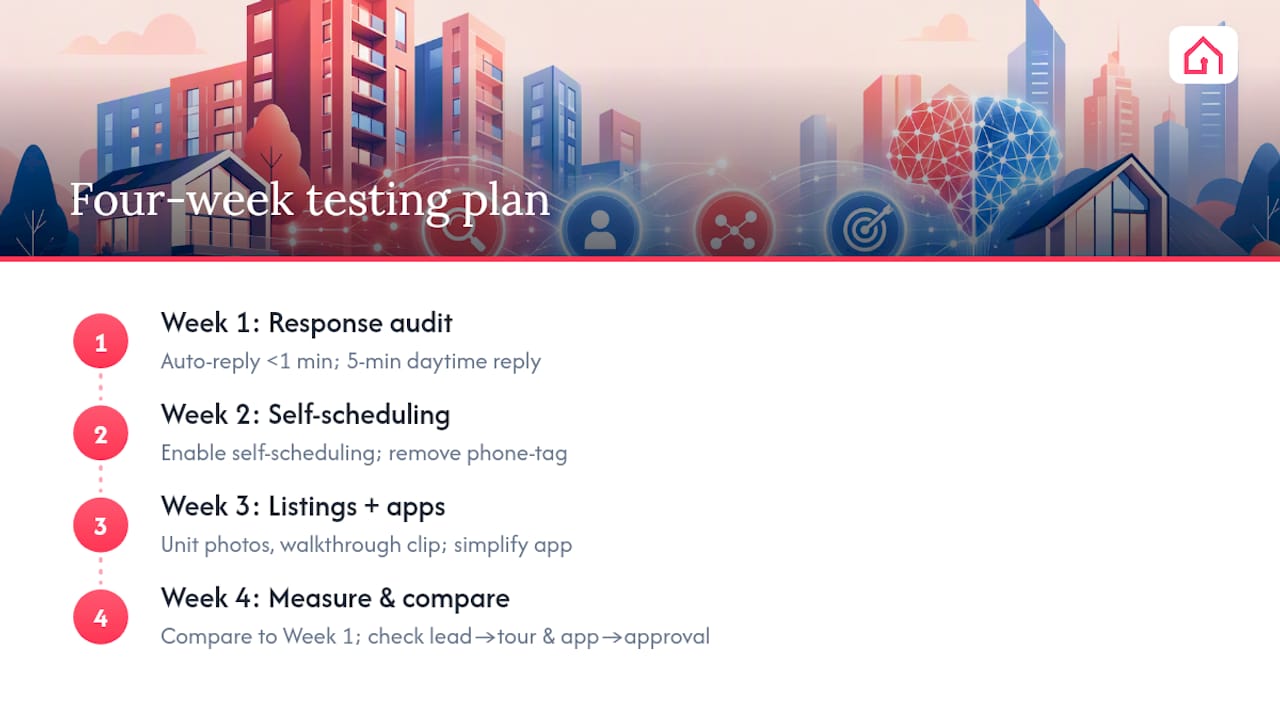
Your four-week plan to test these changes
You don't need to overhaul everything at once. Test the highest-impact changes in sequence, over four weeks, and measure what actually moves the needle before scaling it across your portfolio.
Week 1: Audit your current response times honestly. Set up an auto-reply that fires within one minute outside business hours and commit to a five-minute human response during the day.
Week 2: Turn on self-scheduling for viewings. Remove the phone-tag entirely and watch your lead-to-tour ratio for early movement.
Week 3: Replace any generic listing photos with unit-level images and a short walk-through clip. Simplify your application so nothing requires a duplicate entry of information you already collected.
Week 4: Pull your funnel numbers and compare them against week one. Look specifically at lead-to-tour and application-to-approval, since these two stages usually show the fastest movement from response-time and friction fixes.
Change one variable per week where possible. If you overhaul response time, scheduling, and listings simultaneously, you'll have a better funnel but no idea which fix earned it. Whatever moves the number, do it on your next property too, and keep the discipline of measuring before you scale.
If you're managing this manually across spreadsheets, WhatsApp threads, and a personal inbox, the tactics above are hard to sustain past a handful of properties. Some platforms are built to carry that operational weight, using verified tenant profiles and AI agents to keep response times and follow-up consistent without needing constant online presence.
Solo landlords with one or two units benefit from the Free Plan to get started with basic listing and matching support. Landlords running several properties who want fuller automation typically move to a paid plan for expanded AI usage and priority support, while agencies managing larger portfolios lean on bulk publishing and team accounts. If you'd rather hand off the entire setup, the Full Assistance Pack is a one-off service for landlords who want the workflow built for them.
Explore the AI agents behind Hauzer, Echo, and Lia to see how they fit your current process, or browse live rental listings to see the verified-tenant marketplace from the tenant side first.
Sources
The benchmarks and diagnostic framework in this guide draw on the following sources:
A leasehold improvement is a structural or cosmetic change made to a rented space to suit a tenant's needs, such as new flooring, partition walls, or updated fixtures. It's distinct from routine maintenance and typically becomes part of the property once the lease ends.
Can You Give an Example of a Leasehold Improvement?
A common example is a commercial tenant installing custom shelving, upgraded lighting, or a reception desk in a leased retail unit. Residential examples are rarer but can include built-in wardrobes or a modified kitchen layout agreed with the landlord in advance.
Who Typically Pays for Leasehold Improvements?
Payment responsibility depends on the lease agreement. Landlords sometimes offer a tenant improvement allowance to attract stronger applicants during lease-up, while other agreements leave the full cost to the tenant with landlord approval required beforehand.
How Do You Increase a Lease on a Flat?
Rent increases on an existing lease are governed by local tenancy law and usually require written notice within a set timeframe before the increase takes effect. For new lease conversions, the fastest route to a stronger offer is a fast response time, an accurate unit-level listing, and a frictionless application process, since these consistently outperform reactive rent changes.
How Can Hauzed Help Improve Lease Conversion?
Hauzed combines identity-verified tenant profiles with AI agents (Hauzer for matching, Echo for follow-up, Lia for leasing conversations) that reduce manual filtering and speed up response times. Pricing details for the Free Plan and Full Assistance Pack are available on Hauzed's pricing page.