Discover what is Irish rental market explained in 2026. Learn key changes, laws, and how rent is controlled. Get informed today!
The Irish rental market is defined as the regulated system through which private landlords, institutional investors, and approved housing bodies let residential properties to tenants across Ireland, governed primarily by the Residential Tenancies Board (RTB). As of Q1 2026, registered tenancies reached 246,477, a 2.4% increase year-on-year. That figure tells you the market is growing, but it does not tell you how complex the rules have become. Understanding what is irish rental market explained means grasping three things at once: who the participants are, what the law now requires, and how rent is set and controlled. This guide covers all three, with the most important 2026 changes front and centre.
What is the Irish rental market and how does it work?
The Irish rental market operates under a framework set by the Residential Tenancies Acts and enforced by the RTB, a statutory body responsible for tenancy registration, dispute resolution, and rent data publication. Every private tenancy must be registered with the RTB. Landlords who fail to register face compliance notices and financial sanctions.
The market includes private landlords, cost-rental providers, and Approved Housing Bodies (AHBs). Private landlords account for the largest share by number, with 105,847 registered as of Q1 2026, up 1.3% year-on-year. Cost-rental and AHB tenancies form a smaller but growing segment, offering below-market rents to eligible tenants.
Tenancy agreements in Ireland fall into several categories, including fixed-term, part IV (security of tenure), and the newer minimum-duration tenancies introduced in 2026. Understanding which agreement type applies to your situation is the first practical step for both tenants and landlords.
What did the Residential Tenancies Act 2026 change?
The Residential Tenancies (Miscellaneous Provisions) Act 2026 is the most significant reform to Irish tenancy law in over a decade. It came into effect on 1 March 2026 and reshaped how tenancies are structured, how rent increases work, and how landlords can end a tenancy.
Related Topics
#ireland rental market explained examples#navigate irish rental market guide#what is irish rental market explained#Irish housing market explained#how does the Irish rental market work#Irish rental market overview#understanding Irish rental laws#cost of renting in Ireland#what to expect in Irish rentals#Irish rental market challenges#current trends in Irish rentals
Related Articles
Six-year minimum tenancy terms
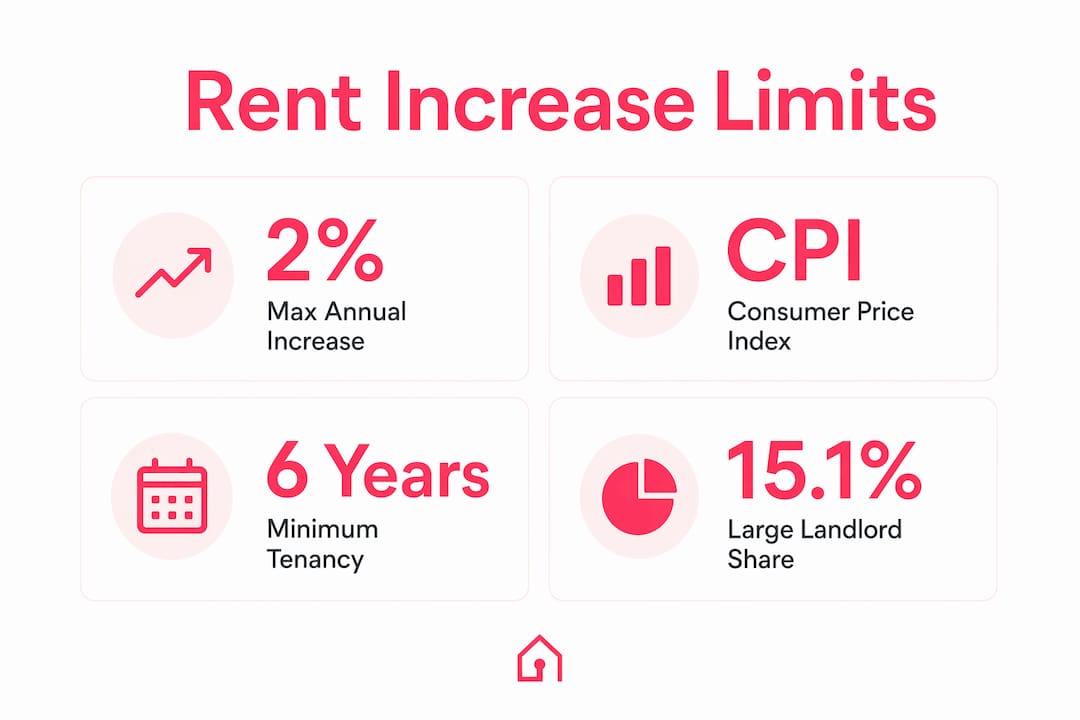
The Act introduced Tenancies of Minimum Duration, requiring a minimum six-year term for most new tenancies. This replaces the previous Part IV rolling system for tenancies created after the commencement date. Rent resets to market rate are permitted only at the end of each six-year term or between separate tenancies.
Rent increase limits
Annual rent increases are now capped at 2% per annum or the Consumer Price Index (CPI), whichever is lower. This applies to both private and cost-rental tenancies in most cases. The cap prevents landlords from raising rents sharply mid-tenancy, giving sitting tenants greater financial predictability.
Small versus large landlord rules
The Act draws a clear line between small and large landlords, and the distinction has real consequences:
Small landlords hold three or fewer tenancies. They retain broader termination rights, including the ability to end a tenancy for personal or family use.
Large landlords hold four or more tenancies, or are companies. They face stricter termination rules and reduced grounds for ending a tenancy.
The tenancy start date determines which legal regime applies. Tenancies begun before 1 March 2026 follow the old rules; those begun on or after that date follow the new framework.
Pro Tip:Always confirm your tenancy start date in writing before signing. That single date determines which version of the law governs your entire tenancy, including your rights on rent increases and termination.
Legal experts note that strict procedural requirements for landlords have risen sharply. A rent notice or termination notice that does not follow the correct format is invalid, even if the underlying reason is legitimate.
Who are the landlords and tenants in the Irish market?
The Irish rental market is not a single, uniform system. It is made up of distinct landlord types and tenant groups, each operating under different rules and facing different pressures.
Landlord size and market share
Landlord type
Tenancy share nationally
Tenancy share in Dublin
Large landlords (100+ tenancies)
15.1%
29%
Small private landlords
Majority by number
Minority by volume
Large landlords with 100 or more tenancies now provide 15.1% of all private tenancies nationally. In Dublin, that figure rises to 29%. This growing institutional presence means a significant share of Dublin renters are dealing with corporate landlords rather than individual property owners, which changes the nature of the tenancy relationship and the applicable termination rules.
Small private landlords still dominate by sheer number. Most hold one to three properties and manage them personally. Their experience of the rental market is very different from that of an institutional investor with hundreds of units and a dedicated compliance team.
Student accommodation
Student-specific accommodation operates under its own rent rules. Rents in purpose-built student accommodation may increase annually by 2% or CPI, but resets to market rate are only permitted every three years, starting 1 March 2029. New student developments built after 10 June 2025 are exempt from the 2% cap but remain subject to structured rent resets. This distinction matters if you are a student searching for accommodation or a developer planning a new scheme.
What are the current rent trends and termination patterns?
Rent prices in Ireland continue to rise, but the gap between new and existing tenants is one of the most striking features of the current market.
New tenancy rents increased 5% year-on-year to an average of €1,755 per month as of Q4 2025. Existing tenancy rents rose 4.4% to €1,503 per month over the same period. Sitting tenants pay, on average, €252 less per month than new tenants. That gap is a direct result of rent increase caps protecting existing tenants while new tenancy rents reset to market rate.
Tenancy type
Average monthly rent (Q4 2025)
Year-on-year increase
New tenancies
€1,755
5.0%
Existing tenancies
€1,503
4.4%
Difference
€252
—
This pricing gap creates a strong incentive for sitting tenants to stay put. It also explains why Notices of Termination have become a critical issue. The RTB recorded 7,062 Notices of Termination in Q1 2026, the highest quarterly figure on record. Sixty percent of those notices cited intended property sales as the reason. That means the primary driver of tenant displacement is not rent arrears or anti-social behaviour. It is landlords exiting the market entirely.
Industry commentators view the 2026 reforms as paving the way for long-term tenancy stability and increased institutional investment, despite this short-term disruption. The logic is that longer minimum terms and capped increases make the market more predictable for both sides, even if the transition period is uncomfortable.
How do you navigate the Irish rental market as a tenant or landlord?
Knowing the rules is one thing. Applying them correctly in practice is another. The 2026 reforms created what legal analysts describe as a layered system of tenancy law, where the applicable rules depend entirely on when the tenancy started. Both tenants and landlords must verify which regime governs their agreement before taking any formal action.
For tenants
Confirm your tenancy start date. This determines whether the six-year minimum term applies to you and which rent increase rules govern your agreement.
Check RTB registration. Your landlord is legally required to register your tenancy. You can verify this on the RTB website. Unregistered tenancies are a red flag.
Know your rent increase rights. If your tenancy started on or after 1 March 2026, your rent cannot increase by more than 2% per annum or CPI. Any notice that exceeds this is invalid.
Read your tenancy agreement carefully. Fixed-term clauses, break options, and notice periods all affect your security of tenure.
Use the RTB dispute resolution service if your landlord issues an invalid notice or breaches rent rules. The RTB has enforcement powers and issues financial sanctions.
For landlords
Compliance is not optional. The RTB issued 19 sanctions totalling €78,849 in early 2026, with 151 compliance notices issued for failure to register tenancies. Non-compliance creates long-term liability, not just a one-off fine.
Short-term lets add another layer of complexity. Lets under 14 days require explicit planning permission and are subject to rent pressure zone rules. Landlords who have been using platforms for short-term holiday rentals in rent pressure zones must obtain planning permission or return the property to the long-term rental market.
Pro Tip:If you are a small landlord considering exiting the market, take legal advice before issuing a Notice of Termination. The grounds, format, and notice period must all be correct. An invalid notice restarts the clock and delays your exit.
For a detailed breakdown of your rights and obligations under the 2026 framework, the 2026 landlord-tenant law guide on the Hauzed blog is a practical starting point.
Key takeaways
The Irish rental market in 2026 is shaped by the six-year minimum tenancy term, a 2% annual rent cap, and a record level of termination notices driven primarily by landlords selling up.
Point
Details
Tenancy start date matters
The date your tenancy began determines which legal rules apply to rent increases and termination.
Rent gap is significant
New tenants pay an average of €252 more per month than sitting tenants in equivalent properties.
Termination notices are rising
Q1 2026 saw a record 7,062 notices, with 60% linked to property sales rather than tenant behaviour.
Institutional landlords are growing
Large landlords now provide 29% of private tenancies in Dublin, reshaping the city's rental dynamic.
Non-compliance carries real costs
The RTB issued sanctions and 151 compliance notices in early 2026, signalling active enforcement.
The rental market is more layered than most people realise
From where Hauzed sits, the most underappreciated challenge in the Irish rental market is not the cost of renting. It is the sheer complexity of knowing which rules apply to you at any given moment.
The 2026 reforms are well-intentioned. Longer minimum terms protect tenants from frequent displacement. Rent caps give sitting tenants financial breathing room. But the layered system, where your rights depend on a tenancy start date that may be buried in a document you signed years ago, creates genuine confusion for both sides. Tenants who do not know their start date cannot challenge an invalid rent increase. Landlords who do not understand the small versus large landlord distinction may issue termination notices that are legally void.
The record number of termination notices in Q1 2026 is a warning signal. When landlords exit at scale, supply tightens, new tenancy rents rise faster, and the gap between what sitting tenants pay and what new tenants pay widens further. That cycle is already visible in the data.
The practical advice is straightforward: get your paperwork in order, know your category, and use the RTB's resources before taking any formal step. The market rewards preparation. For tenants, a strong, verified profile and a clear understanding of your rights puts you ahead of most applicants. For landlords, clean registration and correct notice procedures protect you from costly disputes.
— Hauzed
Renting safely in Ireland with Hauzed
The Irish rental market rewards those who are prepared and verified. Hauzed is a trust-first rental marketplace for Ireland, starting with Dublin, built to make the rental process safer and more organised for both tenants and landlords.
Tenants can build a verified rental profile, search listings, send requests, and coordinate viewings without relying on anonymous channels or fragmented message threads. Landlords and agencies can receive better-qualified interest, use AI matching with Hauzer, manage conversations with Echo, and handle their full rental workflow from one place. Whether you are searching for your next home or managing a portfolio, Hauzed gives you a clearer, safer path through a market that has never been more regulated. Browse rental properties and see how verified renting works in practice.
FAQ
What is the Irish rental market?
The Irish rental market is the regulated system through which landlords let residential properties to tenants across Ireland, overseen by the Residential Tenancies Board (RTB). It includes private, cost-rental, and Approved Housing Body tenancies, with 246,477 registered tenancies recorded in Q1 2026.
How does rent control work in Ireland in 2026?
Under the Residential Tenancies (Miscellaneous Provisions) Act 2026, annual rent increases are capped at 2% or CPI, whichever is lower. Rents can only reset to market rate at the end of a six-year tenancy term or between separate tenancies.
What are the most common reasons for tenancy terminations in Ireland?
The RTB recorded 7,062 Notices of Termination in Q1 2026, the highest quarterly figure on record. Sixty percent of those notices cited intended property sales, meaning most terminations are driven by landlords leaving the market rather than tenant-related issues.
What is the difference between a small and large landlord in Ireland?
A small landlord holds three or fewer tenancies and retains broader termination rights, including grounds for personal or family use. A large landlord holds four or more tenancies or is a company, and faces stricter rules on ending a tenancy under the 2026 Act.
Do tenants in Ireland have to pay to use Hauzed?
Hauzed is free for tenants. You can browse listings without an account and create a profile to send requests, save listings, and chat with landlords. Identity verification may be required for certain interactions, which increases trust but does not guarantee rental approval.