Stop missing rental leads: verified intake and AI routing for agents
16 September 2026
18 min read
Pair rule-based rental lead routing with verified tenant intake and AI matching. Letting teams and landlords route leads faster, cut filtering time, and...
Rental lead routing is the automated process of sending each new enquiry to the right agent, team or workflow the moment it arrives, based on rules such as location, unit type or source channel. The single most important move for any letting team is instant delivery paired with a reliable fallback: if the first agent doesn't respond within a set window, the lead automatically re-routes. Get that right and you keep more prospects warm, book more viewings, and lose fewer leads to silence.
TL;DR:
Accurate routing rules require clear naming, specific matching criteria, and appropriate distribution methods to avoid leads sitting unanswered or misassigned.
Capacity caps and automatic availability status help prevent agents from being overwhelmed or missing timely responses to urgent inquiries.
Connecting all lead sources through a unified intake system minimizes lost or duplicated leads and ensures routing rules operate effectively across channels.
Lead scoring based on signals like budget, timing, and source channel enables prioritization and faster responses for high-value prospects.
Regular monitoring of response times, acceptance rates, and conversion metrics is essential to maintain routing efficiency and address evolving team or market conditions.
#rental lead management#automated lead assignment#lead distribution systems#how to optimize lead routing#rental lead routing#real estate lead routing#property rental leads
What is rental lead routing and which method should you use?
Every routing setup boils down to one of four core methods, and picking the wrong one for your team size is the single biggest reason leads sit unanswered; property managers can also benefit greatly from a structured Property Partner Program to streamline operations and improve lead handling. None of these methods is inherently better than another. They solve different problems, and most growing letting teams end up blending two of them.
Round robin cycles leads evenly across a list of agents, one after another, regardless of who's busy or what they're good at. A three-person team splitting general enquiries for a portfolio of similar flats works well here. It's simple and fair, but it ignores specialism entirely, so a student-housing expert might get a luxury penthouse enquiry with no relevant experience.
Waterfall routing sends a lead to one agent first, then cascades to the next person on the list only if the first doesn't respond within a set time. This suits smaller teams where one senior agent should get first refusal on every enquiry, with a backup ready if they're on a viewing. The trade-off is speed for everyone below the top of the list, since a lead can spend several minutes waiting before it reaches someone available.
Weighted routing assigns leads based on a percentage split rather than a strict rotation, so a top performer might receive 40% of leads while a newer agent gets 15%. Agencies use this to protect revenue by favouring proven closers, though it can breed resentment if newer agents never get a fair shot at building a pipeline.
Ping post (also called ping tree) broadcasts a lead to multiple recipients simultaneously and awards it to whoever accepts first, a method borrowed from insurance and mortgage lead-generation markets. According to Lead Distro AI, modern routing engines can execute these decisions in under a second, supporting all four methods depending on the rules configured.
Round robin: fair distribution, weak on specialism, best for homogeneous portfolios
Waterfall: strong hierarchy control, slower for lower-priority agents
Weighted: rewards performance, risks morale issues if unmanaged
Ping post: fastest acceptance, needs multiple available agents to work well
How do you build a routing rule step by step?
A routing rule needs five components to function properly, and most misfires trace back to skipping one of them. Whether you're configuring this inside a CRM, a property management platform, or a dedicated routing tool, the sequence stays the same.
Name the rule clearly. Something like "Dublin 2BR Waterfall" beats "Rule 4" when you're auditing dozens of rules later.
Define the recipients. List the specific agents, teams, or inboxes eligible to receive leads under this rule.
Set the matching criteria. Common fields include geography (postcode or area), unit type, price band, and source channel (portal, website form, WhatsApp).
Assign weight or priority. Decide whether this rule fires before others, and whether leads split evenly or favour specific agents.
Configure the distribution method. Choose round robin, waterfall, weighted, or ping post based on what you established above.
Set the acceptance window. Give the first agent a fixed period, often five to ten minutes, to acknowledge the lead before it re-routes.
Vendor documentation from BoldTrail's routing overview confirms this structure: scope, name, recipients, criteria, distribution, and priority order are the standard building blocks across most routing engines. Rule priority matters as much as the rule itself. If two rules both match a lead, the one higher in your priority list wins, so put your most specific rules (like a named building or premium listing) above your general catchall rules.
When a timeout occurs, don't let the lead simply vanish into a queue. It should re-route to the next agent, alert a manager, or drop into a shared inbox that someone checks hourly.
Pro Tip:Start with a five-minute acceptance window on your highest-value leads and a longer window on lower-priority ones. Tightening the timeout later is easy; loosening a rule that's already lost you leads is not.
How do agent capacity and availability affect routing?
Capacity caps stop a single agent from being buried under twenty leads while a colleague sits idle. Setting a maximum number of open leads per agent, often between five and fifteen depending on your average sales cycle, means routing automatically skips anyone already at their limit and passes the lead to the next available person.
Availability scheduling solves a different problem: routing to someone who isn't actually working. An agent on annual leave or finished for the day shouldn't receive a lead only to leave it cold overnight, since a delayed first response quietly kills conversion rates. Most routing systems let you mark agents as paused or offline, either manually or through calendar integration, so the engine automatically skips them.
Practical rules worth setting:
Cap active leads per agent based on your team's realistic follow-up capacity rather than an aspirational figure.
Pause agents automatically outside working hours rather than relying on someone remembering to toggle a setting.
Build re-route rules that log every handoff, so you can see which agents habitually miss their acceptance window.
Rotate weekend or evening coverage explicitly rather than assuming someone will "just check their phone."
Logging matters more than most teams realise. When a lead bounces from agent to agent because nobody accepted it, that pattern usually points to either an unrealistic cap or a genuine staffing gap, and you won't spot either without a record of every re-route event.
Which channels and integrations does rental lead routing need?
Rental enquiries arrive from more places than most teams admit, and every unconnected channel is a lead sitting in someone's personal inbox instead of your routing system. Portal enquiries, website contact forms, phone calls, live chat widgets, and WhatsApp messages each carry different intent signals. A portal lead browsing five similar listings usually has lower urgency than someone who's just called your office number.
Delivery methods matter as much as capture. The most reliable setup uses a failover chain: a webhook fires the lead into your routing engine instantly, that pushes it into your CRM as the system of record, and if either step fails, an SMS or email fallback ensures the lead still reaches a human. According to Lead Distro AI, routing built this way can complete assignment in under a second, which matters because the Lead Response Management study found that contacting a lead within the first few minutes dramatically increases the odds of reaching them at all.
A single intake layer that ties portals, your website, and messaging apps together avoids the two most common failures: lost leads that never reach a routing rule, and duplicated leads that confuse whoever picks them up.
Portal enquiries: moderate intent, high volume, usually comparing several properties
Website forms: higher intent, often already narrowed to one or two units
Phone calls: highest urgency, needs immediate live pickup or fast callback
Chat and WhatsApp: fast-moving, expects a near-instant reply or the conversation dies
Pro Tip:If your portal, website, and WhatsApp leads land in three separate places, you don't have a routing problem yet. You have a visibility problem, and no amount of clever rules will fix it until every channel feeds one system.
How do you score and prioritise high-value rental leads?
Not every enquiry deserves the same speed of response, and a simple scoring model lets your routing rules treat a serious applicant differently from someone idly browsing. Three to five signals are usually enough to start: budget fit against the listed rent, move-in date proximity, completeness of the enquiry (phone number provided, specific unit named), and source channel, since a direct phone call typically signals more urgency than a portal message.
A basic weighting might give budget fit and move-in urgency the heaviest weight, with channel and message completeness as smaller modifiers. The exact numbers matter less than having any structure at all. Once a lead crosses your high-score threshold, the rule attached to it should behave differently: route it to your most senior available agent, trigger an immediate phone call rather than a queued message, or fire both an SMS and an email simultaneously instead of relying on one channel.
Budget fit: does the enquiry's stated range match the listing's rent?
Move-in timing: is the prospective tenant ready now or browsing for a date month away?
Enquiry completeness: did they leave a phone number and specify a unit?
Source channel: a phone call or direct message usually outranks a generic portal click
Keep the model simple at launch. A five-input spreadsheet reviewed weekly beats an elaborate scoring engine nobody understands or trusts. Adjust weightings once you have a few months of lead-to-lease data showing which signals actually predicted a signed tenancy.
What mistakes quietly break rental lead routing?
Over-engineering is the most common failure. Teams build fifteen nested rules to cover every edge case, then nobody can explain why a specific lead went where it did, and fixing one rule breaks three others. Start with three or four rules covering your highest-volume scenarios, then expand only when you have evidence a gap exists.
Poor data quality causes the second most damage. If your intake form doesn't capture postcode or unit type reliably, no routing rule built on that criteria will fire correctly, and leads default to a catchall queue nobody prioritises. Missing fallbacks compound this: a rule with no re-route timeout means a lead can sit with an unresponsive agent indefinitely.
Analysis from Chili Piper's routing guide points to speed-to-lead decay, fairness drift, and misaligned data as the three recurring causes of routing failure, and treats routing as something requiring ongoing maintenance rather than a one-time setup.
Skipping fallback rules entirely, leaving leads with no escape route
Letting stale templates confuse agents about what a lead actually wants
Never reviewing whether weighted splits still reflect current agent performance
Ignoring duplicate leads that arrive through two channels at once
Weekly checks should cover response times and acceptance rates; monthly reviews should look at lead-to-tour and lead-to-lease conversion by agent and by rule. The Lead Response Management study has long shown that speed to first contact is one of the strongest predictors of whether a lead converts at all, which makes response-time tracking the single metric worth checking most often.
How does a verified rental marketplace simplify routing?
Routing works best when the leads arriving in it are already reasonably qualified, and that's where most letting teams lose time. Sorting through anonymous portal messages and unverified WhatsApp enquiries before you can even apply a routing rule wastes hours every week.
Hauzed approaches this from the intake side rather than the distribution side. Tenants complete identity verification and build a fuller rental profile before contacting a landlord, so what reaches your routing system already carries more signal than a blank message from an unknown sender. Verified rental listings work the same way in reverse, giving tenants confidence the landlord side is genuine too.
Hauzed's AI agents handle specific pieces of the workflow rather than replacing human judgement. Hauzer suggests tenant matches for a property, helping landlords and agents see who's genuinely suited before sending an invitation. Echo manages chat follow-up and smart replies, cutting down repetitive back-and-forth. Lia supports leasing conversations where WhatsApp-style workflows are available. None of this is fully autonomous. Some actions still need review depending on your account settings.
Verified tenant profiles reduce time spent filtering low-quality enquiries
AI matching surfaces suitable tenants before you manually scan every message
Automated follow-up keeps conversations moving without constant manual replies
Centralised requests, invitations, and chat reduce the number of places a lead can get lost
How do you monitor rental lead routing performance?
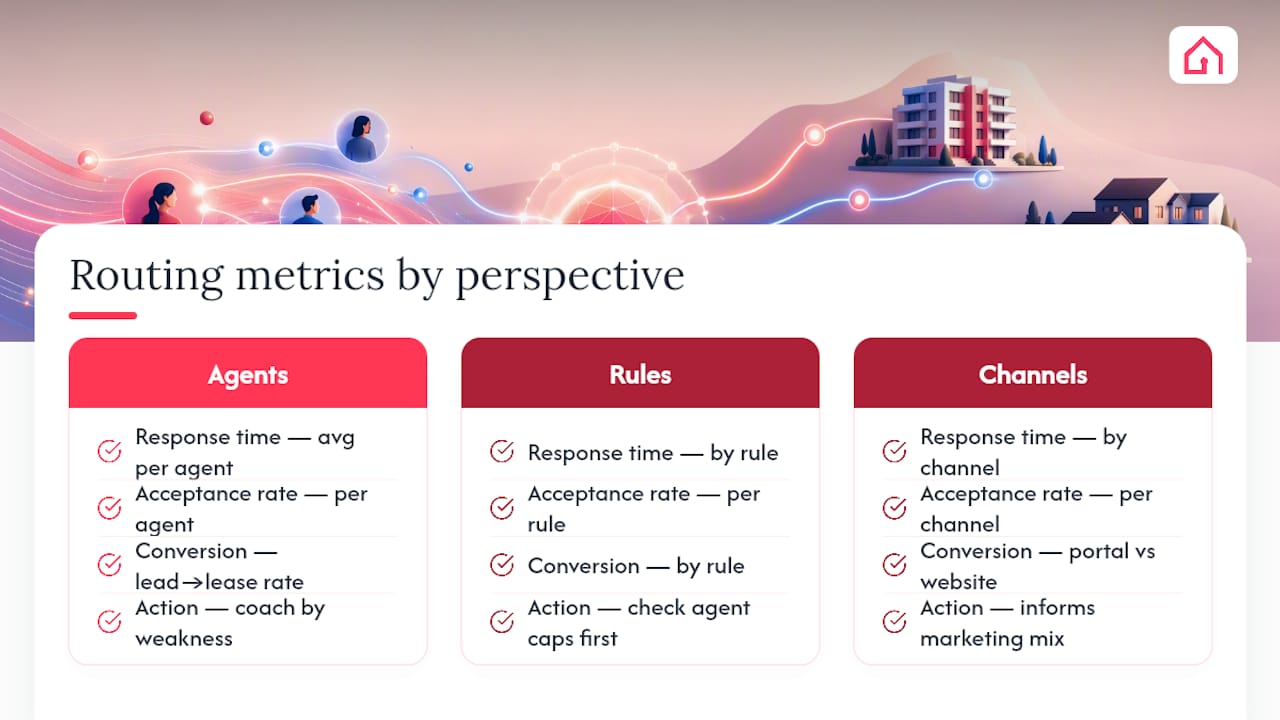
Routing rules are only as good as the data you review afterwards, and most teams check this far less often than they should. Three metrics matter more than the rest: response time from lead arrival to first agent contact, acceptance rate (how often the first-assigned agent actually engages before a timeout fires), and conversion from lead to viewing to signed tenancy.
Track these by agent and by rule, not just in aggregate. An agent with a strong lead-to-lease rate but a slow response time is worth coaching differently from one who replies instantly but rarely converts. Watching both numbers separately reveals problems a single blended metric would hide.
Dashboards don't need to be elaborate. A simple weekly export showing average response time per agent, acceptance rate per rule, and conversion by source channel gives you enough to spot drift before it becomes a pattern. If one rule's acceptance rate drops sharply, that's usually a capacity or availability problem, not a rule-design problem, so check agent caps before rewriting the rule itself.
Comparing performance across channels also matters. If your portal leads convert at half the rate of your website leads, that's worth knowing before you invest more budget in portal listing spend. Routing data, reviewed properly, tells you as much about your marketing mix as it does about your agents.
Set a fixed cadence for this review, whether weekly or fortnightly, and stick to it. Ad hoc glances at routing data catch obvious failures but miss the slow decline that costs you conversions over months rather than days.
What privacy and security rules apply to rental lead routing?
Every lead that flows through a routing system carries personal data, and that data is subject to GDPR requirements across Ireland and the EU, regardless of which routing tool or CRM you use. Names, phone numbers, email addresses, and any documents attached to an enquiry all fall under data protection obligations, which means you need a lawful basis for processing them and a clear retention policy for how long you keep lead records after a tenancy is filled or a prospect goes cold.
Sensitive documents deserve particular care. Payslips, identification, or bank statements should never be requested or exchanged through unencrypted chat or email threads, since that's precisely the kind of exposure that turns a routine enquiry into a data breach. Any platform handling this kind of information should route it through secure, consent-based upload flows rather than general messaging.
Access control matters just as much as collection. If your routing system gives every agent visibility into every lead's full history regardless of assignment, you're creating unnecessary exposure. Restrict access to the agent or team actually handling a lead, and log who viewed what, so an audit trail exists if a dispute or complaint arises.
Third-party integrations widen your risk surface too. Every webhook, CRM push, and messaging integration in your routing chain is a point where data passes between systems, and each one needs to be assessed for how it stores and secures that data, not just whether it delivers leads quickly.
How do you handle duplicate or conflicting rental leads?
Duplicate leads are one of the most common causes of agent confusion, and they happen more often than most teams expect. A prospective tenant messages through a portal, then fills in your website form an hour later, then sends a WhatsApp message asking the same question. Without deduplication, three agents might independently start working the same person, unaware of each other's conversations.
The fix starts at intake, not at routing. Match incoming leads against existing records using phone number or email as the primary identifier before a routing rule even fires. If a match exists, the new enquiry should attach to the existing lead record and notify the agent already assigned, rather than triggering a fresh assignment.
Conflicting leads are a subtler problem. Two agents might both have a legitimate claim to the same lead, one because they were assigned it a week ago and never closed it, another because a fresh enquiry just came through a different channel with no visible link to the earlier one. Resolve this with a clear ownership rule, typically first-assigned-agent-wins within a defined window, say 30 days, after which a stale lead becomes available for reassignment.
Make the resolution visible. When a duplicate merges or a conflict resolves, both agents involved should see a note explaining what happened and why, rather than discovering the mix-up when they both turn up expecting to lead the same viewing. That small bit of transparency prevents most of the friction duplicate leads otherwise cause between team members.
How should agents be trained on routed leads?
Routing only pays off if the agents receiving leads know exactly what to do with them the moment they land, and that's a training gap most teams underestimate. New agents need to understand not just how to reply to a lead, but why a particular lead reached them: what criteria matched, what score it carries, and what response time is expected.
Build a short onboarding checklist covering the acceptance window for your rules, the escalation path if they can't respond in time, and the minimum information they need to log before moving a lead forward. Pair this with a handful of real (anonymised) example leads so new agents see what a well-handled routed enquiry actually looks like, rather than learning by trial and error on live prospects.
Response-time expectations need to be explicit, not assumed. Telling an agent to "reply quickly" means nothing without a number attached, whereas telling them their acceptance window is ten minutes and their target first-reply time is under five gives them something concrete to work against.
Refresh training whenever you change a routing rule. If you introduce weighted routing or shift acceptance windows, agents who don't know the change will be confused when their lead volume shifts unexpectedly. A five-minute team update after any rule change costs far less than the lost leads that follow when agents don't understand why their queue suddenly looks different.
When should you trade fairness for performance in routing?
Round robin feels fair because everyone gets an equal share, but equal isn't always effective. When a listing needs specialist knowledge, a period property with unusual lease terms, say, or a portfolio of student lets with specific compliance quirks, weighted routing toward the agent who actually knows that stock usually beats sending it to whoever's next in line.
The trap is switching too early, based on gut feeling rather than evidence. Before you weight anything, run a genuine test: two weeks of round robin against two weeks of weighted routing on a comparable batch of leads, then compare lead-to-tour and lead-to-lease rates, not just response time. Response time tells you if your rule works mechanically. Conversion tells you if it actually helps.
Keep the experiment narrow. Change one variable, the distribution method, and hold everything else steady, or you won't know what caused the shift you see.
— Hauzed
Try a verified routing workflow with Hauzed
Hauzed is the alternative to juggling scattered portal inboxes and personal WhatsApp threads: leads arrive already carrying a verified tenant profile, so routing rules have real signal to work with instead of guessing from a blank message.
If message chaos and unverified enquiries are the reason your routing rules never quite work as intended, that's the problem Hauzed was built to solve. Verified tenant profiles cut down the filtering work before a lead even reaches your routing logic, while AI agents like Hauzer, Echo, and Lia handle matching and follow-up so fewer leads stall waiting on a manual reply. Compare what's included across the Free Plan and Full Assistance Pack, or look at the AI Team page for details on how Hauzer, Echo, and Lia work in practice. Landlords managing a single property can start on a free plan today; agencies with larger portfolios should contact the provider about onboarding options. Either way, the next step is the same: create a listing on Hauzed's rental marketplace and see how verified leads land differently.
Lead routing is the automated process of assigning an incoming enquiry to a specific agent, team, or workflow based on rules such as location, unit type, or source channel, so the right person handles it without manual sorting.
What Is the Best Rental Lead Routing Software?
There's no single best option for every team; the right choice depends on volume and complexity, but the strongest setups combine fast, rule-based routing with verified lead intake, which is the approach Hauzed's marketplace and AI agents are built around.
How Fast Should a Rental Lead Be Contacted?
Aim for contact within minutes, not hours; response-time research consistently shows that contacting leads quickly dramatically increases the odds of reaching the prospect at all.
What Happens When an Agent Doesn't Respond to a Routed Lead?
A well-configured routing rule should automatically re-route the lead to the next available agent after a short acceptance window, typically five to ten minutes, rather than leaving it unanswered.
Can Small Landlords Use Rental Lead Routing, or Is It Only for Large Agencies?
Landlords with even one or two properties benefit from basic routing and fallback rules, since a single missed enquiry on one listing can mean weeks of extra vacancy.