Avoid scams: secure rental messaging with templates and privacy rules
13 September 2026
15 min read
Copy-ready tenant and landlord templates, clear rules on what never to send in chat, and a platform checklist for secure, property-linked messaging.
Send this on your first message: your name, the property reference, your intended move-in date, and one line on affordability, such as "I'm currently earning €3,200 net monthly, well above the rent." That single message answers a landlord's top three questions before they even ask. Never attach payslips, ID photos, or bank statements to that first chat. Use a secure upload flow instead.
TL;DR:
Using a secure messaging platform linked to the property ensures conversations are auditable, timestamped, and linked to a verified listing.
Sharing sensitive documents should always occur through dedicated upload links, not in chat, to protect personal data and maintain compliance.
Verifying landlord and tenant identities involves checking property details online and using platforms with verified profiles to prevent scams.
Typical initial messages should be concise, including your name, property reference, move-in date, and a brief note on affordability, with follow-ups after two to three days.
Watch out for common rental scams, such as requests for deposits before viewings, inconsistent property details, and landlords who cannot show the property in person or via video.
What is secure rental messaging and why does it matter?
Secure rental messaging means every conversation about a property stays traceable, consented, and tied to the actual listing, with only the information genuinely needed at each stage. It is the practical opposite of a scattered chain of WhatsApp texts, emails, and phone calls where nobody remembers who agreed to what.
Keeping communication on one auditable channel cuts delays because landlords can see the full history of a request without digging through three apps. It also reduces disputes: if a tenant claims a repair was promised or a landlord insists a deposit clause was mentioned, a timestamped record settles it in seconds. Advicenow's tenant guidance makes the same point about disagreements generally: prepare evidence and follow up important conversations in writing, because a verbal understanding is worth far less than a recorded one. A single property-linked thread also means a maintenance report or a viewing confirmation cannot vanish into a deleted text chain.
Ready-to-use tenant and landlord message templates
Copy these, swap in your own details, and drop anything that reveals more than the landlord needs at this stage.
Tenant, single applicant:
"Hi, I'm [Name], interested in [Property reference/address]. I'm looking to move in from [date] and can afford the rent comfortably on my current income. Happy to share references or documents through a secure upload if needed."
Tenant, household or group application:
"We're a group of [number] renting together, all in stable employment, applying jointly for [Property reference]. Our preferred move-in date is [date]. We'd like to apply as one household and can each verify our details individually."
Landlord, viewing invite:
"Thanks for your interest in [Property reference]. I have viewing slots on [dates/times]. Let me know what suits, and I'll confirm."
Landlord, secure document request:
"To move forward with your application, could you upload proof of income and ID through the secure link rather than sending them here? That keeps your documents protected."
The rule that ties all five together: never write "here's my payslip" or "my PPS number is" in the message body. Offer instead: "payslips are available on request via secure upload." It signals you understand the risk without slowing the application down.
Secure document sharing and privacy: what to send, what not to send, and how
Never send photos of your passport, driving licence, bank statements, or payslips through ordinary chat, whether that's SMS, WhatsApp, or a listing site's basic messenger. None of these were built to store or protect identity documents, and once a file sits in a chat thread, it is copied, cached, and effectively out of your control.
Prefer a secure platform upload or a time-limited encrypted link. If a landlord asks for proof of income, a good response looks like this: "I can upload my payslips through your platform's document flow rather than sending them here. Could you send me the secure link?" That single sentence protects both sides and shows you know what proper process looks like.
Consent and retention matter just as much as the transfer method. Ask what happens to a document once a decision is made. Many property professionals wrongly assume that using a messaging app automatically satisfies data protection obligations, when in reality it demands active policies for consent, storage limits, and deletion. If you're the one holding tenant documents, delete copies you no longer need and confirm deletion in writing when a tenant asks.
What features to prefer in a messaging channel or platform
Not every chat app is fit for tenancy business. A few structural features separate a genuinely safe rental messaging platform from a convenient but risky one.
Timestamps on every message, so there's an exact record of when something was said or agreed.
Attachments with access control, meaning documents aren't visible to anyone outside the conversation.
An audit trail that survives even if one party deletes the app or changes phones.
A message-to-listing link, tying the conversation permanently to the specific property.
Role-based access, so agency staff only see the conversations relevant to their properties.
A secure upload flow for identity and income documents, separate from the chat itself.
Personal WhatsApp causes real problems here. Using the standard consumer version for tenancy business can breach WhatsApp's own business usage rules and create GDPR exposure, since it was never designed for record-keeping obligations landlords are legally expected to meet.
Pro Tip:Before agreeing to chat on a landlord's or tenant's preferred app, ask one question: "If we needed to look back at this in six months, could we?" If the honest answer is no, push for a platform that keeps a proper trail.
Tone, length and follow-up: practical rules that win replies
Landlords skim. A message under 60 words with a clear structure gets read; a five-paragraph life story gets ignored.
Open with the one-line formula: who you are, the property reference, your move-in date, and a brief affordability note.
Mention one specific feature of the property, such as the garden or the transport link, to prove you actually read the listing.
Keep the whole message to three or four sentences.
Wait two to three days before following up, not two to three hours.
Use a polite nudge like: "Just following up on my message about [Property reference] as I'm still very interested."
Some warning signs repeat across almost every rental scam, and they're worth memorising rather than relearning the hard way.
A request for a deposit or "holding fee" before any viewing takes place.
Pressure to move the conversation off the platform and onto WhatsApp or email immediately.
Property details that shift between messages, such as the rent changing or the address being vague.
A landlord who claims to be abroad and cannot show the property in person or via video call.
Photos that look identical to other listings elsewhere online.
Run a reverse-image search on the listing photos, check whether the same property appears under a different price on another site, and ask a question only someone who genuinely owns or manages the property could answer. Keep every message as evidence, and report anything suspicious to the platform involved. Research into how rental platforms detect fraud and phishing patterns in the rental market covers these patterns in more depth.
How secure rental messaging can be supported
Secure rental messaging ties every conversation to a verified profile and a specific property listing, rather than leaving tenants as one anonymous message in a crowded inbox. A tenant profile that already carries verified identity and preferences means less need to repeat sensitive details in chat, because a landlord can review your profile before you even send a message.
Document uploads happen through a secure flow rather than the chat window itself, and conversations stay linked to the property they concern, creating a natural audit trail. AI tools can reduce the manual load without replacing human judgement. Some actions still need review, and access depends on account settings and plan.
Verification increases trust. It does not guarantee a rental will be approved, and the final decision always rests with the landlord or agent.
Best channels and platforms for secure rental messaging, comparing their security features and privacy policies
Not all channels handle rental business equally well, and the differences matter more than most people realise until something goes wrong.
Basic SMS and personal messaging apps offer speed and familiarity but almost no structure. There's no reliable way to link a message to a specific property, no built-in document protection, and no audit trail if the app is deleted or a phone is lost. These channels work fine for confirming "running five minutes late," but they're a poor fit for anything involving documents or agreements.
Email remains genuinely strong for record-keeping. It supports attachments, timestamps, and searchable history, and it's generally preferable for important tenancy communications precisely because it creates a paper trail. Its weakness is speed. Email threads can get buried, and it's easy to lose track of which version of a document was actually sent.
Property-linked platform messaging, the kind built into a rental marketplace, combines the best of both. Messages stay attached to the listing, documents move through a separate secure upload rather than the chat itself, and both parties can see a full history without hunting through folders. Privacy policies on dedicated rental platforms are also generally built around the specific data landlords and tenants exchange, rather than a general-purpose messaging app's broader terms.
For agencies managing several properties, structured portfolio tools that route conversations by property avoid the confusion of one shared inbox covering unrelated tenancies.
How to encrypt or protect sensitive information when messaging landlords or tenants
Encryption matters less than most people assume when the bigger risk is where a document ends up sitting after it's sent. A message can be end-to-end encrypted in transit and still be a privacy problem if it's stored indefinitely on a device, backed up to an unencrypted cloud account, or forwarded without a second thought.
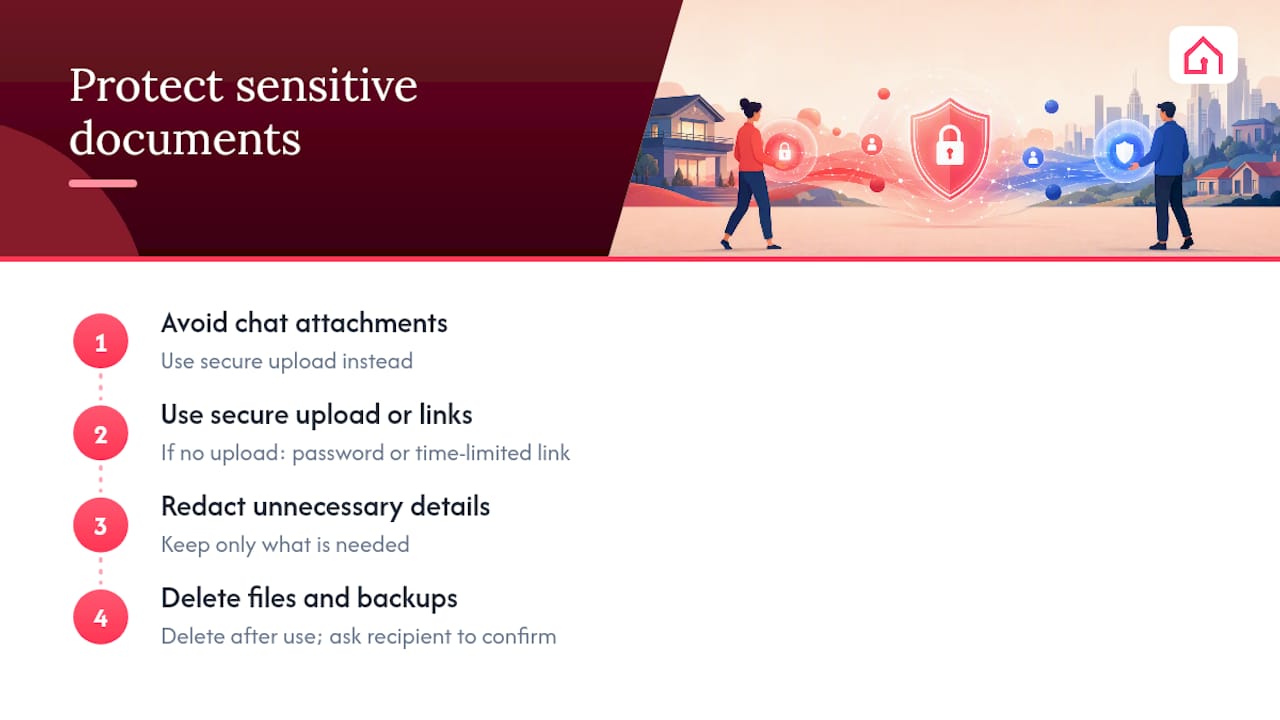
The most reliable protection is to avoid sending sensitive files as chat attachments at all. Use a platform's dedicated secure upload feature, which typically stores documents separately from the message thread and restricts who can view them. If a secure upload isn't available and email is the only option, use a password-protected file or a time-limited sharing link rather than a raw attachment, and share the password through a separate channel, such as a text message.
Strip documents down to what's actually needed. A payslip can often be cropped to show only the net income figure rather than the full document with an address and employer details. Redact anything not directly relevant to the request, and ask the other party what they intend to do with a document once a decision has been made.
Delete sensitive files from your own device and any backups once they've served their purpose, and ask the recipient to confirm they've done the same. This matters just as much for a landlord holding a tenant's ID scan as it does for a tenant holding a landlord's bank details for rent transfers. Neither party should be keeping identity documents longer than the process requires.
Legal and privacy considerations when exchanging rental information via messaging
Data protection law applies to rental messaging exactly as it does to any other personal data exchange, and both individual landlords and larger agencies are expected to comply. This isn't a technicality that only concerns businesses with dedicated compliance teams.
Surveys of the property sector show a genuine gap between belief and practice here: many landlords and agents assume that using a business-labelled messaging app automatically satisfies their obligations, when in fact proper compliance requires active policies for consent, data recording, and deletion, not just the right app icon. Simply switching from a personal WhatsApp number to a business one doesn't close that gap on its own.
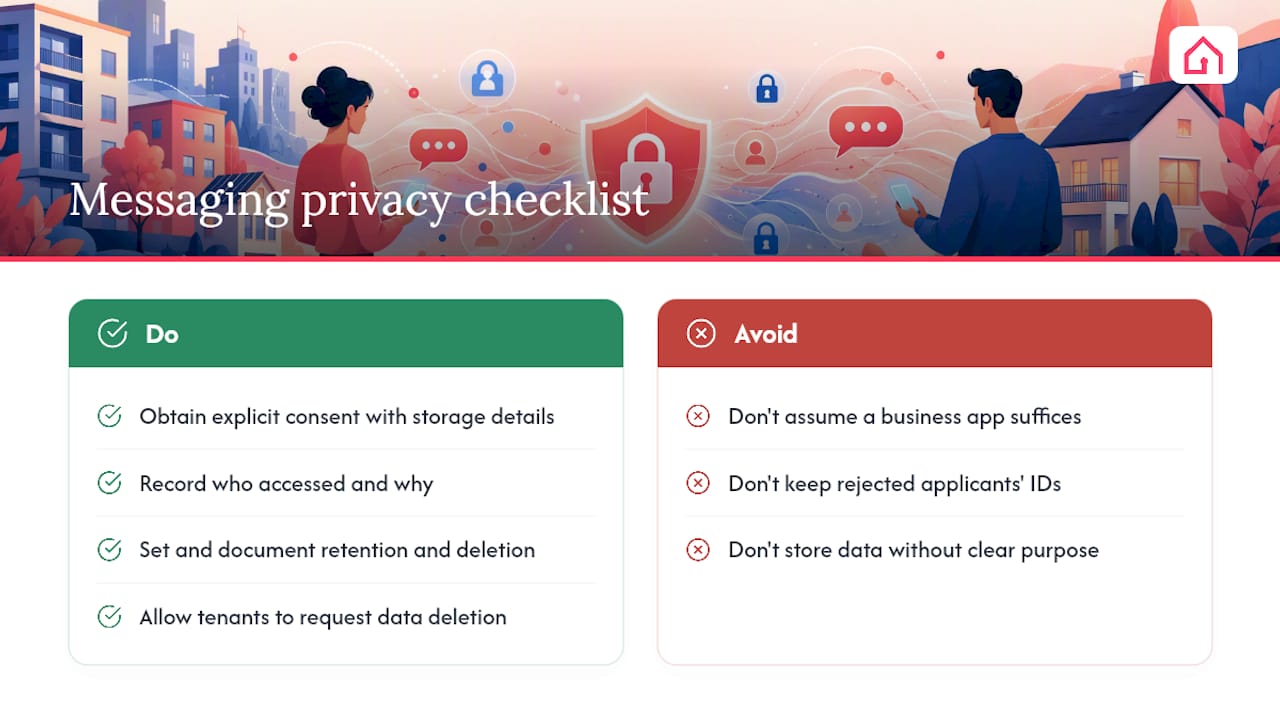
Consent should be explicit rather than assumed. If a landlord asks a tenant to send proof of income, that request should make clear what will be stored, for how long, and who else might see it. Tenants have the right to ask what data a landlord or agent holds on them and to request its deletion once it's no longer needed for the tenancy or application process.
Retention limits matter too. Holding a rejected applicant's ID document for months after a decision has been made carries risk with no corresponding benefit. A sensible rule for either side is to store only what's needed for as long as it's needed, and to document when and why something was deleted.
None of this replaces proper legal advice for a specific dispute, but the basic principle holds across almost every rental interaction: treat personal data exchanged over messaging with the same care you'd expect from a bank or a GP surgery, not a casual group chat.
How to verify the identity of the landlord or tenant before engaging through messaging
A first message tells you almost nothing about who is actually on the other end. Verifying identity before sharing anything sensitive is one of the simplest habits that prevents most rental scams outright.
For tenants checking a landlord, start by confirming the property exists as described. Search the address on a mapping service, check whether the same listing appears elsewhere with different contact details or a different price, and ask a question that only someone with genuine access to the property could answer, such as the exact floor a flat sits on within a building. A landlord unwilling to do a video call or an in-person viewing before requesting money is a strong signal something's wrong.
For landlords vetting a prospective tenant, a verified profile on a rental platform, one where identity has already been checked as part of account creation, removes much of the guesswork before a conversation even starts. This is a meaningfully different position from receiving one message from an anonymous phone number with no history attached to it.
Both sides benefit from keeping verification steps within a platform built for that purpose rather than exchanging documents ad hoc over chat. A verified badge or profile doesn't guarantee good faith in every case, but it substantially narrows the field of people willing to go through that process just to run a scam.
Publisher perspective: why secure, verified messaging should be standard
Hauzed exists because too much of rental communication still happens through channels built for casual chat, not tenancy decisions worth thousands of euros. Verified profiles and secure uploads aren't extra friction. They're what a serious process should look like. If you're messaging about a property today, treat every conversation as something that might need to be checked later, and choose the channel that makes that possible.
— Hauzed
How to get started with Hauzed
Hauzed is the alternative to juggling five different apps for one rental search. Every conversation stays tied to the actual property, documents move through secure uploads instead of chat attachments, and you're never just one more anonymous message in someone's inbox.
Getting started takes three steps: create a profile, complete identity verification, and use listing-linked chat and secure upload flows for anything sensitive. For tenants, this replaces sending scanned documents to strangers over text with a process that puts you in control of what's shared and when. For landlords and agents, verified tenant activity means fewer low-quality messages and a clearer record of every conversation tied to a property. Head to the Hauzed rental marketplace to build your profile and start messaging with the protections built in from the first message onward.
Secure messaging is communication that keeps content protected from unauthorised access, typically through encryption, access controls, and a clear record of who sent what and when. In rental contexts, it also means keeping conversations tied to the specific property and avoiding sensitive attachments in the chat itself.
Is WhatsApp safe for messaging a landlord or tenant?
Personal WhatsApp works for quick, low-stakes updates, but using the standard consumer version for tenancy business can create GDPR and record-keeping problems, since it isn't built for business compliance requirements.
Should I send my payslip or ID over chat if a landlord asks?
No. Ask for a secure upload link or a platform-based document flow instead, and offer to verify your details that way rather than sending files directly through a chat window.
How long should a first rental application message be?
Keep it to three or four sentences: your name, the property reference, your move-in date, and one line on affordability. Anything longer tends to get skimmed rather than read properly.
How can I tell if a rental listing is a scam?
Watch for requests for payment before a viewing, pressure to move off-platform, and inconsistent property details between messages, and verify photos and the address independently before sending anything.