What is a tenancy deposit scheme? UK guide for tenants and landlords
28 de julio de 2026
11 min de lectura
Learn what a tenancy deposit scheme is and how it protects both tenants and landlords. Ensure your deposit is safe and understand your rights.
A tenancy deposit scheme is a government-approved service that protects your deposit money and provides an independent route to resolve disputes when a tenancy ends. Under UK law, landlords must protect deposits for assured shorthold tenancies (ASTs) that began after 6 April 2007, and they must do so within 30 calendar days of receiving the funds. Three schemes are approved: the Deposit Protection Service (DPS), MyDeposits, and the Tenancy Deposit Scheme (TDS).
If you are a landlord, your immediate actions are:
Protect the deposit within 30 calendar days of receiving the money
Serve the prescribed information to your tenant within the same 30-day window
Keep a dated receipt and a copy of everything you send
If you are a tenant, your immediate actions are:
Ask your landlord for the scheme name and your protection reference number
Check the scheme's website to confirm your deposit is registered
Keep your receipts, inventory, and any written communication from day one
The core function is straightforward: a scheme keeps your deposit safe and impartial until both parties agree on how it should be returned. Without one, a tenant's money sits in a landlord's bank account with no independent oversight, and recovering it after a dispute can mean going to court.
The second function is equally important. Every government-approved scheme provides an Alternative Dispute Resolution (ADR) service, which lets an independent adjudicator decide how the deposit should be split when landlord and tenant disagree. ADR is typically faster and cheaper than court proceedings, and it is free for both parties to use.
Why this matters in practice: A scheme does not just protect money. It creates an evidence-based process where both sides submit their case and a neutral third party decides. That structure alone reduces the incentive for unfair deductions.
Pro Tip:Take time-stamped photos at check-in and save them somewhere you can access easily months later. Adjudicators treat dated photographic evidence as some of the most persuasive material in any dispute.
Who must protect a deposit, and when does the 30-day clock start?
Landlords, or agents acting on their behalf, must protect deposits for ASTs that started after 6 April 2007. The obligation applies in England and Wales. Scotland and Northern Ireland operate their own separate schemes, so if your property is there, verify the local rules before acting.
A common mistake: the 30-day clock starts on the date the deposit funds are received, not on the tenancy start date. If a tenant pays two weeks before moving in, you have two fewer weeks to comply than you might assume. Diarise the receipt date the moment the money arrives.
Holding deposits are different. A holding deposit (paid to reserve a property) is capped at one week's rent under the Tenant Fees Act and is not a tenancy deposit until the tenancy begins. It does not trigger the 30-day protection duty on its own.
Within those 30 days, three things must be completed:
Transfer or register the deposit with an approved scheme (DPS, MyDeposits, or TDS)
Serve the prescribed information to the tenant
Record the date of receipt and keep proof of lodgement
Custodial vs insured schemes: which model suits you?
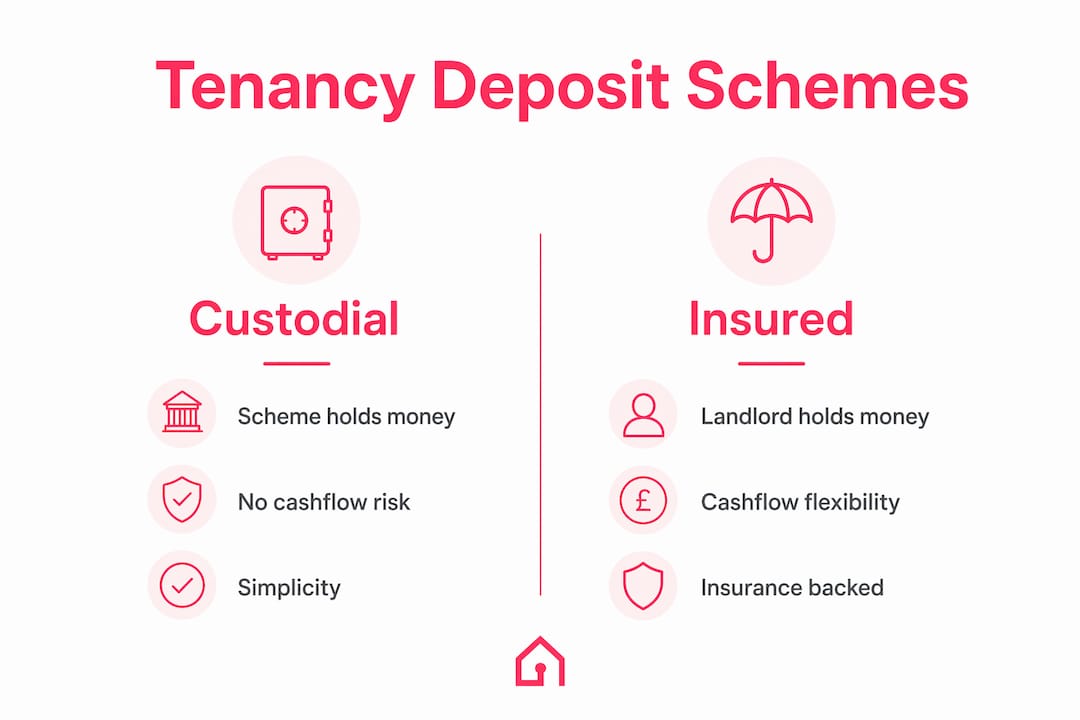
There are two protection models, and the right choice depends on your cashflow and administrative preferences rather than on legal safety — both satisfy the law equally.
Dimension
Custodial scheme
Insured scheme
Who holds the money
The scheme administrator
The landlord or agent
Fee to landlord/agent
Free
A premium is charged
ADR/adjudication
Provided by the scheme
Provided by the scheme
Return speed
Scheme pays out on agreement
Landlord repays directly
UK jurisdictions
England & Wales (check each scheme)
England & Wales (check each scheme)
Custodial suits landlords who want simplicity and zero cashflow risk. The money leaves your account immediately, so there is no danger of accidentally spending it. Insured suits landlords who want to retain the funds for liquidity, accepting a fee in exchange for that flexibility.
From a tenant's perspective, custodial schemes offer slightly more visible security because the money is held by a neutral third party from day one. With an insured scheme, the landlord retains the funds but is insured against failing to return them.
What prescribed information must landlords give tenants?
Prescribed information is a standalone legal duty, separate from protecting the money itself. Failing to provide it carries the same financial penalties as failing to protect the deposit, even if the money is safely lodged with a scheme.
The prescribed information must include:
The name and contact details of the scheme
How to apply for repayment of the deposit
Information about the scheme's ADR service
The deposit reference number
What to do if there is a dispute
Pro Tip:Prescribed information must be reissued whenever material tenancy terms change, such as when a fixed term rolls into a periodic tenancy. Many landlords miss this step.
Keep a paper trail that covers: dated receipt of funds, proof of scheme lodgement, a copy of the prescribed information, and a signed or emailed acknowledgement from the tenant. Tenants can verify their protection directly on the scheme's website using their reference number.
How does the ADR and adjudication process work?
When a tenancy ends and you cannot agree on deductions, the scheme's ADR service is your first port of call, not the court. It is faster, free, and designed specifically for deposit disputes.
One party (usually the tenant) raises a dispute with the scheme
Both sides submit their evidence within the scheme's deadline
An independent adjudicator reviews the case
A binding decision is issued, and funds are distributed accordingly
The evidence that carries most weight includes:
A signed, dated check-in inventory with photographs
Time-stamped photos from move-in and move-out
Receipts for any repairs or cleaning
Written communication between landlord and tenant
A copy of the prescribed information
Pro Tip:Platform timestamps and secure document uploads create a neutral, auditable record. Adjudicators treat contemporaneous digital evidence as highly persuasive, particularly when both parties can see the same file trail.
What can you do if your landlord didn't protect the deposit?
If your deposit was not protected or you never received the prescribed information, you have a clear legal remedy. Courts can order a financial penalty of between one and three times the deposit amount under section 214 of the Housing Act 2004. The exact multiplier is at the judge's discretion.
Your steps:
Ask your landlord in writing for the scheme name and reference number
Check the DPS, MyDeposits, and TDS websites directly to confirm whether protection exists
Contact Citizens Advice for practical guidance on your next steps
Consider a county court application for a penalty order and return of the deposit
Possession claims are also affected. An unprotected deposit can prevent a landlord from relying on certain possession grounds, including a Section 21 notice. This is a significant practical consequence for landlords who delay compliance.
This article is general information, not legal advice. Confirm your position with a qualified adviser or the relevant scheme before taking court action.
Move-in and move-out checklists for tenants and landlords
At move-in (tenants)
Check the inventory carefully and note any discrepancies in writing before signing
Take time-stamped photos of every room, including existing damage
Confirm your deposit is protected and save the scheme name and reference number
Keep copies of all documents, including the tenancy agreement and prescribed information
Clean to the standard described in the tenancy agreement
Take time-stamped photos matching the check-in inventory
Record meter readings and photograph them
Request any agreed deductions in writing before handing back keys
Landlord checklist
Diarise the date funds are received and protect within 30 days
Serve prescribed information within the same window
Produce a clear, signed inventory with photographs at check-in
Provide a final deposit accounting within 10 days of reaching agreement at move-out
Pro Tip:Using Hauzed's verified document upload and timestamped chat keeps your evidence in one place, making it far easier to produce a clean record for ADR if a dispute arises.
How to protect documents and verify identity safely on rental platforms
Always upload sensitive documents through a secure, vendor-controlled flow, never through open chat or email. Sharing identity documents via WhatsApp or unencrypted email exposes you to fraud and removes the audit trail you may need later.
Practical steps for safe document handling:
Use two-factor authentication on any platform holding your rental documents
Prefer platform upload over email for payslips, references, and identity documents
Watermark or redact fields that are not required (for example, full account numbers on bank statements)
Only share documents with consent and through flows that log access
Hauzed's verified rental marketplace uses identity verification to increase trust on both sides. Verified tenant profiles, centralised receipts, and timestamped chat create an auditable record that reduces disputes and speeds up ADR when one does occur. Landlords and agencies benefit from knowing that the people they are dealing with are real and prepared.
Key takeaways
A tenancy deposit scheme is a legal requirement for ASTs in England and Wales, and non-compliance carries penalties of up to three times the deposit amount.
Point
Details
Protect within 30 days
The clock starts when funds are received, not on the tenancy start date.
Serve prescribed information
This is a separate legal duty; failing it carries the same penalties as not protecting the deposit.
The scheme's dispute service is faster and free; go there before considering court.
Non-compliance penalties
Courts can order 1–3 times the deposit amount and possession claims may be blocked.
Why verified platforms reduce deposit disputes
Deposit disputes rarely come down to bad faith alone. They usually come down to missing evidence: a photo that was never taken, a message that was never saved, a receipt that cannot be found. The scheme's adjudicator can only work with what is in front of them.
That is why the platform you use to manage your rental matters as much as the scheme you choose. When landlords and tenants communicate through a verified, timestamped system, the evidence trail builds itself. There is no scramble at move-out to reconstruct what was said or when. The record is already there.
Hauzed is built around that idea. Verified profiles, secure document uploads, and structured chat mean that both sides enter a tenancy with a clear, auditable record from the start. For landlords and agencies managing multiple properties, that consistency across every tenancy reduces the administrative burden of compliance and makes ADR far less stressful when it is needed.
Where to find authoritative help on deposit protection
GOV.UK tenancy deposit protection: The primary source for legal requirements, scheme names, and the 30-day rule. Start here.
Deposit Protection Service (DPS): One of the three government-approved schemes; offers both custodial and insured options.
MyDeposits: Government-approved insured and custodial scheme; check their website to verify a deposit reference.
Tenancy Deposit Scheme (TDS): The largest provider by value in the UK; offers free custodial protection and paid insured options.
Citizens Advice: Best for tenants who need practical, step-by-step guidance on checking protection or pursuing a remedy.
House of Commons Library briefing: Neutral, detailed overview of the legislation and ADR framework; useful for landlords and agents who want the legal background.
FAQ
What is a tenancy deposit scheme in simple terms?
It is a government-approved service that holds or insures your deposit and provides an independent adjudicator to resolve disputes at the end of a tenancy.
How long does a landlord have to protect a deposit?
Landlords must protect the deposit and serve the prescribed information within 30 calendar days of receiving the funds.
What happens if a landlord does not protect the deposit?
A court can order the landlord to pay a penalty of between one and three times the deposit amount, and certain possession grounds may be unavailable until the deposit is protected.
Can a tenant check whether their deposit is protected?
Yes. Each of the three approved schemes (DPS, MyDeposits, and TDS) has an online lookup tool where you can search using your address or reference number.
Is a holding deposit the same as a tenancy deposit?
No. A holding deposit reserves a property and is capped at one week's rent under the Tenant Fees Act. It only becomes a tenancy deposit, and triggers the 30-day protection duty, once the tenancy formally begins.