How to approve tenants without delays: UK landlord guide
25 de julio de 2026
21 min de lectura
Learn how to approve tenants without delays using a streamlined workflow, essential documents, and digital verification methods. Act fast!
You can reliably approve tenants without delays by standardising your onboarding workflow, requiring a fixed document set upfront, using digital verification (Open Banking and digital ID), and priming referees before the reference request lands in their inbox. Get those four things right and most applications resolve in 24–48 hours. Miss any one of them and you are looking at 5–7 days of chasing.
The benchmarks are clear: automated checks such as credit scoring and Open Banking complete in minutes, while comprehensive references average 48 hours at modern platforms. Human referees — employers and previous landlords — are where timelines collapse. The Renters' Rights Bill and the end of Section 21 make thorough vetting more important than ever, so the goal is not to skip checks but to run them faster.
Here is what to do first:
Send every applicant a required-document list before they start the form.
Ask tenants to notify their employer and previous landlord that a reference request is coming.
Use Open Banking for income verification instead of waiting for PDF payslips.
Use a digital ID flow (Yoti-style) for identity and Right to Rent checks.
Set automated chasers from day one so nothing sits waiting in an inbox.
Platforms such as Hauzed combine identity verification, secure document uploads, and AI-assisted matching to support this workflow from the start.
What is actually causing your tenant approval delays?
Most landlords assume delays come from the volume of applications. They rarely do. The real bottleneck is almost always a person who has not replied yet.
Employer and landlord references are the single largest cause of delay. An HR department on a busy week, a previous landlord who does not recognise the email address, or a line manager on annual leave can each add 3–5 days to a process that should take two. The automated parts of referencing — credit checks, identity verification, Open Banking — are fast. The human parts often cause delays.
The typical timeline breakdown looks like this:
Stage
Standard timeframe
Real-world timeframe
Tenant submits information
1–2 hours
1–2 days
Credit and ID checks
Instant to 2 hours
Instant to 4 hours
Employment reference
1–2 days
2–4+ days
Landlord reference
1–2 days
2–4+ days
Total turnaround
2–3 working days
5–7+ working days
The gap between the standard and real-world columns is almost entirely explained by human non-response. Automated platforms with persistent reminders and secure upload links can push most references to under 24 hours, but only when the human steps are managed proactively.
Other common delay sources include:
Incomplete applications. Tenants who submit without all required documents force a second round of requests, adding 24–48 hours immediately.
Wrong contact details. A single typo in an employer's email address can create a two-day delay before anyone notices.
Manual admin queues. Agents or landlords who check their inbox infrequently add their own delay on top of the referee's lag.
Unprimed referees. A reference request that arrives without warning looks like spam to a busy HR team.
The insight that most landlords miss is this: swapping tools rarely solves the problem. Process ownership and proactive communication — telling tenants exactly what to prepare, and asking them to alert their referees — outperform any platform upgrade when the human factor is the root cause.
Step-by-step workflow to approve tenants faster
A repeatable workflow removes the guesswork and keeps every application moving at the same pace. Here is a concise sequence you can run for every tenancy.
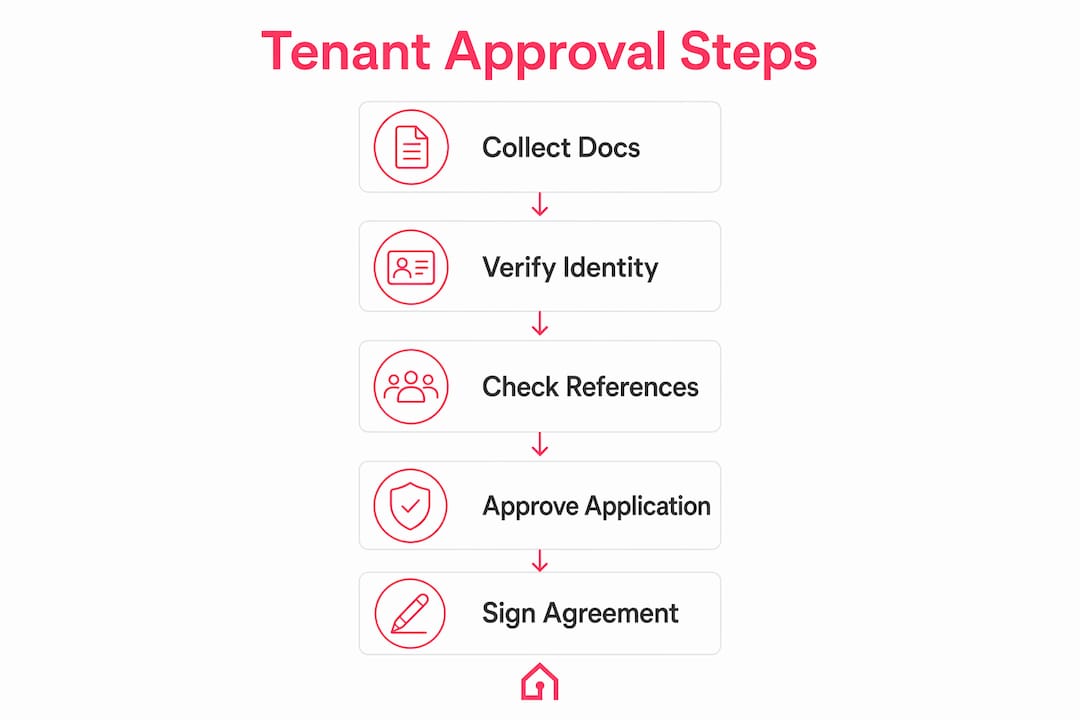
Pre-screen at enquiry stage. Before sending a full application link, confirm the basics: move-in date, household size, income band, and whether a guarantor is needed. This filters out unsuitable applicants before you invest time in referencing.
Send a required-document list immediately. The moment an applicant looks suitable, send them a clear list of what you need (see the checklist section below). Applicants who know what is coming submit faster and with fewer gaps.
Ask the tenant to notify their referees. This is the single highest-impact step most landlords skip. A quick email from the tenant to their employer and previous landlord — "you will receive a reference request shortly, please look out for it" — reliably cuts 2–4 days from the referencing timeline.
Open the secure upload portal. Send one link to a secure upload environment. Do not accept documents by email. A single portal means you can see instantly what has and has not arrived, and the tenant gets prompted automatically when something is missing.
Run automated checks in parallel. Credit check, digital ID, and Open Banking can all run simultaneously the moment the tenant submits. Do not wait for human references to come back before starting these.
Send automated reference requests with a 48-hour deadline. Make the deadline explicit in the request. Referees who see a clear deadline respond faster than those who receive an open-ended email.
Review and decide. Once all checks are back, make your decision and communicate it the same day. Holding an offer open without a decision wastes the tenant's time and yours.
Set a hold offer window. If you are proceeding, ask the tenant to confirm acceptance within 24 hours and pay a holding deposit. This protects both parties and keeps the timeline moving.
Pro Tip:Pre-boarding referees is the fastest free improvement you can make. Ask every applicant to send a two-line email to their employer and previous landlord before you send the reference request. The difference between a reference that returns in hours and one that drags for days is often just that one step.
Example timelines:
Sub-24-hour goal: Tenant submits complete documents at 9 AM, automated checks run by 10 AM, reference requests sent with same-day deadline, employer and landlord respond by 4 PM, decision by 5 PM. Achievable when the tenant is prepared and referees are primed.
Conservative 48-hour target: Tenant submits by end of day one, automated checks complete overnight, references return by end of day two, decision on morning of day three. Realistic for most well-managed applications.
What documents should you collect upfront?
Collecting the right documents at the start prevents the back-and-forth that adds days to every application. Here is the UK-specific list to request from every applicant before referencing begins.
Tenant documents:
Passport or UK driving licence (for identity and Right to Rent verification)
Recent utility bill or council tax statement (proof of current address, dated within 3 months)
Three months' payslips or Open Banking consent (income verification)
Universal Credit or benefit statement where applicable
Employer contact details: full name, email address, and direct phone number of HR or line manager
Previous landlord contact details: name, email, and phone number
Guarantor details if required (name, address, proof of income)
Which checks are instant and which need third parties:
Check
Typical turnaround
Who owns the task
Alternative if unresponsive
Digital ID / Right to Rent
Minutes
Tenant (self-serve)
Manual document check
Credit check
Instant to 2 hours
Landlord / agent
No alternative — required
Open Banking income check
Minutes
Tenant (consent)
3 months' payslips + bank statements
Employer reference
1–5 days
Employer / HR
Payslips + contract + bank statements
Previous landlord reference
1–4 days
Previous landlord
Tenancy agreement + 12 months' bank statements showing rent payments
Guarantor verification
1–2 days
Guarantor
Additional income evidence
Open Banking is worth highlighting separately. It provides verified income and expenditure data in seconds and removes the risk of doctored payslips. For any applicant where affordability is a close call, Open Banking is the faster and more reliable option. For a deeper look at how fraud detection fits into this process, the Hauzed guide on rental platform fraud detection covers the mechanics in detail.
Pro Tip:Always verify referee contact details with the tenant before sending the reference request. Ask them to confirm the exact email address for their HR department or line manager. One typo can create a 48-hour delay before anyone realises the request never arrived.
How digital ID and Open Banking speed referencing in the UK
The two technology changes that make the biggest practical difference are digital identity verification and Open Banking. Both shift the bottleneck away from an agent's inbox and onto the tenant's own quick actions.
Digital ID (Yoti-style flows) lets tenants verify their identity and satisfy Right to Rent requirements without posting documents or visiting an office. The check completes in minutes when the tenant is prepared. For British and Irish citizens, a registered Digital Verification Service (DVS) can handle the check entirely online. For non-British or non-Irish nationals, the Home Office online service using a share code is the correct route.
Open Banking connects directly to the tenant's bank account with their consent and extracts verified transaction data. There is no PDF to request, no payslip to authenticate, and no opportunity for a document to be altered. AI-driven bank statement analysis can flag affordability issues and fraud indicators faster than any manual review. For landlords where income verification is the critical step, Open Banking is the single most effective tool available.
Operational rules that make the difference:
Require Open Banking as the default for income verification; accept payslips only as a fallback.
Require digital ID for all identity and Right to Rent checks where the tenant's nationality allows it.
Use a single secure upload link rather than email attachments — it creates a clear audit trail and prompts tenants automatically when something is missing.
Set automated chasers for referees at 24 hours and 48 hours after the initial request.
Use a real-time dashboard so you can see at a glance which checks are complete and which are stalled.
Pro Tip:Prioritise automation for the checks where human response is historically slowest: HR departments at large employers and private landlords who are not professional agents. Both groups respond better to polite, timed automated reminders than to a single manual email.
For landlords managing more than one property, the Hauzed guide on managing multiple rental properties covers how dashboards and team workflows reduce administrative queues across a portfolio.
UK legal and compliance pitfalls that slow approvals
Speed is only useful if the checks you run are legally valid. Several compliance requirements can cause delays when misunderstood — and skipping them creates far bigger problems later.
Right to Rent checks are mandatory for all adults who will use the property as their main home, including British citizens. You must complete the check before the tenancy agreement is signed. GOV.UK guidance sets out three valid routes:
Check original documents yourself (manual check).
Use a registered Digital Verification Service (DVS) for British and Irish citizens.
Use the Home Office online service with a share code for non-British or non-Irish nationals.
If a tenant has a time-limited right to rent, the check must be completed no earlier than 28 calendar days before the tenancy start date. The Right to Rent Code of Practice (updated 1 October 2026) is the authoritative reference for acceptable documents and follow-up check requirements. When you need the Home Office Landlord Checking Service, it responds within two working days.
Key compliance principle: You cannot insist a tenant uses the online service if they can provide an acceptable original document from List A or List B. Doing so is discriminatory under the scheme's code of practice. Run checks consistently across all applicants regardless of perceived nationality.
Post-Section 21 implications change the cost calculation for vetting. With the Renters' Rights Bill removing no-fault evictions, a tenancy that goes wrong now carries a realistic risk of 6–9 months' arrears plus legal fees before you can regain possession. An extra two days on thorough checks is genuinely cheap compared to that outcome. This is not an argument to slow down — it is an argument to run every check correctly the first time rather than cutting corners to save a day.
Deposit and holding deposit rules:
Holding deposits are capped at a week's rent under the Tenant Fees Act 2019.
Security deposits are capped at several weeks' rent (for annual rent under certain thresholds).
Deposits must be protected in a government-approved scheme within 30 days of receipt.
If you withdraw an offer after taking a holding deposit, you must return it unless the tenant provided false information or failed a Right to Rent check.
Keep a written record of every check, every document received, and every decision made. That paper trail is your protection if a decision is later challenged.
This article is general information, not legal advice. Confirm current requirements with GOV.UK or a qualified professional for your specific situation.
How Hauzed helps landlords approve tenants faster
Hauzed is built around the idea that the rental process works better when both sides are verified and prepared before the first serious conversation. For landlords who want to reduce the time from offer to keys, the platform brings several of the workflow steps described above into one place.
Features that reduce approval delays:
Identity verification flows so tenants arrive at the conversation already verified, reducing the time you spend chasing documents.
Secure document uploads through the platform rather than email chains, with clear visibility of what has and has not been submitted.
Hauzer, Hauzed's AI matching agent, which helps landlords identify suitable tenant profiles from verified interest rather than sorting through unqualified messages.
Echo, the automated follow-up assistant, which handles chat replies and reminders so applications do not stall because a message went unanswered.
Lia, a leasing conversation assistant for WhatsApp-style workflows where available, keeping communication moving without requiring the landlord to be available at all hours.
Landlord dashboards that give a real-time view of where each application stands, so nothing sits in a queue unnoticed.
A practical example: A landlord receives a verified tenant request through Hauzed. Hauzer surfaces the match and the landlord reviews the tenant's verified profile and uploaded documents. Echo handles the initial back-and-forth while the landlord reviews. The landlord sends a formal invitation, the tenant confirms, and the referencing process begins with identity already verified. With Open Banking consent given at the profile stage and referees pre-notified, the full process from invitation to decision can complete in under 48 hours.
Pro Tip:Combine Hauzed's identity verification and document upload flows with the referee pre-notification step from Section 3. The two together remove the two most common causes of delay: missing documents and unprimed referees.
For a detailed checklist of what to collect and verify, the Hauzed tenant screening checklist covers every step in a printable format.
Templates and deadlines: what to send and when
Good communication templates remove ambiguity and give referees a clear reason to act quickly. Here are five ready-to-use messages and a reminder timetable.
Template 1 — Tenant pre-notification to employer:
Subject: Reference request coming your way
Hi [Name], I am currently applying for a rental property and my landlord will be sending you a reference request shortly. It will come from [referencing platform/agent name]. I would really appreciate it if you could respond when you get a moment. Thank you.
Template 2 — Tenant pre-notification to previous landlord:
Hi [Name], I hope you are well. I am applying for a new rental and my prospective landlord will be in touch to verify my tenancy with you. Please look out for an email from [referencing platform/agent name]. Thank you for your help.
Template 3 — Landlord/agent document reminder to tenant:
Hi [Name], we are still waiting for [specific document]. Could you please upload it via the secure link sent earlier? We need it by [date/time] to keep your application on track.
Subject: Reminder: reference request for [Tenant Name]
Hi [Name], we sent a reference request for [Tenant Name] yesterday and have not yet received a response. Could you please complete it at your earliest convenience? The link is [link]. If you have any questions, please reply to this message.
Template 5 — Guarantor onboarding message:
Hi [Name], [Tenant Name] has listed you as a guarantor for their rental application. We will need to verify your identity and income. Please use the secure link below to upload the required documents: [link]. If you have questions, please contact us at [contact details].
Reminder timetable:
Day 0: Send reference requests and document upload link to tenant and referees simultaneously.
Day 1 (24 hours): Automated chaser sent to any referee who has not responded.
Day 2 (48 hours): Second automated chaser sent; flag any non-responses for manual review.
Day 2–3: If still no response, contact the tenant and ask them to follow up directly with their referee.
Day 3–4: If referee remains unresponsive, request alternative evidence (see escalation section).
Keep the tone of all chasers polite and specific. Referees respond faster when the message tells them exactly what is needed and how long it will take to complete.
Move-in timeline from offer accepted to keys handed over
A fast approval only saves time if the move-in process is equally well organised. Here is the sequence to follow once an offer is accepted.
Key steps and timing:
Step
Responsible party
Typical turnaround
Compliance risk
Holding deposit collected
Landlord / agent
Same day as offer acceptance
Must not exceed one week's rent
Final referencing checks completed
Landlord / agent
Within 24–48 hours of offer
Right to Rent must be complete before signing
Tenancy agreement drafted and sent
Landlord / agent
1–2 days
Must reflect agreed terms; check prescribed information
Tenancy agreement signed by all parties
Tenant / landlord
1–2 days
Date of signing is the legal start of tenancy
Security deposit collected and protected
Landlord / agent
Within 30 days of receipt
Must be in a government-approved scheme
Inventory and property condition report
Landlord / agent
Day of or day before move-in
Protects both parties at end of tenancy
Key handover
Landlord / agent
Move-in day
Confirm in writing
Before handing over keys, confirm in writing that:
All referencing checks are complete and satisfactory.
Right to Rent check has been conducted and documented.
The tenancy agreement has been signed by all named tenants.
The security deposit is protected and the tenant has received the prescribed information.
The inventory has been signed by the tenant.
Do not hand over keys before the tenancy agreement is signed. If a tenant asks to move in before signing, the agreement is considered to have started from the date they took possession — which means your Right to Rent check must have been completed before that date.
When delays persist: escalation and when to walk away
Even a well-run process occasionally stalls. Here is how to handle it without losing good tenants or making rash decisions.
Decision guide for persistent non-response:
After 48 hours with no referee response: Send a second automated chaser and ask the tenant to contact their referee directly.
After 72 hours: Request alternative evidence. For an employer reference, ask for payslips, a signed employment contract, and three months' bank statements showing salary credits. For a landlord reference, ask for the tenancy agreement plus 12 months' bank statements showing rent payments.
After 5 working days with no response and no alternative evidence: Consider whether the application can proceed on the evidence available. If not, withdraw the offer.
Alternative evidence that is generally acceptable:
Payslips plus bank statements (in place of employer reference)
Tenancy agreement plus bank statements showing rent payments (in place of landlord reference)
Accountant's letter plus SA302 tax return (for self-employed applicants)
Escalation flow:
Automated chasers at 24 and 48 hours.
Tenant contacted directly at 48–72 hours to chase their referee.
Alternative evidence requested at 72 hours.
Manual phone call to referee at day 4 if no response.
Decision to proceed on alternative evidence or withdraw at day 5.
Pro Tip:Keep a written record of every escalation step, including dates, messages sent, and responses received. If you withdraw an offer, document the reason clearly and ensure it is based on the referencing outcome, not on any protected characteristic. A clear paper trail protects you from discrimination claims and supports your position if a holding deposit dispute arises.
Applicants who push hard to skip checks or demand an unusually fast decision are worth noting. Maintaining a standardised timeline and documenting any request to depart from it is good practice for every application.
For a broader guide on how to screen tenants in the UK, including how to handle edge cases and conditional references, the RentrIQ landlord guide covers the process in detail.
Key takeaways
Approving tenants without delays comes down to three things: a fixed document checklist sent upfront, digital verification tools that remove waiting, and proactive communication that primes referees before requests arrive.
Point
Details
Standardise documents upfront
Send a required-document list before the application starts to prevent incomplete submissions.
Use Open Banking and digital ID
Both complete in minutes and remove the need to wait for PDF payslips or manual ID checks.
Prime referees in advance
Tenants notifying their employer and previous landlord can cut 1–3 days from the referencing timeline.
Automate chasers from day one
Automated reminders at 24 and 48 hours keep references moving without manual effort.
Hauzed for verified workflows
Hauzed combines identity verification, secure uploads, Hauzer matching, and Echo follow-up to support faster approvals.
Why speed and careful vetting are not opposites
There is a version of this conversation that treats speed and thoroughness as a trade-off. It is the wrong frame.
The landlords who approve tenants fastest are not the ones who skip checks. They are the ones who have removed the friction from running checks correctly. They send the document list before the application opens. They ask tenants to prime their referees. They use Open Banking instead of waiting for payslips. They set automated chasers so nothing sits in a queue. The result is a thorough, compliant process that completes in 24–48 hours rather than a week.
Post-Section 21, the cost of a tenancy that goes wrong has risen considerably. Months of arrears and legal proceedings are a realistic outcome when vetting is rushed or records are incomplete. The extra day or two spent running checks properly is not a delay — it is protection. The landlords who understand this do not feel the tension between speed and diligence because they have built a process where both happen at the same time.
Hauzed: a faster path from application to keys
Fewer delays start with better-qualified applicants. Hauzed gives landlords a verified tenant pool from the outset, so you spend less time filtering and more time deciding.
The practical benefits for date-to-decision time are straightforward: tenants arrive with identity verification already completed, documents uploaded through secure flows, and profiles that give you the information you need before the first conversation. Hauzer helps you identify the right match from verified interest. Echo handles follow-up so applications do not stall between messages. Lia supports leasing conversations where WhatsApp-style workflows are available.
You do not need to rebuild your entire process to use it. The workflow steps in this guide work with or without Hauzed. But if you want the verification, matching, and follow-up handled in one place rather than across separate tools and email chains, Hauzed is worth exploring. For a practical checklist to use alongside the platform, the tenant reference best practices guide is a good next step.
Useful sources and further reading
Official UK guidance:
Right to Rent: how to check — GOV.UK
Right to Rent Code of Practice (1 October 2026) — GOV.UK
Landlord's guide to Right to Rent checks — GOV.UK
Industry and referencing guides:
Resource
What it covers
Vorensys: how long does tenant referencing take?
Benchmark timelines, Open Banking, and referee pre-notification
Passref: tenant referencing timeline
Stage-by-stage breakdown and automation impact
Agentcheck: tenant vetting checklist
Post-Section 21 vetting context and compliance checklist
LetSorted: how to screen tenants UK
AI affordability scoring and fraud detection
RentrIQ: how to screen tenants
Operational landlord guide including edge cases
Hauzed guides:
Tenant screening checklist for landlords: 2026 guide
The most common cause is an unresponsive employer or previous landlord. Automated checks (credit, ID, Open Banking) complete in minutes, but human references can add 3–5 days when referees are not primed or are slow to reply.
What is the new law for landlords in 2026?
The Renters' Rights Bill removes Section 21 no-fault evictions, making thorough tenant vetting more important. A tenancy that goes wrong now carries a realistic risk of several months' arrears plus legal fees before possession can be regained.
What are red flags for tenants?
Applicants who pressure you to skip checks, provide inconsistent contact details for referees, or cannot supply basic income evidence are worth scrutinising carefully. Excessive urgency to bypass a standardised timeline is itself a warning sign.
What is the 2% rule for renting?
The 2% rule is a US-market affordability heuristic (monthly rent should be at least 2% of the property's purchase price) and does not apply in the UK. UK landlords typically require tenants to earn at least two to three times the annual rent, though lenders and referencing providers may use different thresholds
Can I approve a tenant in under 24 hours?
Yes, with the right preparation. If the tenant submits complete documents, gives Open Banking consent, and has pre-notified their referees, automated platforms can complete the full reference in under 24 hours. It requires a prepared applicant and responsive referees, but it is a realistic target rather than an exceptional outcome.