Discover what is tenant screening and learn key steps to protect your rental property. Ensure your tenants are reliable with our UK guide.
Tenant screening is the set of identity, affordability, and background checks landlords use to assess whether a prospective tenant can pay rent and look after a property. Before you progress to viewings or make an offer, the immediate steps are straightforward: obtain written consent, verify photo ID, confirm the right to rent, run an affordability check, and record every result.
Quick TL;DR for landlords:
Get written consent before collecting any personal data
Check a valid passport or driving licence alongside proof of address
Confirm the right to rent (mandatory in England)
Verify income covers an amount significantly higher than the annual rent
Request references from the employer and previous landlord
Store copies securely and keep them for at least one year after the tenancy ends
Thorough tenant verification is your first line of defence against rent arrears, property damage, and unlawful lets. According to , insurers commonly expect evidence of a four-point reference check — proof of identity, proof of address, credit check, and employment confirmation — before they will consider malicious damage claims. Skip the checks and you may find your policy offers no cover when you need it most.
Related Topics
#role of tenant history in screening#why landlords verify tenants#digital tenant screening explained#what is a verified tenant profile#what is property owner verification#tenant id verification types#types of tenant verification methods#benefits of digital tenant screening#examples of digital tenant verification#what does tenant vetting mean#tenant screening process#tenant screening best practices#how tenant screening works#what is tenant screening#tenant background check#how to screen tenants
Consistent, documented checks also protect you in disputes. A landlord who can produce a signed consent form, a copy of the tenant's ID, and a written affordability assessment is in a far stronger position than one who relied on a verbal conversation.
Pro Tip:Keep a simple screening log for every applicant, accepted or rejected. If a decision is ever challenged, your written rationale — applied consistently across all applicants — is your clearest evidence of fair treatment.
What core checks should UK landlords run?
NRLA resources set out the standard checks that make up a full tenant reference. Here is what each one covers:
Identity: Passport or photocard driving licence. Cross-reference the photo with the person in front of you and check that names match across all documents.
Proof of address: A recent utility bill, bank statement, or council tax letter dated within the last three months.
Right to Rent (England): A statutory requirement for all adult occupants. Three routes exist: a manual document check, a registered Digital Verification Service, or the Home Office online check using a share code. The Gov.uk landlord's guide explains each route in detail.
Affordability: Payslips (typically the last three months), bank statements, or a letter from an accountant for the self-employed. A gross income of around 2.5× the annual rent is a widely used threshold; apply it consistently to every applicant.
Credit and CCJ check: Reveals county court judgements, defaults, and payment patterns. Lawful only with explicit consent, and the result should inform, not automatically determine, your decision.
Employment reference: Written confirmation from the employer of role, salary, and contract type.
Previous landlord reference: Confirms rent payment history and property condition at the end of the prior tenancy.
Pro Tip:For applicants without a UK credit file — international arrivals, for example — ask for six months of bank statements instead. This is a lawful alternative route that keeps your process consistent and avoids indirect discrimination.
How to run a tenant screening workflow step by step
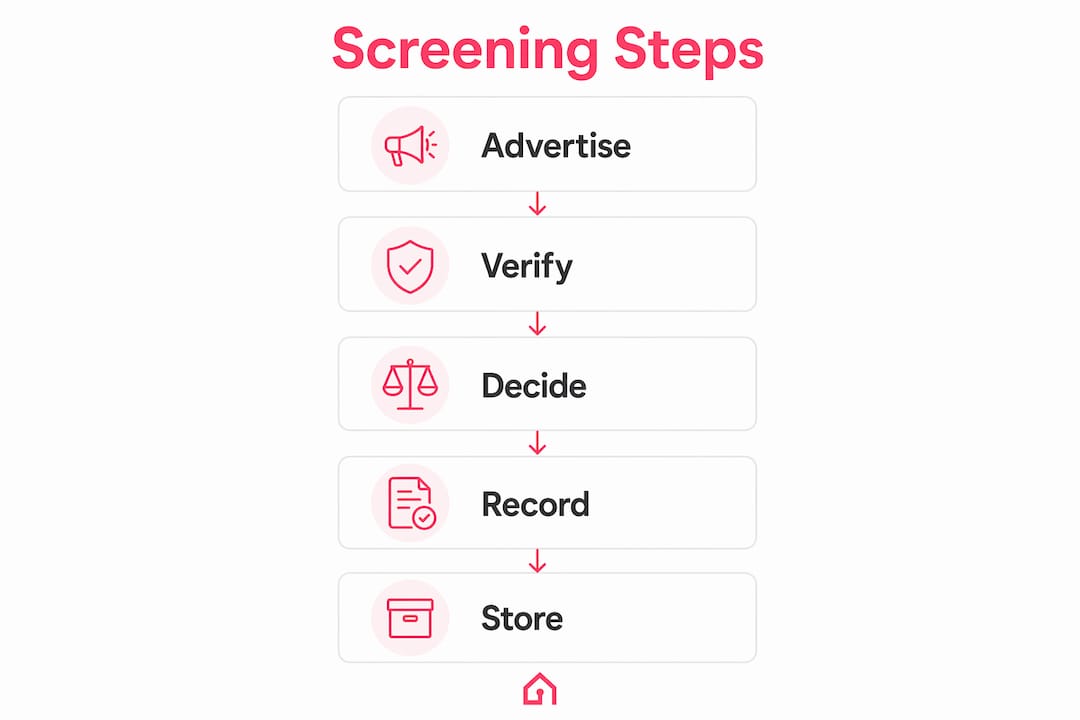
A clear workflow prevents gaps and keeps your process audit-ready. The rental application process typically moves through four stages.
Stage 1 — Advertise and collect. State in your listing that applicants will be asked to complete a standard form and consent to referencing checks. Collect the application form, consent, ID, proof of address, and income evidence before arranging a viewing where possible.
Stage 2 — Verify. Complete the Right to Rent check within the required timeframe (no earlier than 28 calendar days before the tenancy start date for time-limited permissions). Run the credit and CCJ check with consent. Contact the employer and previous landlord in writing and keep their replies.
Stage 3 — Decide. Document your rationale. If you accept, note which criteria the applicant met. If you make a conditional offer — requiring a guarantor or a larger deposit — state the reason in writing. If you reject, record the objective financial or legal basis.
Stage 4 — Record and store. Retain copies of all documents for the duration of the tenancy and for at least one year after it ends. A platform that stores chat history, document uploads, and check results in one place makes this considerably easier.
Legal essentials: Equality Act, Right to Rent, and data protection
Getting the legal framework right is not optional. Four rules shape every lawful screening decision.
Equality Act 2010. Applying objective, consistently applied financial criteria is lawful. Blanket exclusions — for example, refusing all applicants in receipt of housing benefit — can amount to indirect discrimination and breach the Act, as LetSorted's guidance explains clearly. Judge every applicant on the same affordability criteria.
Right to Rent. In England, failing to carry out checks can attract civil penalties of up to £10,000 per occupant for a first breach. Retain evidence for at least one year after the tenancy ends. The Home Office code of practice sets out how to avoid unlawful discrimination during these checks.
Tenant Fees Act 2019. Landlords must not charge tenants for referencing. Any such fee is likely recoverable by the tenant and could undermine possession proceedings.
UK GDPR. You need a lawful basis — usually explicit consent — to process personal data. Store documents securely, limit access, and have a clear retention policy.
Legal requirement
Key rule
Practical consequence
Equality Act 2010
Apply consistent financial criteria
No blanket exclusions; document every decision
Right to Rent (England)
Check all adult occupants before tenancy starts
Civil penalty up to £10,000 per occupant for first breach
Tenant Fees Act 2019
No referencing fees charged to tenants
Fee is recoverable; may affect possession
UK GDPR
Obtain explicit consent; store data securely
Retain for tenancy duration plus at least one year
DIY referencing versus professional referencing services
Running checks yourself costs less upfront, but the risks are real. DIY referencing carries higher GDPR exposure because you are handling sensitive personal data directly, and you typically cannot access the credit bureau databases that professional services use. An incomplete or poorly documented check may not satisfy your insurer when a claim arises. Industry practitioners note that professional services provide audit-ready reports that are more likely to satisfy insurers and reduce dispute exposure.
Professional referencing makes sense for high-value lets, HMOs, international applicants without a UK credit file, or whenever your time is limited. The cost is borne by you, not the tenant — the Tenant Fees Act is clear on that point.
DIY is reasonable for straightforward lets where you know the local market well, you have time to contact references personally, and you are confident in your GDPR obligations. Whatever route you choose, always get explicit written consent first. Cross-market platforms like HomeRent demonstrate how objective screening criteria can be applied consistently regardless of the referencing method used.
How Hauzed supports your tenant screening workflow
Hauzed handles several steps in the screening process directly, though it does not replace every check a landlord must carry out.
What the platform supports:
Identity verification for tenants before they can interact in key platform flows
Secure document uploads with tenant consent, so payslips and proof of address stay out of chat threads
Chat history and invitation records that form part of your audit trail
AI-assisted follow-up via Hauzer and Echo, reducing the time spent chasing replies manually
Lia for leasing conversations where that workflow is available
What landlords still need to do:
Commission or run a credit and CCJ check through a referencing provider or credit bureau
Contact the employer and previous landlord directly for written references
Complete the Right to Rent check through the appropriate statutory route
Make and document the final tenancy decision
Pro Tip:Use Hauzed's document upload flow to collect income evidence and ID copies with consent, then store the Right to Rent check result and reference letters alongside them. That single, organised record is what an insurer or tribunal will want to see.
Hauzed's fraud-detection features add a further layer of confidence, but identity verification on the platform is a trust mechanism, not a guarantee of financial solvency or perfect tenancy behaviour. The final decision always rests with you.
What tenants should prepare to speed up approval
A well-prepared application stands out immediately. Gather these before you apply:
Photo ID: Passport or photocard driving licence
Proof of address: Utility bill, bank statement, or council tax letter dated within the last three months
Income evidence: Three months of payslips, or six months of bank statements if you are self-employed or have a thin credit history
Employer contact: Name, email, and phone number of your HR contact or line manager
Previous landlord reference: Contact details and permission to approach them
Right to Rent share code: Generate this via the Home Office online service if you have an eVisa, biometric residence permit, or settled/pre-settled status
Upload documents only through secure platform flows, not through chat. If your credit history is limited, a guarantor letter or a larger deposit offer — agreed upfront — can reassure a landlord without requiring you to share more data than necessary.
Key takeaways
Lawful, consistent tenant screening protects landlords from financial loss and legal liability while giving tenants a fair, transparent process.
Point
Details
Consent comes first
Always obtain written consent before collecting or processing any personal data.
Four-point check is the baseline
ID, proof of address, credit check, and employment confirmation satisfy most insurer requirements.
Right to Rent is mandatory in England
Retain evidence for at least one year after tenancy end; penalties can be substantial per occupant for a first breach.
Never charge tenants for referencing
The Tenant Fees Act 2019 makes referencing fees recoverable by the tenant.
Hauzed supports the workflow
Verified profiles, secure document uploads, and AI follow-up reduce admin, but landlords must still run credit and Right to Rent checks.
A landlord's view on sensible, lawful screening
The landlords who avoid the most trouble are rarely the ones who ask the most questions. They are the ones who ask the same questions of every applicant and write down the answers. Consistent criteria — the same income threshold, the same reference request, the same document checklist — make it almost impossible for a rejected applicant to claim unfair treatment. The one time I have seen a landlord genuinely struggle in a dispute was when they had made an exception for one applicant and could not explain why. Keep your process boring and repeatable. The paperwork feels like overhead until the day you need it.
Hauzed: verified screening, less admin
Tenant screening done properly takes time. Hauzed cuts the repetitive parts without cutting corners.
Tenants on Hauzed arrive with verified identities and completed profiles, so you spend less time chasing basic documents and more time evaluating the right candidates. Hauzer matches you with suitable tenants before you have opened a single message. Echo handles follow-up so conversations do not go cold. Every document upload, chat, and invitation sits in one place, ready to support an insurance claim or a possession case if you ever need it.
For tenants, the platform is free to use. Build a stronger profile, upload your documents securely, and connect with landlords who can see you are a serious applicant from the start.
Gov.uk: Landlord's guide to Right to Rent checks — the primary statutory guidance covering all three checking routes, acceptable documents, and record-keeping obligations.
Gov.uk: How to check a tenant's Right to Rent — a step-by-step practical guide to manual checks, share codes, and the Landlord Checking Service.
NRLA: The complete guide to tenant referencing — industry best-practice guidance on the four-point check and insurer expectations.
LetSorted: Tenant screening and discrimination — clear explanation of what the Equality Act 2010 permits and prohibits in screening decisions.
LetSorted: How to screen tenants — practical guidance on the Tenant Fees Act and lawful referencing processes.
Consult these sources directly when making decisions on contested cases, and keep a record of which guidance you followed.
This article is general information, not legal advice. Confirm current rules with Gov.uk or a qualified professional for your specific situation.
FAQ
What is tenant screening in the UK?
Tenant screening is the process landlords use to verify a prospective tenant's identity, right to rent, affordability, and rental history before granting a tenancy. It typically includes ID checks, a credit check, employment confirmation, and a previous landlord reference.
Is tenant screening a legal requirement?
The Right to Rent check is a statutory requirement for all adult occupants in England; failing to carry it out can result in a civil penalty of up to £10,000 per occupant for a first breach. Other checks such as credit and employment references are not legally mandated but are strongly recommended by the NRLA and expected by most landlord insurers.
Can landlords charge tenants for referencing?
No. The Tenant Fees Act 2019 prohibits landlords from charging tenants for referencing checks, and any such fee is likely recoverable by the tenant.
How does Hauzed help with tenant verification?
Hauzed verifies tenant identities before they interact in key platform flows and supports secure document uploads with consent, giving landlords a cleaner starting point. Landlords still need to run credit checks and Right to Rent checks through the appropriate statutory routes.
How long should landlords keep Right to Rent records?
Gov.uk guidance requires landlords to retain evidence of Right to Rent checks for the duration of the tenancy and for at least one year after it ends, to preserve the statutory excuse against a civil penalty.